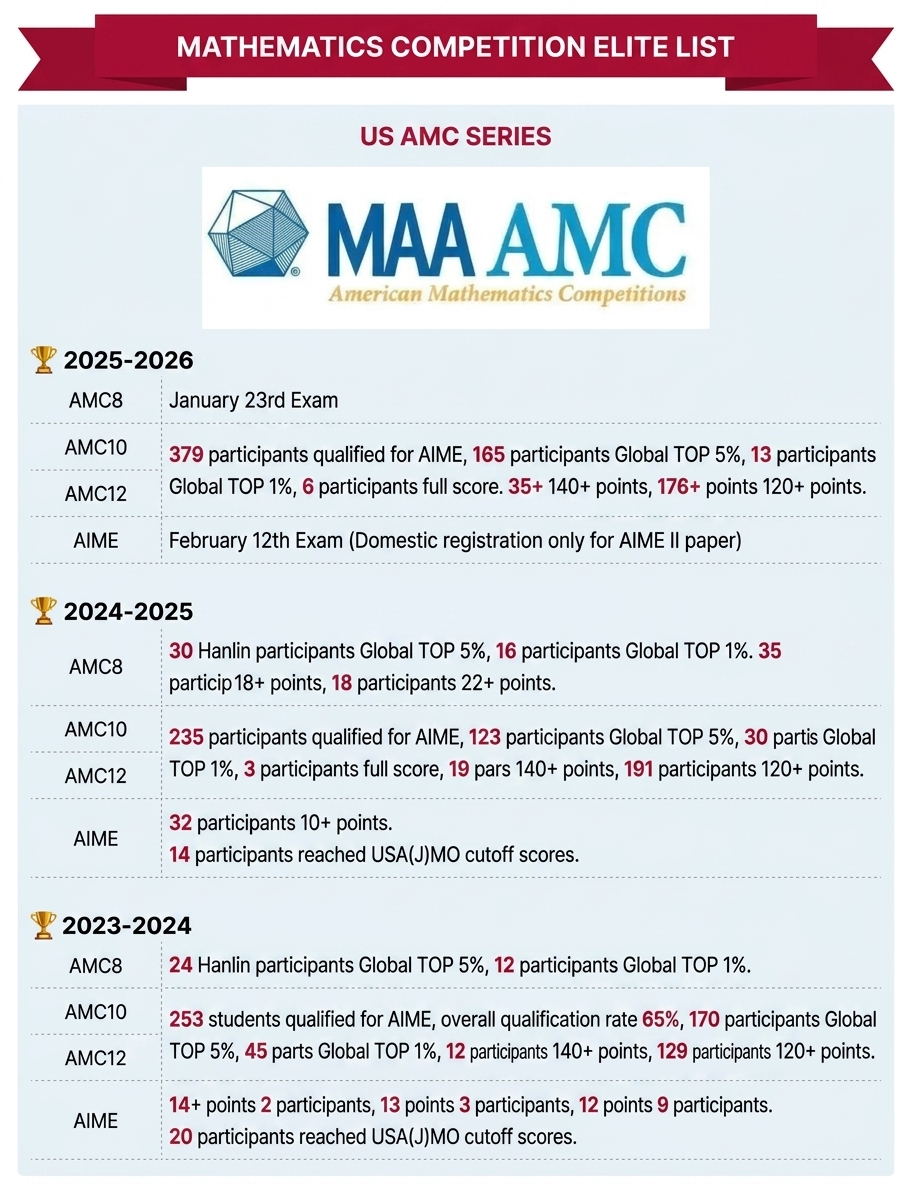

The 2025 AMC10/12 award cutoff scores have been officially released. This year, two new honors have been innovatively introduced: "Global Top 10%" and "Global Top 25%", aimed at recognizing more outstanding students. This means the overall probability of students winning awards will significantly increase.

I. 2025 AMC10/12 Award Cutoff Scores Update!
II. Comprehensive Analysis of AMC10/12 Competition Awards
| Award Name | Qualification Criteria | 2025 Cutoff Scores |
|---|---|---|
| Perfect Score Award | Score = 150 | Perfect score required for both AMC10/12 A/B |
| Distinguished Honor Roll (DHR) | Global Top 1% | AMC10A: 136.5, AMC12A: 150 (must be perfect!) |
| Honor Roll (HR) | Global Top 5% | AMC10A: 112.5, AMC12A: 127.5 |
| AIME Qualification | AMC10: Top 2.5%, AMC12: Top 5% | AMC10A: 105, AMC12A: 96 |
| Achievement Roll | Grade 8 or below + AMC10 ≥ 90 | AMC10 only, dual age + score threshold |
| Top 10% Award | Global Top 10% | AMC10A: 94.5, AMC12B: 109.5 |
| Top 25% Award | Global Top 25% | AMC10A: 69, AMC12A: 66 |
III. Three Core Values of the New Awards
1. Enabling More Students to "Win Awards"
In the past, only about 6% of test-takers could win awards (1% + 5%).
Now, Top 25% means approximately 75,000+ winners (based on 300,000 test-takers).
Average students can also receive official certification, breaking the misconception that "competitions are only for top students."
2. "Effective Endorsement" for College Admissions
| Award | Application Value |
|---|---|
| Top 25% | Demonstrates mathematical ability above the global average, suitable for: - US high school / UK undergraduate initial screening - Domestic international school transfers / placements |
| Top 10% | Showcases strong logical and problem-solving skills, can be included in: - Common App activities list - UCAS Personal Statement |
| HR / DHR / AIME | "Hard currency" for top STEM program applications, highly regarded by Ivy Leagues / Oxbridge / G5 universities |
3. Inspiring Learning Confidence and Long-term Motivation
Getting the first competition certificate → building the belief that "I can do it."
Laying a psychological foundation for subsequent challenges like AIME, Euclid, Physics Bowl.
Avoid giving up interest in mathematics due to the frustration of "zero awards."
III. Award Difficulty and Goal Suggestions by Student Type
| Student Type | Recommended Goal | Preparation Focus |
|---|---|---|
| G6–G8 (AMC10) | Achievement Roll (≥90) or Top 25% | Strengthen algebra and geometry foundations; master word problem techniques |
| G9–G10 (AMC10) | AIME qualification (≥105) or HR (≥112.5) | Strengthen combinatorics and number theory; train problem-solving thinking for challenging questions |
| G11–G12 (AMC12) | AIME qualification (≥96) or Top 10% (≥87+) | Supplement complex numbers, vectors, advanced probability models |
| STEM Program Applicants | At least AIME qualification; aim for HR/DHR | Systematic training + real exam mock tests + error correction loop |
| Humanities/Social Science Applicants | Top 10% or AIME qualification is sufficient | Ensure accuracy on the first 15 questions; strategically choose which of the last 10 questions to attempt |
IV. Efficient Preparation Strategy: Three-Phase Sprint Method
Phase 1: Foundation Building (3 months)
Core Tasks: Master the four major modules (Algebra 35%, Geometry 30%, Combinatorics 25%, Number Theory 10%).
Key Breakthroughs: AMC10: permutations and combinations, power of a point theorem, average speed traps; AMC12: complex number operations, trigonometric identities, solid geometry volume.
Phase 2: Real Exam Intensive Practice (3 months)
Work through past papers from 2015–2025, categorized by question number for training.
Q1–15: 20 minutes time limit, target accuracy ≥95%.
Q16–20: 25 minutes time limit, target accuracy ≥70%.
Q21–25: Specialized breakthrough, learn techniques such as "construction method" and "symmetry."
Phase 3: Mock Exam Sprint (1–2 months)
2 full mock exams per week (strictly 75 minutes).
Build an error log categorized by "knowledge point + error cause" (e.g., number theory – misunderstanding of congruence).
Adjust time allocation strategy: don't get stuck on difficult problems; prioritize securing points on foundational questions.
V. Common Misconception Reminders
| Misconception | Correct Understanding |
|---|---|
| "Only DHR is useful" | Top 10%/25% are also effective in the initial screening stage, especially for non-top applicants |
| "Chinese version is easier" | The English version is closer to the original problem context and exercises academic English; it is recommended to prioritize English |
| "More practice is better" | Blind practice is not as effective as in-depth study of 10 sets of real exams + thorough review |