

AMC 12 Competition Exam Content
The AMC 12 competition is designed for students in Grade 12 and below; its questions and scope of coverage overlap significantly with those of the AMC 10 exam. When referenced against domestic mathematics curricula, the AMC 12 is generally considered to correspond to the knowledge level of the 11th grade.
The exam primarily assesses four core modules: Algebra, Combinatorics, Number Theory, and Geometry. However, at the advanced core level, it incorporates three additional modules: calculations and graphing involving logarithms and trigonometric functions, and complex numbers. Furthermore, questions drawn from these three advanced modules appear in almost 100% of AMC 12 exams.
1. Basic Number Theory:
Prime numbers, prime factorization, divisibility rules (including remainder rules), greatest common divisors (GCD) and least common multiples (LCM), repeating decimals, fractions, etc.;
2. Fundamental Algebra:
Equations, inequalities, Vieta's formulas, laws of exponents and logarithms, etc.;
3. Sequences and Series:
Arithmetic sequences, geometric sequences, complex mixed sequences, logical reasoning involving sequences, etc.;
4. Geometry:
Parallel lines, triangle inequalities, similar and congruent triangles, properties of altitudes, medians, and angle bisectors in triangles, the Law of Sines and Law of Cosines, quadrilaterals and polygons, circles, spheres, rectangular prisms, and regular polyhedra;
5. Functions:
Linear functions, quadratic functions, absolute value functions, inverse functions, composite functions, trigonometric and inverse trigonometric functions, exponential and logarithmic functions, polynomial functions, etc.;
6. Probability and Statistics:
Sets, permutations and combinations, the Binomial Theorem, mean, median, mode, variance, standard deviation, etc.
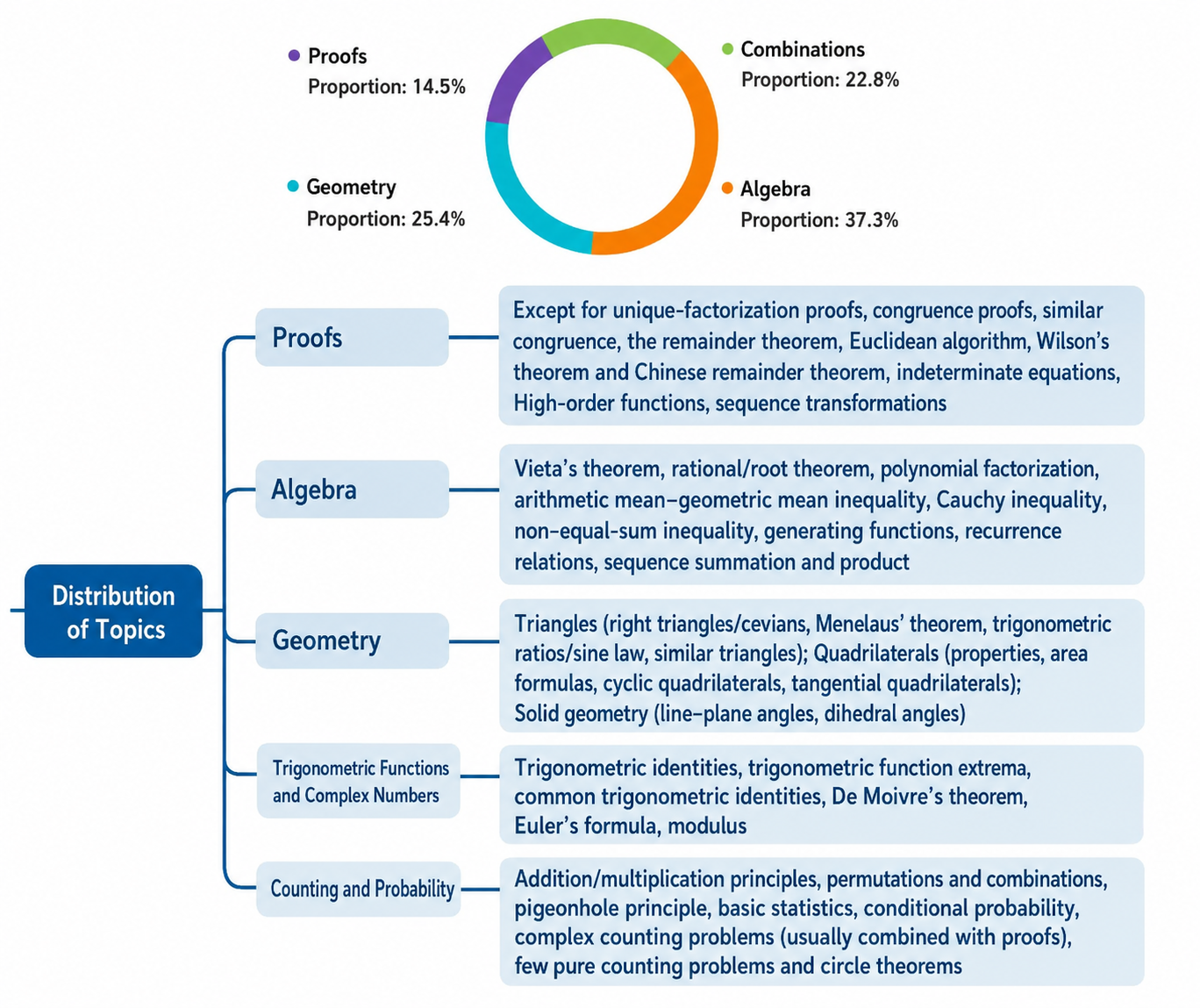
AMC 12 Difficulty Distribution
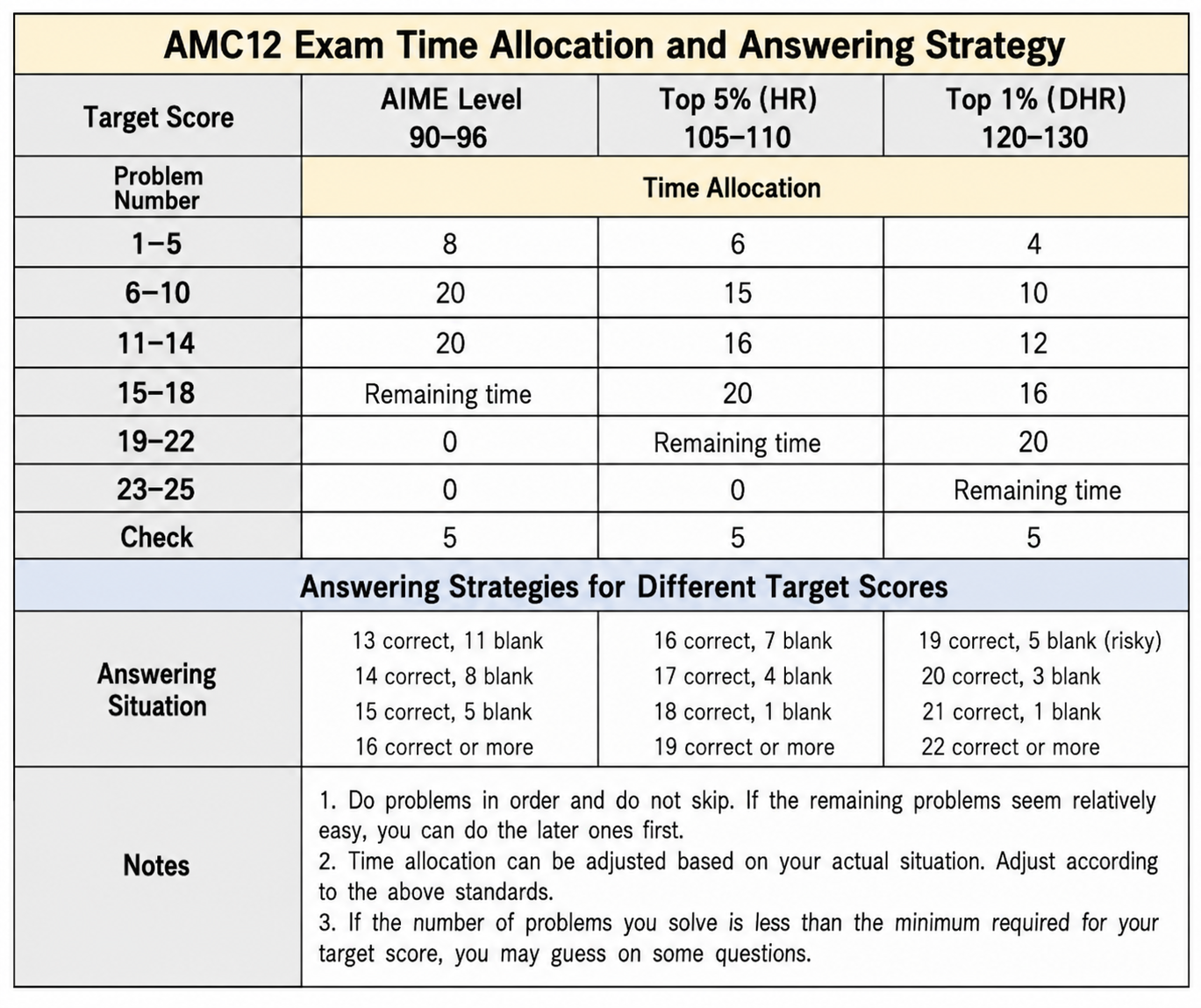
The AMC 12 consists of 25 multiple-choice questions, arranged roughly in order of increasing difficulty. The questions can be broadly categorized into three main sections:
Questions 1 through 15
These questions are typically relatively basic and straightforward, designed to assess students' understanding of mathematical concepts and their mastery of fundamental problem-solving techniques. Most students who have prepared diligently and are familiar with the relevant mathematical topics should be able to answer these questions correctly.
Questions 16 through 20
This section introduces a greater level of complexity and may require deeper critical thinking and more sophisticated problem-solving strategies. These questions often serve to distinguish students with stronger mathematical aptitude and a higher level of proficiency. While challenging, the problems in this stage remain solvable for students with above-average mathematical abilities.
Questions 21 through 25
The final few questions typically constitute the most difficult portion of the entire exam. They demand not only a solid foundation in mathematical knowledge but also innovative thinking and advanced problem-solving skills.
Comparison of the Difficulty of the 2023 AMC 12 vs. Previous Years
| contrast | 2022 10A | 2022 10B | 2021 10A Fall | 2021 10B Fall |
| 1-10 | Difficulty Decreased | Difficulty Increases | Of comparable difficulty | Of comparable difficulty |
| 11-20 | Of comparable difficulty | Difficulty Decreased | Difficulty Decreased | Difficulty Decreased |
| 21-25 | Of comparable difficulty | Of comparable difficulty | Difficulty Increases | Of comparable difficulty |
AMC 12 Problem-Solving Strategies
1. The "Assigning Values" Method
Applicable Scenarios: When the number of equations is fewer than the number of variables (though this is generally *not* applicable to Diophantine equations involving integers), or when the initial terms of a recursive sequence are large and complex.
Procedure:
Assume specific values for certain variables to simplify the problem.
For recursive sequences, one can assume simple initial values or directly assign variables to generate the sequence recursively, observing whether any periodicity or obvious patterns emerge.
2. The "Measurement" Method
Applicable Scenarios: Certain geometry problems—particularly when the given conditions uniquely determine the specific figure.
Procedure:
Construct a standard diagram or a diagram representing a special case based on the problem's conditions.
Obtain the answer directly by measuring side lengths, angles, and other geometric properties. *Note:* However, in recent years, test-setters have often designed problems to circumvent this direct measurement approach; therefore, this method should be used with caution.
3. Pattern Recognition
Applicable Scenarios: Recursive sequences, recursive functions, newly defined number-theoretic functions, combinatorial recurrence problems, two-player game problems, etc.
Procedure:
Begin by analyzing the simplest initial cases and gradually explore the underlying nature of the problem.
Observe carefully and attempt to identify the inherent patterns; this process often leads to the discovery of the problem's solution.
4. The "Number-Shape Integration" Method (Visual-Analytic Approach)
Applicable Scenarios: Problems involving the interplay between functions and geometry.
Procedure:
Translate functional relationships into graphical representations, leveraging the intuitive visual nature of diagrams to solve the problem.
Conversely, one can also translate geometric information from a diagram into functional expressions to facilitate deeper mathematical analysis.
5. The "Extreme Values" Method
Applicable Scenarios: Problems requiring the determination of maximum or minimum values, or problems involving ranges.
Procedure:
Consider the extreme cases of the problem—such as maximum values, minimum values, boundary conditions, etc.
By analyzing how the problem behaves under these extreme conditions, one can deduce the solution applicable to the general case.
6. The "Process of Elimination" Method
Applicable Scenarios: Multiple-choice questions or problems where multiple potential answers are presented.
Procedure:
Based on the given conditions and logical reasoning, systematically rule out options that are clearly incorrect.
Gradually narrow down the range of possible answers until the correct solution is identified.
Which is more difficult: the AMC 12 or China's National College Entrance Examination (Gaokao)?
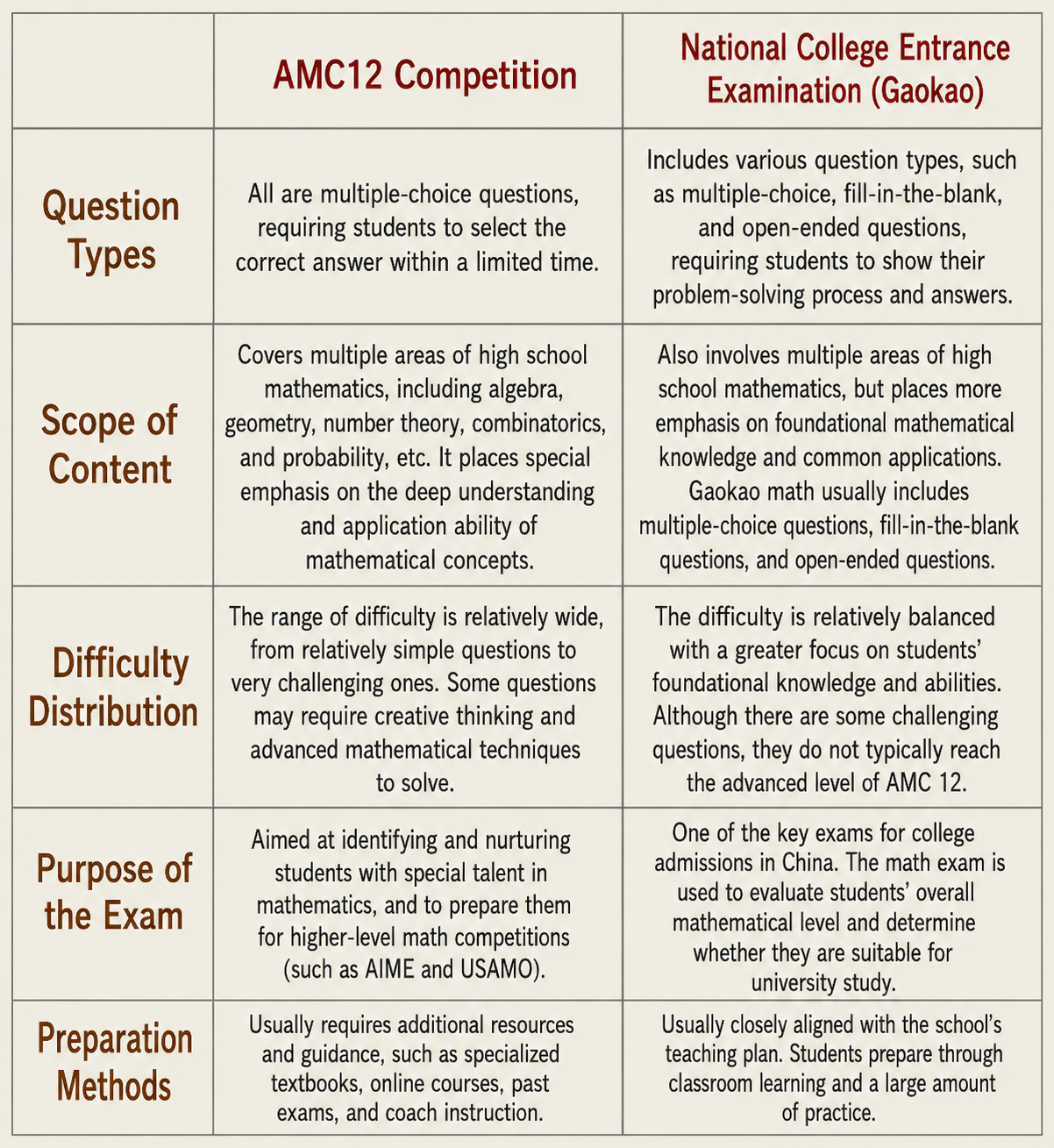
The AMC 12 does not require knowledge of calculus, whereas certain problems in the Gaokao mathematics exam may necessitate an understanding of limits and calculus. Furthermore, the computational demands of the AMC 12 are generally not as extensive as those of the Gaokao; instead, it places particular emphasis on students' ability to interpret and comprehend problems, as well as their skills in analyzing and solving them.