Our AMC 12 tutoring program features exclusive, proprietary study materials. Our instructors—all graduates of prestigious universities both domestically and abroad—possess extensive experience in competition coaching. Furthermore, we offer differentiated classes tailored to students of varying proficiency levels, ensuring a truly targeted approach that maximizes learning efficiency and yields exceptional results.
AMC12 $9.9 Trial Class Now Available!

Latest Course Schedule
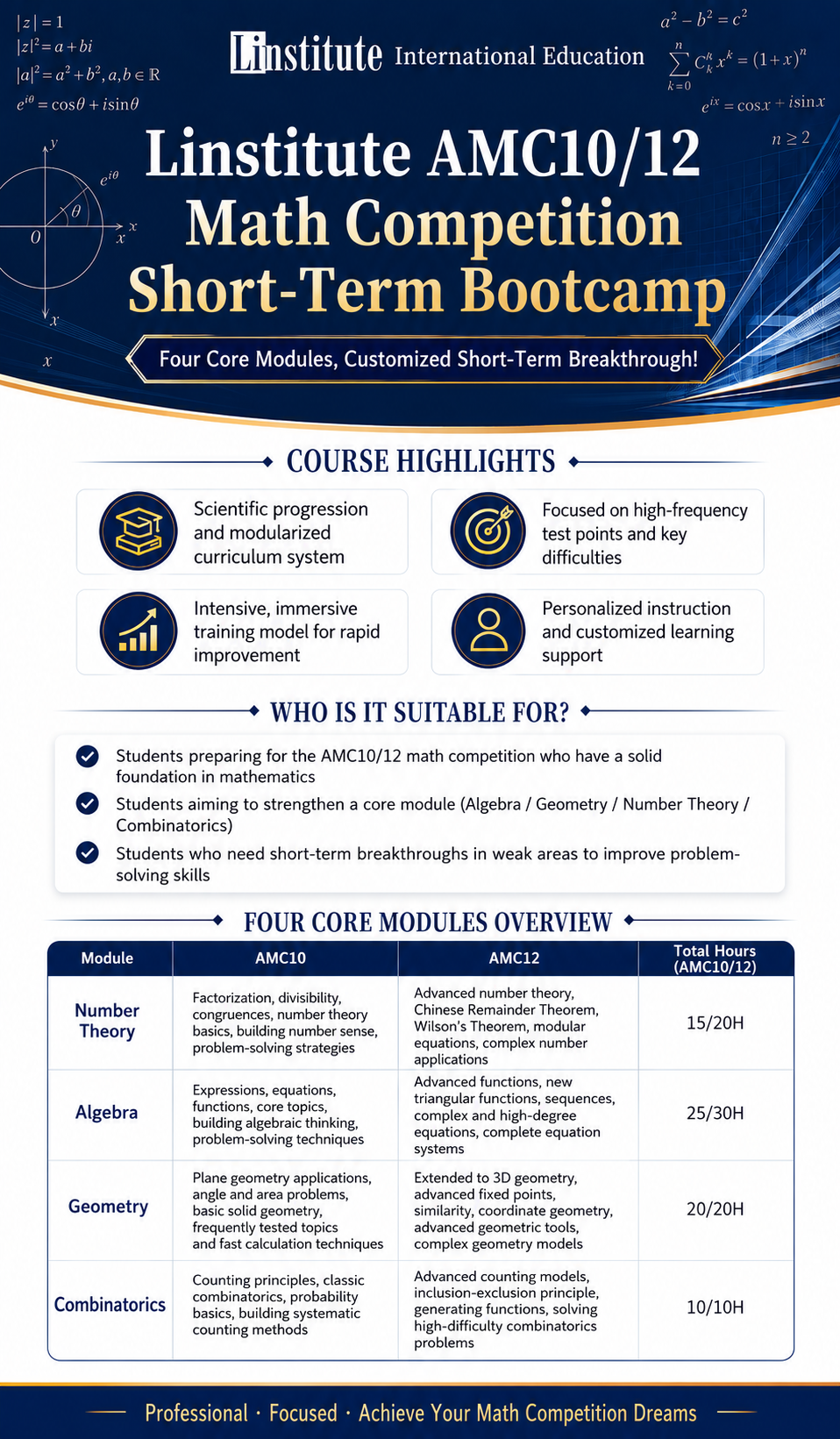
2026 Season Class Schedule
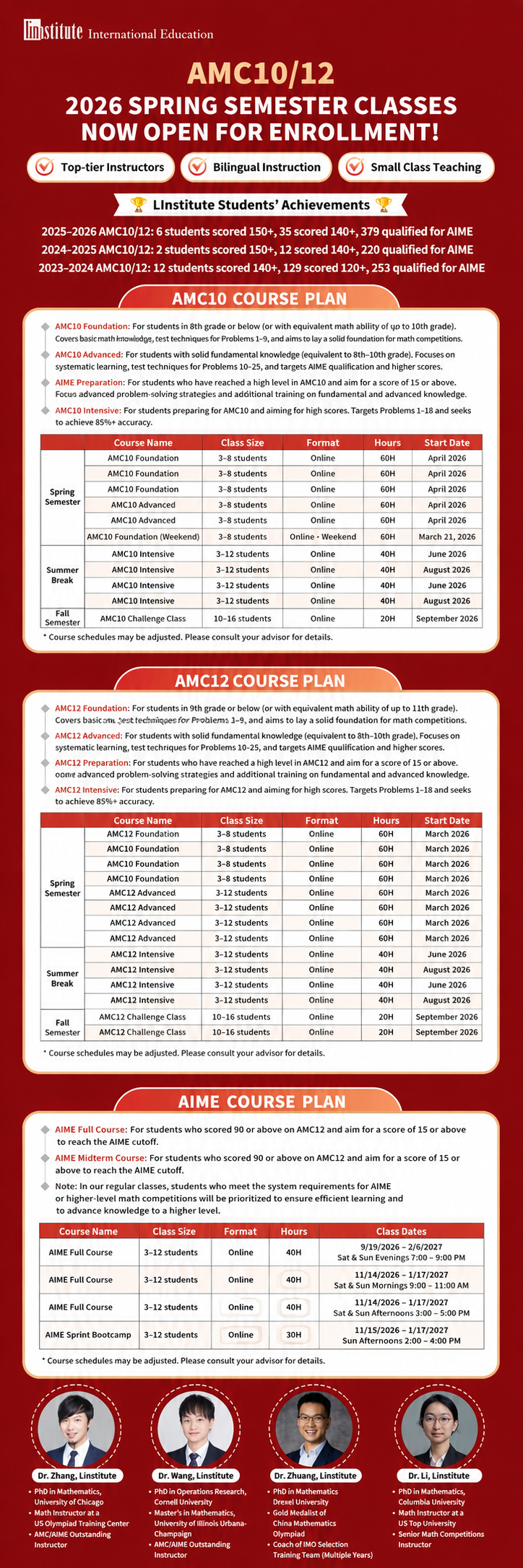
Mentor Lineup (Partial)
Teacher Gao
M.S., University of Nebraska–Lincoln (USA)
Certified Outstanding AMC Coach
Has participated in exchange programs across various countries in South America and Europe, as well as the UK, gaining familiarity with diverse educational systems. Possesses extensive practical experience in mathematics instruction; in the classroom, employs heuristic teaching methods to help students gain a deep understanding of specific concepts, while guiding the development of their creative thinking and fundamental logical reasoning skills.
Teacher Zhang
Ph.D. in Theoretical Mathematics, University of Rochester (USA)
Postdoctoral Researcher, Shanghai Center for Mathematical Sciences at Fudan University
Officially Certified Outstanding AMC Coach
Boasts 7 years of experience in theoretical mathematics research and related instruction. Has systematically taught the majority of specialized courses—ranging from the undergraduate to the graduate level—within university mathematics departments. During doctoral studies, participated extensively in lectures and training programs related to the AMC and major U.S. collegiate mathematics competitions (such as the Putnam and Virginia Tech competitions).
Teacher Li
B.S., Department of Mathematics, Southern University of Science and Technology (SUSTech)
M.S. in Quantitative Finance, National University of Singapore (NUS)
Certified Outstanding AMC Coach. Possesses years of experience studying, living, and working abroad, underpinned by a solid background in mathematics education and a strong foundation in the natural sciences; a multiple-time recipient of national and university scholarships. Holds extensive frontline experience in mathematics instruction, with a teaching philosophy that emphasizes organizing underlying logical structures and fostering the ability to apply learned concepts to solve new problems.
AMC 12 Math Competition: Fundamentals Preparation Course
Course Prerequisites
Foundation Class (40 Hours): Designed for students with little to no prior competition experience or background in mathematics competition studies.
Students who correctly answer 7 or fewer questions on the AMC 12 diagnostic test are placed in the Foundation (Preparatory) Class.
The objective of this course is to assist students in establishing a foundational, systematic framework of (secondary-level) mathematics competition knowledge, and to provide them with an introductory understanding of the typical problem-solving techniques and analytical approaches utilized in such competitions. After the course, students can further choose to study in full courses or intensive classes of AMC10/12 based on their actual learning conditions.
Course Outline
Number theory
(1)Divisor Problems of integers
Exponents, Prime factorization, Number of divisors, LCM and GCD
(2) Remainder/Divisibility Problems of integers
Modulus, Congruence, simple Modular algebra; Divisibility rules; Venn diagram, Union formula for two/three sets
(3)Digit Problems in different base representations
Base-10 representation, Base-2 representation, Different base conversion
Algebra
(1)Sequences
Arithmetic Sequences, Geometric sequences, Periodic Sequences and Simple Recursive Sequences
(2)Algebraic Manipulations and Polynomials
Expansion and Factorization Formulas; Binomial theorem, Pascal Triangle; Polynomials, Division Algorithm, Remainder Theorem, Vieta's Theorem for higher deg
(3) Inequalities and Extreme Value Problems
Polynomial inequalities; AM-GM inequality
(4)Trigonometry
Trigonometric Functions: Definition, graph and properties; Baisc Trigonometric identities
(5) Logarithm
Definition and Algebraic Properties of logarithm; Change Base formula
(6)Complex Number
Definition and basic algebraic rules of complex numbers; Coordinate and vector representation of complex numbers; Conjugates, Modulus; *The Polar Form
Geometry
(1)Basics in Geometry
Basic facts in geometry; Area problems and the Area method; Heron's Formula; The Law of Sine/Cosine
(2)Triangles
Similar and Congruent; Angle bisector and the Angle Bisector Theorem, Incenter, Median and the Centroid;
(3) Circles
Chords, Arcs, Angles and Areas; Inscribed Circles and Circumscribed Circles; Four Concyclic Points; The Power of a Point Theorem;
(4) Simple Solid Geometry
Prisms, and Pyramids; Sphere and Cones; Lines and Planes in Space; Three Perpendicular Theorem
Combinatorics
(1) Counting Problems
Sum rules and Product rules
(2)Permutation Problems and Combination Problems
Permutation Numbers and Combination Numbers; Balls into Boxes Problems
(3)Simple Probability Problems
The Concept of Probability and basic Properties; Simple Geometric Probability
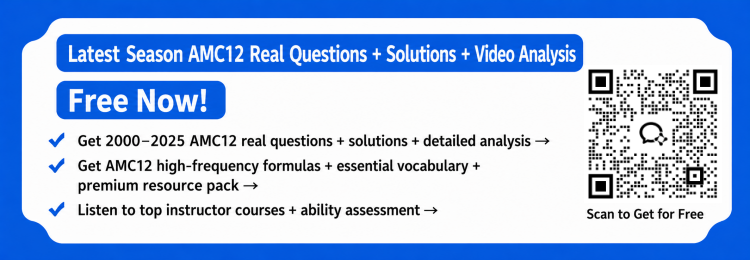
Scan to Preview the Course and Get a Personalized 1-on-1 Study Plan!
Claim Your AMC 12 Gold-Standard Study Materials + Course Discounts ⇓
AMC 12 Math Competition Intensive Coaching Course
Course Prerequisites
This course is designed for high-achieving students who possess substantial prior experience in mathematics competitions, have already achieved notable results in various contests, and aspire to attain an AMC 12 "Distinction" (Top 5%) or higher. Admission to this intensive program requires a score of between 14 and 17 correct answers (inclusive) on the AMC 12 diagnostic pre-test.
The primary objective of this course is to assist students in rapidly consolidating and systematizing the core conceptual framework of mathematics competitions. It aims to deepen and expand their understanding of specific topics, while significantly increasing the volume and intensity of instruction regarding advanced problems (specifically Questions 20 and beyond). Furthermore, the course seeks to foster a profound understanding and mastery of competition-specific problem-solving techniques and analytical mindsets, thereby laying a solid foundation for subsequent preparation for the AIME.
Course Outline
1. Number theory
(1) Prime Factorization: Number of divisors, Sum/Product of divsiors; Factorization Method for Solving LCM and GCD; Euclidean Algorithm and *Bezout's Theorem
(2) Congruence Theory and Divisibility: Modulus and Residue, Properties of Congruence, *Modular Inverse; Divisibility Rules; Principle of Inclusion and Exclusion; *Euler's Theorem/Fermat's little Theorem, *Chinese Remainder Theorem(CRT), *Wilson's Theorem
(3) Digit Representation and Base conversion, Short Division Algorithm; Infinite repeating decimal
2. Algebra
(1) Arithmetic sequences, Geometric sequences, Periodic sequences; Recursive sequences and *Characteristic Equation Method
(2) Algebraic Manipulation; Pascal Triangle and Binomial Theorem, Hockey-stick Theorem; Polynomials and Division Algorithm, Fundamental Theorem of Algebra, Generalized Remainder Theorem, Rational Root Theorem, Vieta's Theorem for higher degree polynomials
(3) Polynomial Inequalities; Fundamental Inequality, Cauchy's inequality and Extreme Value Problems
(4) Trigonometric Functions and Trigonometric identities; *Product-Sum and Sum-Product Identities
(5) Logarithm and its Calculation
(6) Complex Numbers; Properties of Conjugates and Modulus; Vector representation of Complex Numbers; Polar Form; DeMoivre' Theorem, Roots of unity
3. Geometry
(1)Basics in Geometry; The Law of Sine and the Law of Cosine; Heron's fomula, Area and Area Method
(2) Triangles: Similar Triangles; Angle Bisector and the Angle Bisector Theorem, *Angle bisector length formula; Median and Centroid, Median length formula; Centers of Triangle; Menelaus and Ceva's Theorem, Stewart's Theorem
(3) Circles: Basic geometric properties of circles; Cyclic quadrilaterals; Power of a Point Theorem; *Ptolemy's theorem
(5)Solid Geometry: Box, Cube, Prism; Pyramids; Surface Area and Volume; *Frustums; Cylinder and Sphere; *Theorem of Three Perpendiculars, *Euler's Polyhedron Formula
4. Combinatorics
(1)Basic Counting Principles: Sum rules and Product rules; Geometric Counting Problems
(2) Permutations and Combinations; Circular Permutations; Grouping Theorem; Balls-and-Boxes Problems; *Advanced Combinatorial Identities; *Recursive Methods in Combinatorics
(3) Elementary Probability and Basic Statistics
*(Features a faster pace compared to the comprehensive full-year course, with a greater emphasis on practicing challenging problems and exploring advanced extensions of key concepts.)
AMC 12 Math Competition Exam Preparation Course
Course Information
The Sprint Class is typically offered following the start of the autumn academic term in September—approximately two and a half months prior to the competition. This course assumes that students have already undertaken a certain level of systematic study in AMC or general mathematics competitions. Within a condensed timeframe, the class provides a rapid and concise review of the core concepts across all key subject areas, relying primarily on detailed explanations of representative past exam questions to facilitate highly efficient preparation during this critical sprint phase.
Course Outline
1. Number theory
(1) Prime Factorization: Number of divisors, Sum/Product of divsiors; Factorization Method for Solving LCM and GCD; Euclidean Algorithm and *Bezout's Theorem
(2) Congruence Theory and Divisibility: Modulus and Residue, Properties of Congruence, *Modular Inverse; Divisibility Rules; Principle of Inclusion and Exclusion; *Euler's Theorem/Fermat's little Theorem, *Chinese Remainder Theorem(CRT), *Wilson's Theorem
(3) Digit Representation and Base conversion, Short Division Algorithm; Infinite repeating decimal
2. Algebra
(1) Arithmetic sequences, Geometric sequences, Periodic sequences; Recursive sequences and *Characteristic Equation Method
(2) Algebraic Manipulation; Pascal Triangle and Binomial Theorem, Hockey-stick Theorem; Polynomials and Division Algorithm, Fundamental Theorem of Algebra, Generalized Remainder Theorem, Rational Root Theorem, Vieta's Theorem for higher degree polynomials
(3) Polynomial Inequalities; Fundamental Inequality, Cauchy's inequality and Extreme Value Problems
(4) Trigonometric Functions and Trigonometric identities; *Product-Sum and Sum-Product Identities
(5) Logarithm and its Calculation
(6) Complex Numbers; Properties of Conjugates and Modulus; Vector representation of Complex Numbers; Polar Form; DeMoivre' Theorem, Roots of unity
3. Geometry
(1)Basics in Geometry; The Law of Sine and the Law of Cosine; Heron's fomula, Area and Area Method
(2) Triangles: Similar Triangles; Angle Bisector and the Angle Bisector Theorem, *Angle bisector length formula; Median and Centroid, Median length formula; Centers of Triangle; Menelaus and Ceva's Theorem, Stewart's Theorem
(3) Circles: Basic geometric properties of circles; Cyclic quadrilaterals; Power of a Point Theorem; *Ptolemy's theorem
(5)Solid Geometry: Box, Cube, Prism; Pyramids; Surface Area and Volume; *Frustums; Cylinder and Sphere; *Theorem of Three Perpendiculars, *Euler's Polyhedron Formula
4. Combinatorics
(1)Basic Counting Principles: Sum rules and Product rules; Geometric Counting Problems
(2) Permutations and Combinations; Circular Permutation; Grouping Theorem; Balls into Boxes; *Advanced Combinatorics Identities, *Recursive Method in Combinatorics
(3) Elementary probability and Simple Stats.
AMC 12 Math Competition Comprehensive Preparation Course
Course Prerequisites
This course is designed for students who possess limited prior experience in mathematics competitions and study, and who have a solid foundation in school-level mathematics, yet have not yet systematically organized the comprehensive body of competition-specific knowledge—specifically those with significant gaps or omissions across various subject areas. Admission to the Full-Track Program requires a score of between 8 and 13 correct answers (inclusive) on the AMC 12 diagnostic assessment.
The primary objective of this course is to assist students in establishing a complete and systematic framework of secondary-level mathematics competition knowledge. Through specialized training exercises focused on specific subject areas, students will gradually become proficient in the problem-solving techniques and analytical approaches required for relevant competition questions. Upon completion of the course, students may—based on their individual progress and learning needs—opt to participate in additional pre-exam intensive practice sessions and one-on-one remedial tutoring to further consolidate their understanding and address specific queries.
Course Outline
1. Number theory
(1) Prime Factorization: Number of divisors, Sum/Product of divsiors; Factorization Method for Solving LCM and GCD; Euclidean Algorithm and *Bezout's Theorem
(2) Congruence Theory and Divisibility: Modulus and Residue, Properties of Congruence, *Modular Inverse; Divisibility Rules; Principle of Inclusion and Exclusion; *Euler's Theorem/Fermat's little Theorem, *Chinese Remainder Theorem(CRT), *Wilson's Theorem
(3) Digit Representation and Base conversion, Short Division Algorithm; Infinite repeating decimal
2. Algebra
(1) Arithmetic sequences, Geometric sequences, Periodic sequences; Recursive sequences and *Characteristic Equation Method
(2) Algebraic Manipulation; Pascal Triangle and Binomial Theorem, Hockey-stick Theorem; Polynomials and Division Algorithm, Fundamental Theorem of Algebra, Generalized Remainder Theorem, Rational Root Theorem, Vieta's Theorem for higher degree polynomials
(3) Polynomial Inequalities; Fundamental Inequality, Cauchy's inequality and Extreme Value Problems
(4) Trigonometric Functions and Trigonometric identities; *Product-Sum and Sum-Product Identities
(5) Logarithm and its Calculation
(6) Complex Numbers; Properties of Conjugates and Modulus; Vector representation of Complex Numbers; Polar Form; DeMoivre' Theorem, Roots of unity
3. Geometry
(1)Basics in Geometry; The Law of Sine and the Law of Cosine; Heron's fomula, Area and Area Method
(2) Triangles: Similar Triangles; Angle Bisector and the Angle Bisector Theorem, *Angle bisector length formula; Median and Centroid, Median length formula; Centers of Triangle; Menelaus and Ceva's Theorem, Stewart's Theorem
(3) Circles: Basic geometric properties of circles; Cyclic quadrilaterals; Power of a Point Theorem; *Ptolemy's theorem
(5)Solid Geometry: Box, Cube, Prism; Pyramids; Surface Area and Volume; *Frustums; Cylinder and Sphere; *Theorem of Three Perpendiculars, *Euler's Polyhedron Formula
4. Combinatorics
(1)Basic Counting Principles: Sum rules and Product rules; Geometric Counting Problems
(2) Permutations and Combinations; Circular Permutation; Grouping Theorem; Balls into Boxes; *Advanced Combinatorics Identities, *Recursive Method in Combinatorics
(3) Elementary probability and Simple Stats.