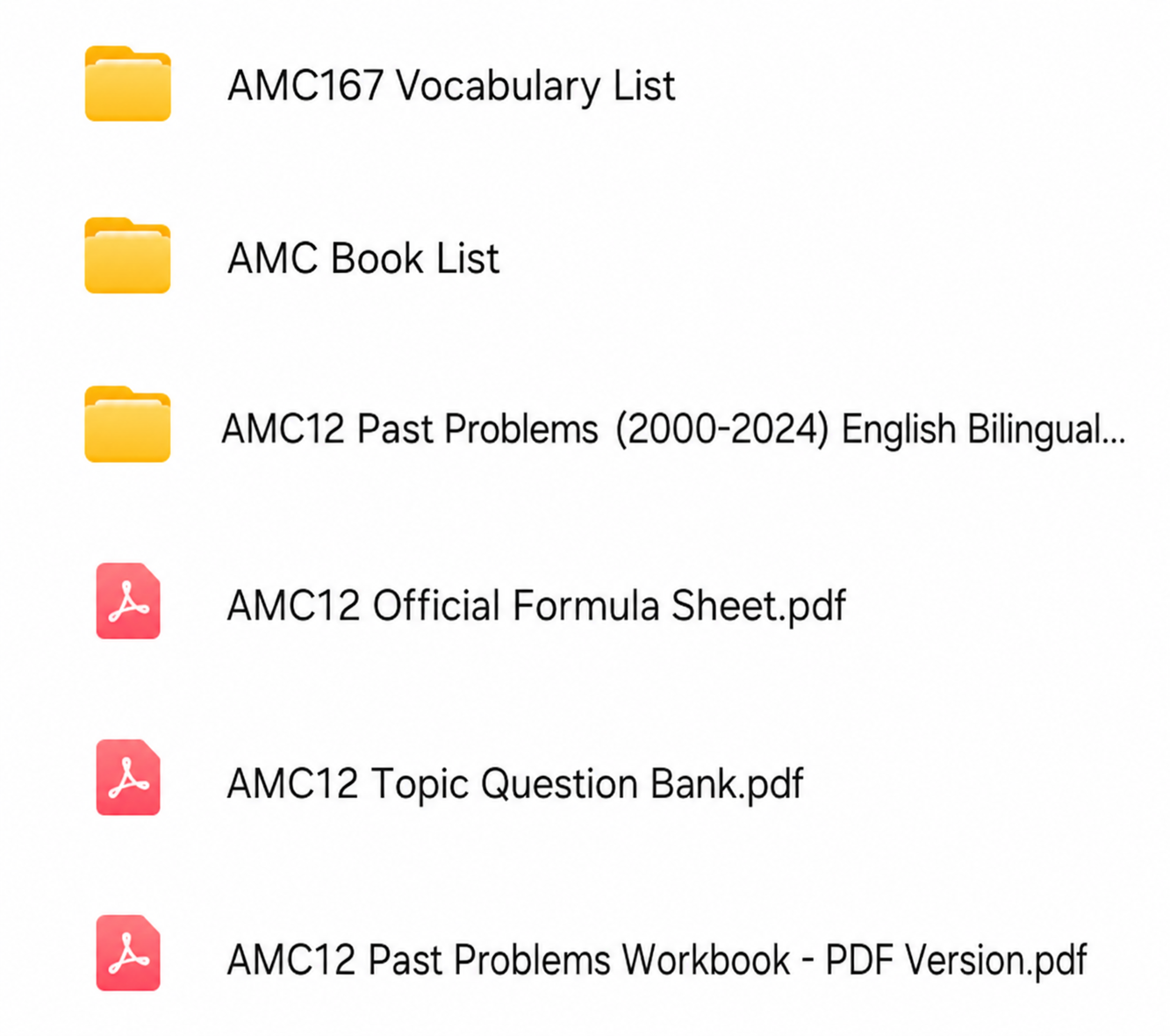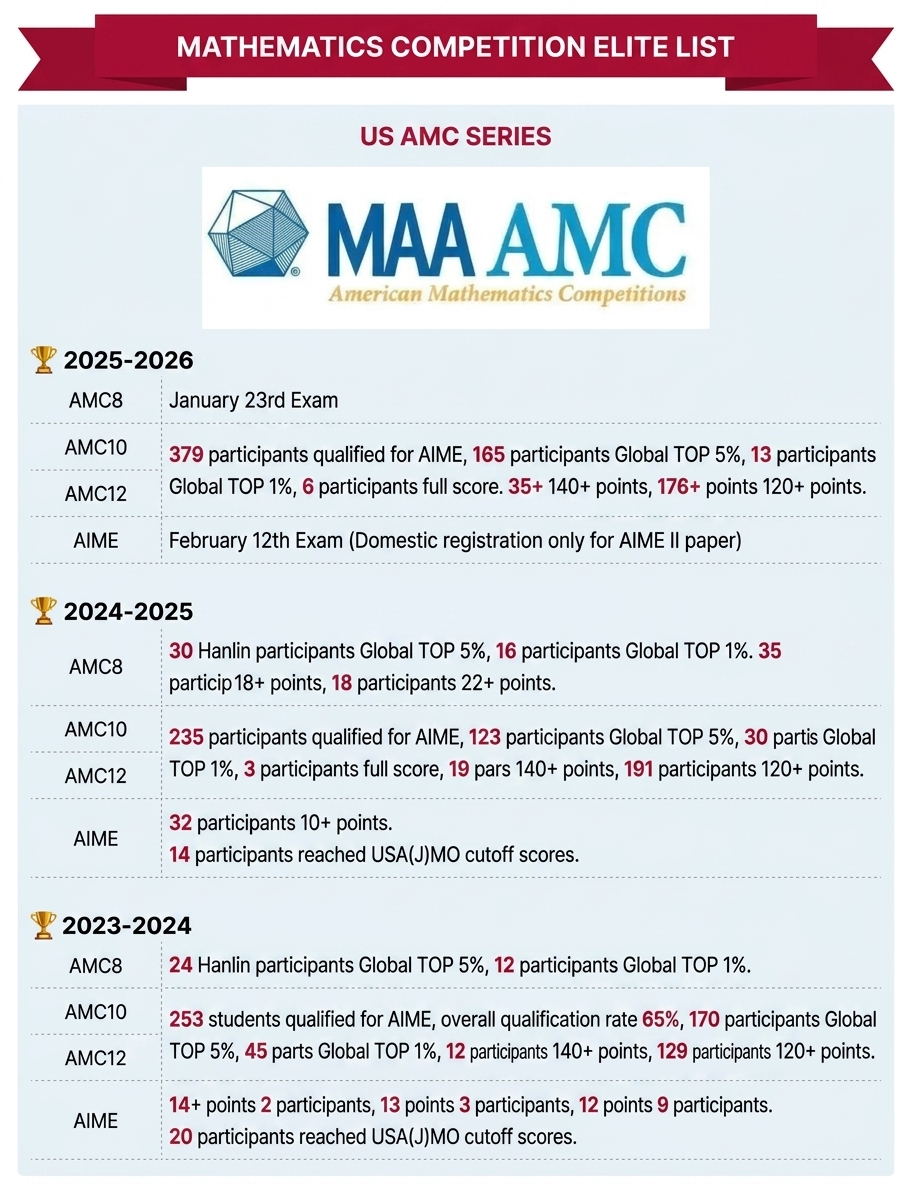

AMC12 is an important competition aimed at improving high school mathematical literacy and cultivating students' logical thinking skills. Its academic authority and wide recognition mean that students who achieve excellent results in this competition can gain a competitive advantage in their academic applications, especially when applying to top universities such as Ivy League schools and G5 institutions. AMC12 scores are often regarded as one of the important evaluation criteria.

I. Analysis of the Reasons for the Collective Rise in AMC12 Cutoff Scores
"Gift Points" Controversy
In the 2023 AMC12 Paper A, the final problem sparked controversy. The MAA committee ultimately decided to award the 6 points for that problem to all test-takers, regardless of whether they answered it correctly.
Direct Impact: This decision led to nearly 200 perfect score students in the China region, whereas in previous years, there were usually fewer than 50 perfect scores. This means a large number of test-takers gained an extra score advantage, pushing the overall cutoff scores higher.
II. Why Is AMC12 Still Worth Taking?
Qualifying for AIME: The primary goal for most students taking AMC12 is to qualify for AIME, thereby adding a competitive advantage to their college applications.
Demonstrating True Ability: Even if perfect scores occur in certain cases, admissions officers will still consider other academic performances (such as A-Level Math grades). If AIME scores are unsatisfactory or standardized test scores do not align with competition results, it may raise doubts.
Academic Enrichment: During the preparation process, students can systematically learn and master a large amount of mathematics knowledge, which not only aids in the competition but also enhances everyday academic performance.
How to Cope with Rising Scores? Improve overall strength: As cutoff scores rise, relying solely on luck or isolated factors can no longer guarantee qualification. Only through systematic training and solid preparation can you stand out in the competition.
III. 2026 AMC12 Long-term Preparation Guide
Phase 1: Foundation Consolidation (6–12 months before the exam)
Algebra
Review content: Core knowledge points such as functions, equations, inequalities, sequences, polynomials, etc.
Key skills: Factorization techniques, analysis of function properties (monotonicity, parity, etc.).
Geometry
Review content: Triangles, circles, similarity and congruence theorems and their applications.
Key skills: Area formulas, volume calculations, proof methods in geometry.
Number Theory
Review content: Divisibility, prime numbers, congruences, and other foundational concepts.
Key skills: Common theorems (such as Fermat's Little Theorem, Euler's Theorem) and their proof ideas.
Combinatorics
Review content: Permutations and combinations, probability basics, counting principles.
Key skills: Modeling thinking, learning to classify and discuss, and recurrence modeling.
Phase 2: Topic Reinforcement (3–6 months before the exam)
Specialized training by module
Summary of high-frequency problem types: Combine with past exam questions to extract high-frequency test points and problem-solving routines for each module.
Develop reasoning ability: Gradually work on medium-to-high difficulty problems to practice multi-step reasoning and comprehensive application skills.
Real simulation
Timed practice: Conduct at least one timed mock test per week to adapt to the exam rhythm and time pressure.
Organize mistakes: Keep an error notebook, mark causes of errors and improvement measures, and avoid repeating the same mistakes.
Phase 3: Sprint & Mock Exams (1–3 months before the exam)
Real simulation
Adapt to exam intensity: Conduct multiple full-length mock exams according to the official exam schedule to ensure both physical and mental readiness for the high-intensity exam environment.
Time allocation strategy: Practice sound time management skills to secure points on easy and medium-difficulty questions, and make wise strategic choices for challenging problems.
Mindset adjustment
Build stress resilience: Gain on-the-spot experience through mock exams to enhance confidence and adaptability.
Detail control: Emphasize details such as accurate problem reading and standard notation to reduce unnecessary point loss.