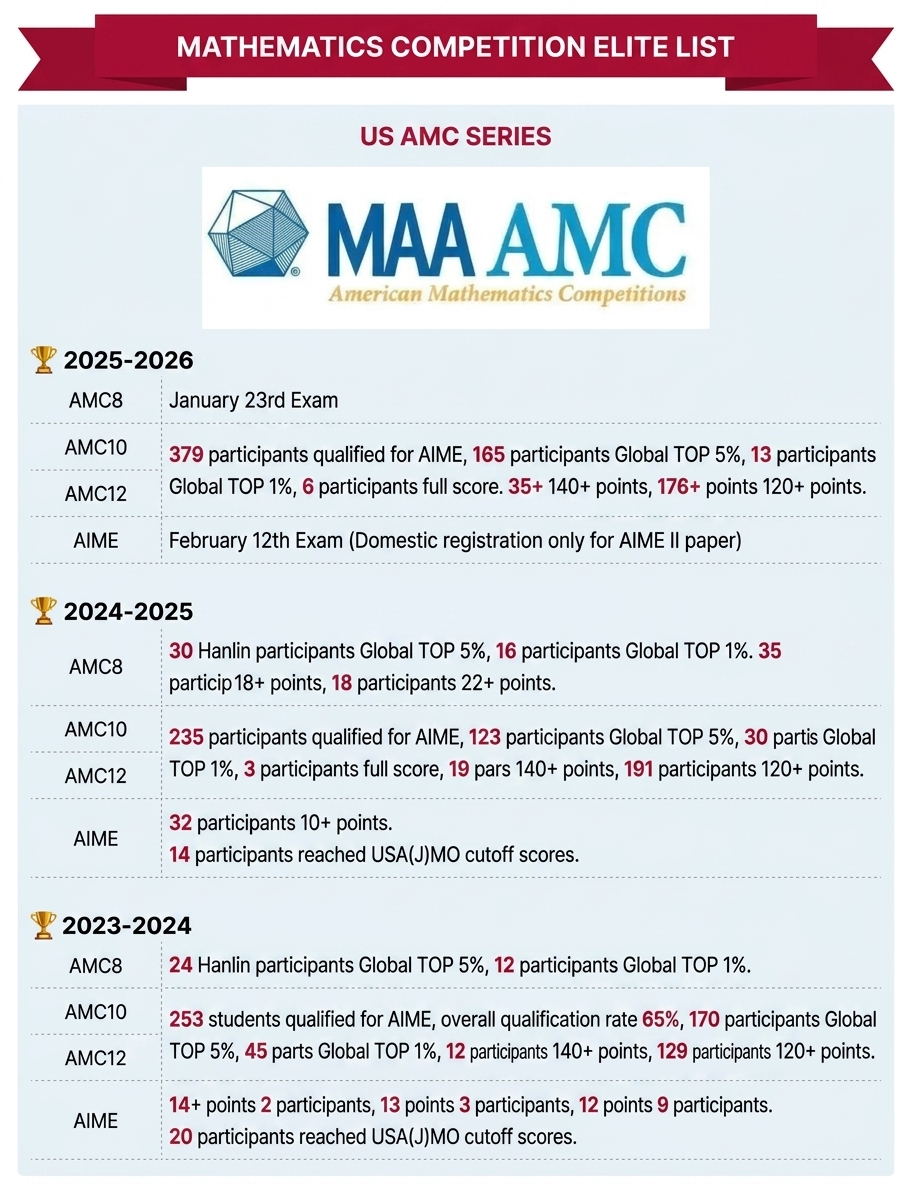

AMC12 is one of the most influential secondary school mathematics competitions in the world, organized by the Mathematical Association of America (MAA). Each year, it attracts participation from over 300,000 students from more than 6,000 schools. It is not only a benchmark for assessing mathematical ability but also a critical stepping stone to AIME, USA(J)MO, prestigious summer programs, and top universities like the Ivy League and G5 institutions.
I. What is AMC12? Why is it so important?
1. Basic Positioning
Target Audience: Students in 12th grade or below (age ≤19.5 on the day of the exam).
Core Objective: To select students with solid mathematical foundations and flexible thinking skills.
Pathway: AMC12 → AIME (top 5%) → USA(J)MO (top 270) → IMO (national team).
2. Value for College Admissions
Top U.S. universities such as MIT, Caltech, CMU, and Brown have a separate section for AMC12 scores on their application systems.
Oxford and Cambridge consider AMC12/AIME as a strong supplement to MAT/STEP for STEM programs.
Top math summer programs (e.g., Ross, PROMYS, SUMaC) explicitly require AIME scores ≥8–9.
The University of Waterloo and other top Canadian universities include AMC12 scores in their scholarship evaluation system.

II. Detailed AMC12 Rules and Format
| Item | Details |
|---|---|
| Exam Language | Bilingual (Chinese/English) – students can choose either language for the questions |
| Exam Dates | - Version A: November 6, 2025 (Thursday) 17:00–18:15 - Version B: November 14, 2025 (Friday) 17:00–18:15 |
| Exam Format | Online computer-based exam / paper-based exam (determined by the test center) |
| Question Format & Quantity | 25 multiple-choice questions (5 options each) |
| Scoring Rules | - Correct answer: +6 points - Unanswered: +1.5 points - Incorrect answer: 0 points → Total possible: 150 points |
| Version A/B Information | Similar difficulty, different content. Students may take one or both versions; the higher score will be used for awards and advancement. |
III. Six Core Modules of AMC12 Content
AMC12 covers all core high school mathematics and extends to pre‑university levels, emphasizing knowledge integration and rapid application.
| Module | Core Topics |
|---|---|
| 1. Algebra | Factoring techniques, Vieta‘s formulas (roots and coefficients), inequalities (AM-GM, Cauchy), Binomial Theorem, functional equations, exponential and logarithmic operations |
| 2. Plane Geometry | Triangle centers (incenter, circumcenter, centroid, orthocenter), Power of a Point Theorem, similarity and congruence, trigonometry (Law of Sines/Cosines), coordinate geometry, area methods |
| 3. Number Theory | Divisibility, prime factorization, modular arithmetic, Fermat‘s Little Theorem, Euler’s theorem, linear Diophantine equations, modular inverses |
| 4. Combinatorics | Addition/Multiplication principles, Inclusion-Exclusion Principle, Pigehole Principle, combinatorial identities, probability and expectation, recurrence counting |
| 5. Sequences & Series | Arithmetic/geometric sequences, recursive sequences, summation techniques (telescoping, shifting subtraction), integrated problems combining with algebra and combinatorics |
| 6. Complex Numbers & Basic Graph Theory | Algebraic and geometric representation of complex numbers, roots of unity, basic graph theory models (paths, connectivity) and combinatorial applications |
IV. AMC12 vs. Chinese High School Math: Three Fundamental Differences
| Aspect | AMC12 | Chinese High School Math (including CMO system) |
|---|---|---|
| 1. Thinking Style | Breadth-first: a single problem integrates 2–3 knowledge points (e.g., "Number Theory + Combinatorics") | Depth-first: deep exploration of a single knowledge point (e.g., complex inequality proofs) |
| 2. Exam Pressure | 25 multiple-choice questions, 75 minutes, about 3 minutes per question, emphasizing "quick decision-making" | Includes open-ended problems requiring complete solution processes, heavy computation, and rigorous steps |
| 3. Content Focus | High proportion of number theory and combinatorics, emphasizing modeling and application | Focus on algebra and geometry, valuing logical proofs and systematic reasoning |
V. AMC12 Difficulty Benchmark & Advancement Path
| Benchmark System | Difficulty Reference |
|---|---|
| Chinese Curriculum Level | Second semester of 11th grade – first semester of 12th grade mathematics level |
| Competition Difficulty | ≈ Difficulty of the first round of the CMO (Chinese Mathematical Olympiad) |
| AIME Cutoff Score (recent years) | Typically 90–100 points (top 5%). Unusually high in 2025: 96–100.5 points |
| DHR (Top 1%) | Typically 120–135 points. In 2025, AMC12A required a perfect score of 150 to reach the top 1% |
VI. Who is suitable for taking AMC12?
International school students: The curriculum content strongly aligns with AMC12, offering a golden opportunity to demonstrate academic ability.
Students from top tier domestic schools: Bridges the gap to CMO, building solid awards for strong foundation programs / comprehensive evaluation systems.
Students planning to apply for overseas STEM programs: AMC12 + AIME is the "standard credential" for Ivy League / G5 universities.
Math enthusiasts: Even without aiming for college admissions, preparing for AMC12 greatly enhances logical thinking and problem-solving skills.