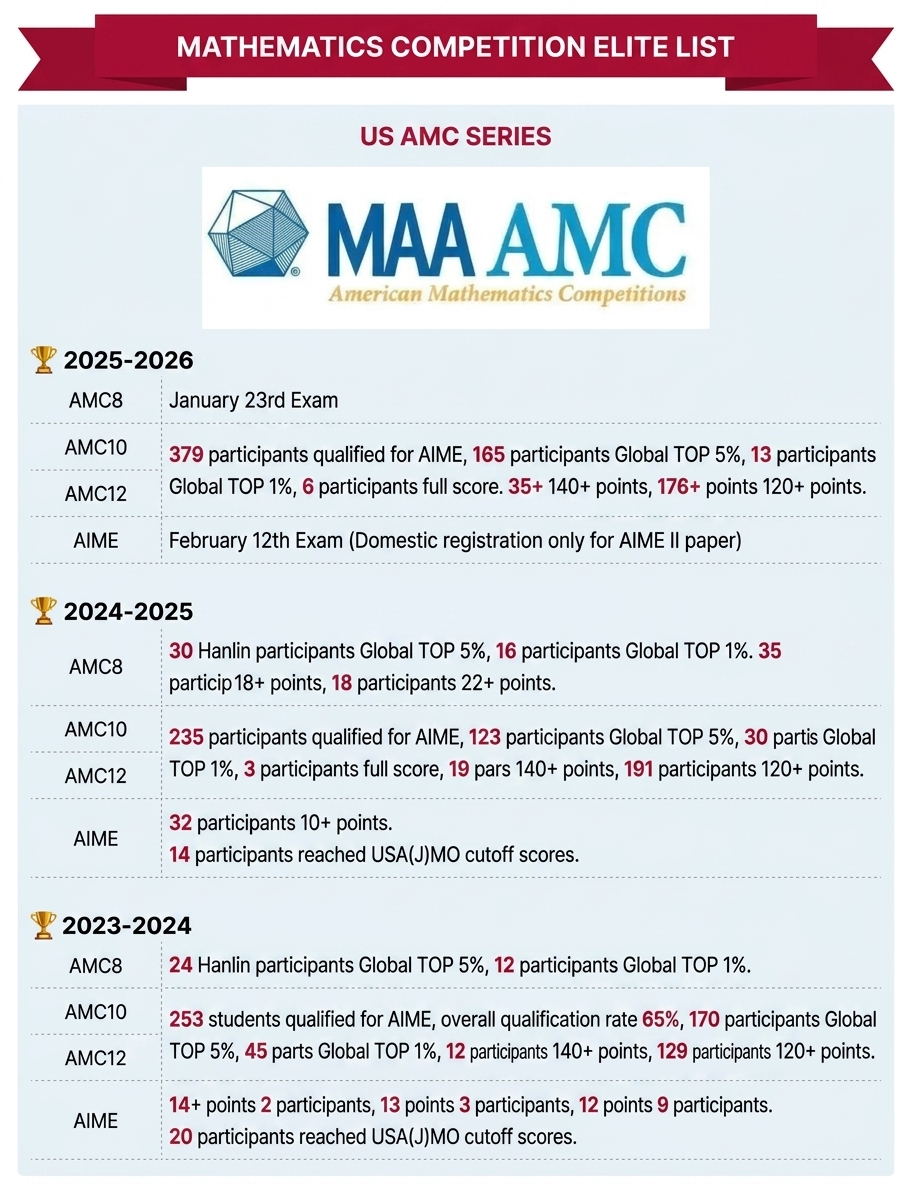
As a higher-level competition in the American Mathematics Competitions (AMC) system, the AMC12 not only covers all standard high school mathematics content but also deeply integrates competition extension topics. For students aiming for top-tier universities, the AMC12 is not only a touchstone of academic ability but also a crucial stepping stone to the AIME (American Invitational Mathematics Examination).

I. AMC12 Question Difficulty and Question Type Distribution
The AMC12 has a total score of 150 points, consisting of 25 multiple-choice questions, with an exam duration of 75 minutes. The difficulty of the questions is distributed in a stair-step pattern, covering all high school mathematics content, including algebra, functions, trigonometry, logarithms, complex numbers, analytic geometry, solid geometry, probability and statistics. In addition, number theory and combinatorics, which are largely not covered in the standard domestic Chinese high school curriculum, are also tested — these are the main "new difficulties" for Chinese students preparing for the exam.
The specific difficulty distribution of the exam paper is as follows:
Questions 1-10 (Basic Questions): Equivalent to intermediate-level questions in the Gaokao (Chinese college entrance exam), mainly testing basic concepts and operations. This section is the foundation for scoring; candidates should strive to answer all correctly, aiming for zero mistakes.
Questions 11-15 (Intermediate Questions): Difficulty is close to that of Gaokao final problems or the preliminary level of provincial/city-level competitions, requiring students to comprehensively apply multiple knowledge points to solve them.
Questions 16-20 (Relatively Difficult Questions): Close to the basic questions of Round 1 of the Chinese High School Mathematics League. This is the key differentiator for reaching the AIME qualification line and the core area that separates ordinary participants from award winners.
Questions 21-25 (Difficult Questions): Reach the level of the final problems of Round 1 of the High School Mathematics League or intermediate difficulty in the AIME. They involve the cross-cutting application of multiple knowledge points and clever constructions. It is generally recommended that candidates attempt according to their ability and not stubbornly dwell on them.
II. What Level is Needed to Reach the Top 5% in AMC12?
To obtain the AMC12 Distinguished Honor Roll (i.e., to be ranked in the top 5% globally), a score of approximately 115-125 points is usually required, meaning correctly solving about 19 out of the 25 questions. To consistently reach this level, it is not only necessary to control your score, but also to possess the following three core abilities:
1. Comprehensive Mastery of Knowledge Points and Building a Complete System
Candidates must master the core modules of AMC12: algebra, plane geometry, solid geometry, permutations and combinations, number theory, and probability and statistics, ensuring no knowledge blind spots. Especially for high-frequency topics such as number theory and combinatorics, it is not enough to be familiar with basic concepts; in-depth expansion and training are also required.
2. Improving Problem-Solving Speed and Reasonably Arranging Time
Completing 25 multiple-choice questions in 75 minutes means the average time per question cannot exceed 3 minutes. During the preparation process, emphasis must be placed on timed training to develop a scientific problem-solving rhythm:
Basic Questions (1-15): Must all be answered correctly. This is the foundation for winning an award; the difficulty level corresponds to advanced in-class high school question types in China.
Intermediate Questions (16-20): At least 4 out of 5 questions must be correct. These questions focus on the integrated application of knowledge points and are key to winning an award.
Final Problems (21-25): Cover number theory, combinatorics, and advanced functions, with difficulty close to that of the AIME. There is no need to stubbornly solve all of them; getting 1-2 correct is enough. For the remaining questions, it is recommended to leave them blank to avoid point deductions for incorrect answers. Remember not to spend too much time on any single question — mark it and decisively move on if you are unsure.
3. Timely Review and Avoiding Question Traps
While practicing past papers, candidates need to accurately distinguish between error-prone question types and high-frequency difficult questions to avoid traps set by question designers. It is recommended to promptly review and annotate mistakes, and review them repeatedly before the exam to prevent making the same type of errors on the actual test day.