
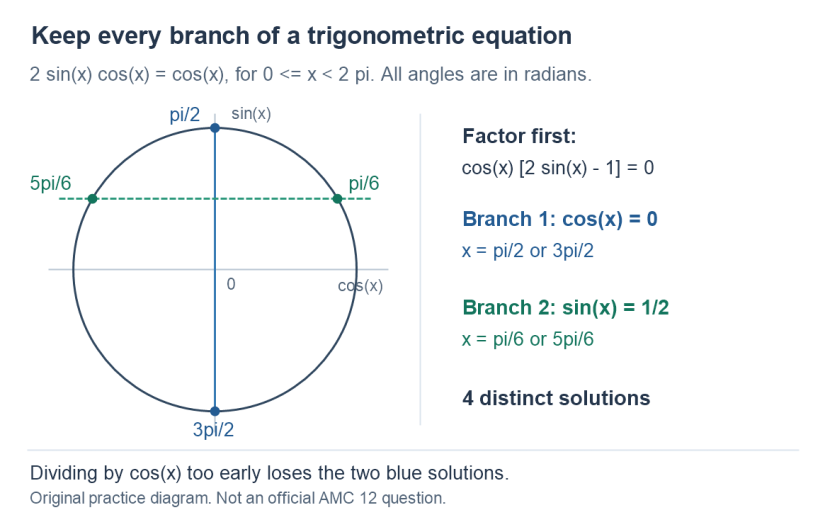
Dividing both sides of an equation can make it shorter, but it can also remove valid solutions. In AMC 12 trigonometry practice, check whether the expression you want to divide by could be zero before cancelling it.
The Mathematical Association of America's AMC overview includes trigonometry within AMC 12's high school mathematics scope and excludes calculus. This guide uses an original equation and unit-circle diagram to practise a useful habit: keep every valid branch, then check the required interval. It is a teaching example, rather than an official AMC 12 question or a difficulty benchmark.
Know the identities but still miss solutions? Try the example below before reading the explanation. Compare your solution list with the four points on the unit circle.
To discuss what to work on next, scan the contact QR code or contact Hanlin on WeChat. Send AMC12 TRIG with your school grade and preparation question.
An original equation to solve
How many distinct real values of x satisfy
2 sin(x) cos(x) = cos(x), where 0 ≤ x < 2π?
(A) 2 (B) 3 (C) 4 (D) 5 (E) 6
All angles in this article are in radians. The interval includes 0 and excludes 2π. List the actual angles before counting them; that makes omissions and repeated values easier to spot.
Move everything to one side and factor
Subtract cos(x) from both sides:
2 sin(x) cos(x) - cos(x) = 0.
Factor out the shared term without dividing by it:
cos(x) [2 sin(x) - 1] = 0.
A product is zero when at least one factor is zero. We therefore need to solve both branches: cos(x) = 0 or sin(x) = 1/2.
Solve both branches on the unit circle
On the unit circle, the point at angle x has coordinates (cos(x), sin(x)). Cosine is the horizontal coordinate and sine is the vertical coordinate.
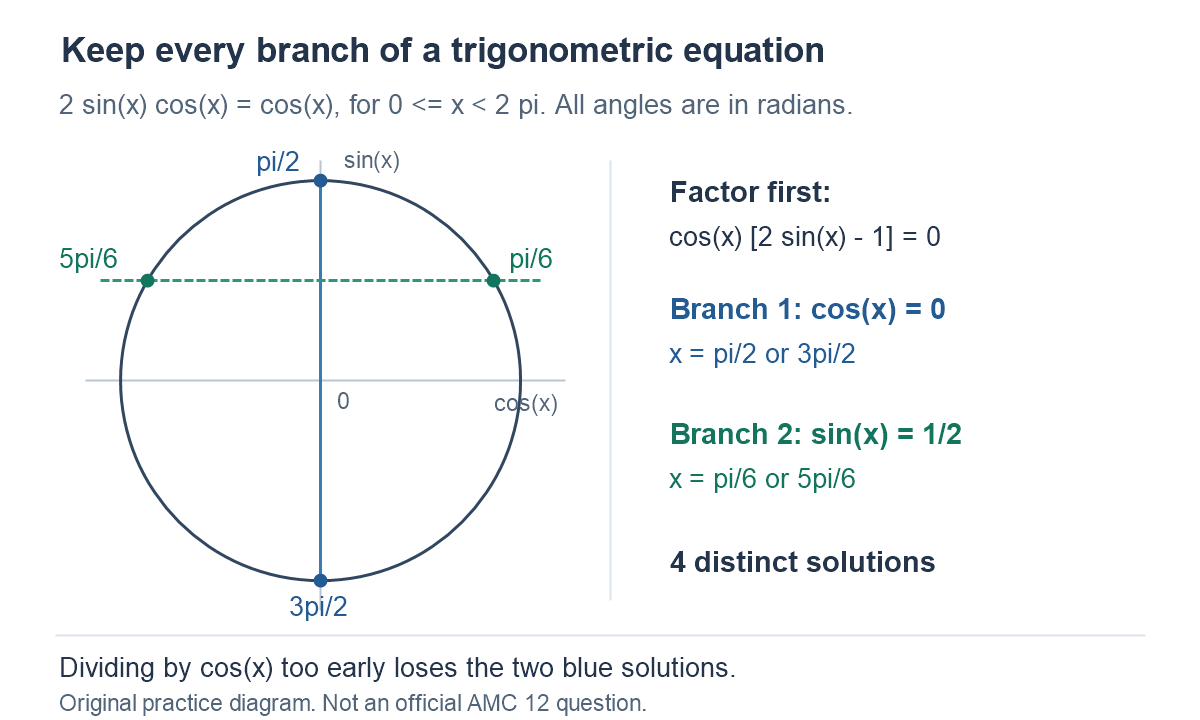
- cos(x) = 0: the horizontal coordinate is zero at the top and bottom of the circle. In the required interval, x = π/2 or 3π/2.
- sin(x) = 1/2: the horizontal line at height 1/2 meets the circle in the first and second quadrants. The angles are x = π/6 or 5π/6.
Combine the two lists and put them in order:
π/6, π/2, 5π/6, 3π/2.
All four lie in the interval, and none is repeated. There are 4 distinct solutions, so the answer is (C).
Why dividing by cos(x) loses two solutions
If you immediately divide the original equation by cos(x), you obtain 2 sin(x) = 1. That step assumes cos(x) is not zero, so it only describes part of the original problem.
At x = π/2 and x = 3π/2, cosine is zero. Substituting either angle into the original equation gives 0 = 0. Both angles are valid, but division would have discarded them.
You can divide after separating and checking the zero case. Factoring is convenient here because it displays both cases in one line. The goal is to preserve the original solution set throughout the calculation.
Check that the list is complete
The factorisation is an identity, so any solution must belong to at least one of the two branches. Within one full turn, cos(x) = 0 gives exactly two angles, and sin(x) = 1/2 gives exactly two. Conversely, every listed angle makes at least one factor zero and therefore satisfies the original equation.
This checks both directions: no valid angle was missed, and no extra angle was introduced. Substitution is useful for testing candidates, but checking a few candidates alone does not establish that the list is complete.
Use a short checklist for trigonometric equations
- Record the interval and angle unit. Distinguish 0 ≤ x < 2π from a closed interval, and keep radians separate from degrees.
- Check restrictions before transforming. Before dividing by a function, consider its zeros. For equations involving fractions, record where denominators are undefined.
- Solve every factor or branch. Use the unit circle to include all relevant quadrants.
- Check the range. For real angles, sine and cosine lie between -1 and 1. An equation such as sin(x) = 3/2 has no real solution.
- Filter, combine and verify. Apply the interval, remove duplicate values and test the original equation.
Try two short practice questions
- Solve cos(x) [2 sin(x) - 3] = 0 for 0 ≤ x < 2π. Which branch can be ruled out immediately?
- Solve sin(x) [2 cos(x) - 1] = 0 for 0 ≤ x < 2π. How would the number of distinct solutions change if the interval included 2π?
Show the answers and reasoning
Question 1: The branches are cos(x) = 0 and sin(x) = 3/2. The second branch is impossible for real x. The solutions are π/2 and 3π/2, giving 2 solutions.
Question 2: The branches are sin(x) = 0 and cos(x) = 1/2. On 0 ≤ x < 2π, their combined solution list is 0, π/3, π, 5π/3, giving 4 solutions.
On the closed interval 0 ≤ x ≤ 2π, the extra value 2π also satisfies the equation, so there are 5 solutions. Although 0 and 2π point in the same direction on the circle, they are distinct real values of x. The question asks for angle values, so the stated interval matters.
Turn a missed solution into a useful review note
Record the exact step where the solution set changed. "Check cos(x) = 0 before dividing" gives you an action to repeat. "Be more careful with trigonometry" does not identify the cause.
For your next session, solve a similar equation with a different sine or cosine value, then explain why your list is complete. Return to the AMC 12 preparation guide if you need help organising broader topic review. The MAA's K-12 educator resources provide official preparation materials and sample competition resources for further practice.
Discuss your AMC 12 preparation with Hanlin
Moving from AMC 10 to AMC 12, planning a first attempt or working on trigonometry? Scan the QR code and send AMC12 TRIG. Tell us what you have studied and where you get stuck so we can discuss your next preparation step.

On your phone, use the button above. You can also save the QR image and scan it within WeChat.
Include these details in your message:
AMC12 TRIG
School grade and mathematics curriculum:
Country or competition region:
Previous AMC or mathematics competition experience:
The topic or step you find difficult:
Sources: the official MAA AMC overview and K-12 educator resources linked above. The examples, diagram and practice suggestions were created for this article.