

Introduction to the AMC 12 Mathematics Competition
The AMC 12 (American Mathematics Competitions 12) is organized annually by the Mathematical Association of America (MAA), with the exam typically held in November. It is specifically designed for students in Grade 12 and below—corresponding to the final year of high school in the domestic system—though exceptional students from the AMC 10 level are also eligible to participate.
The AMC 12 serves as the essential gateway to the AIME (American Invitational Mathematics Examination); students who achieve high scores qualify to advance to the AIME, which is regarded as a significant credential for admission to the top 30 universities in the United States. Whether for students in domestic public schools seeking to enhance their mathematical proficiency, or for those in international schools applying to prestigious overseas universities, the AMC 12 is a highly worthwhile mathematics competition to enter.
What Background is Required to Take the AMC 12?
1. Students with a Foundation in the AMC 10:
If a student is able to correctly answer approximately 18 questions on the AMC 10 exam, they possess the fundamental proficiency required to participate in the AMC 12 competition. This indicates that the student has mastered a sufficient body of mathematical knowledge and problem-solving techniques to tackle the more complex problems encountered in the AMC 12.
2. Students with a Solid Foundation in IB Higher Level (HL) Mathematics:
The Higher Level (HL) Mathematics courses within the IB curriculum are highly rigorous, covering a broad and in-depth range of mathematical concepts. If a student demonstrates excellence in these courses, they are highly likely to perform exceptionally well in the AMC 12 as well.
3. Students with a Solid Foundation in AP Pre-calculus:
Pre-calculus is a mathematics course within the AP curriculum that primarily covers algebra, geometry, trigonometry, and introductory calculus concepts. Students who have mastered this course possess a strong mathematical foundation and are well-prepared to participate in the AMC 12 competition.
About MAA AMC

What is the AMC?
Established in 1950, the AMC is a premier mathematics competition for K-12 students. The American Mathematics Competitions consist of a series of exams designed to foster problem-solving skills and mathematical knowledge among middle and high school students.
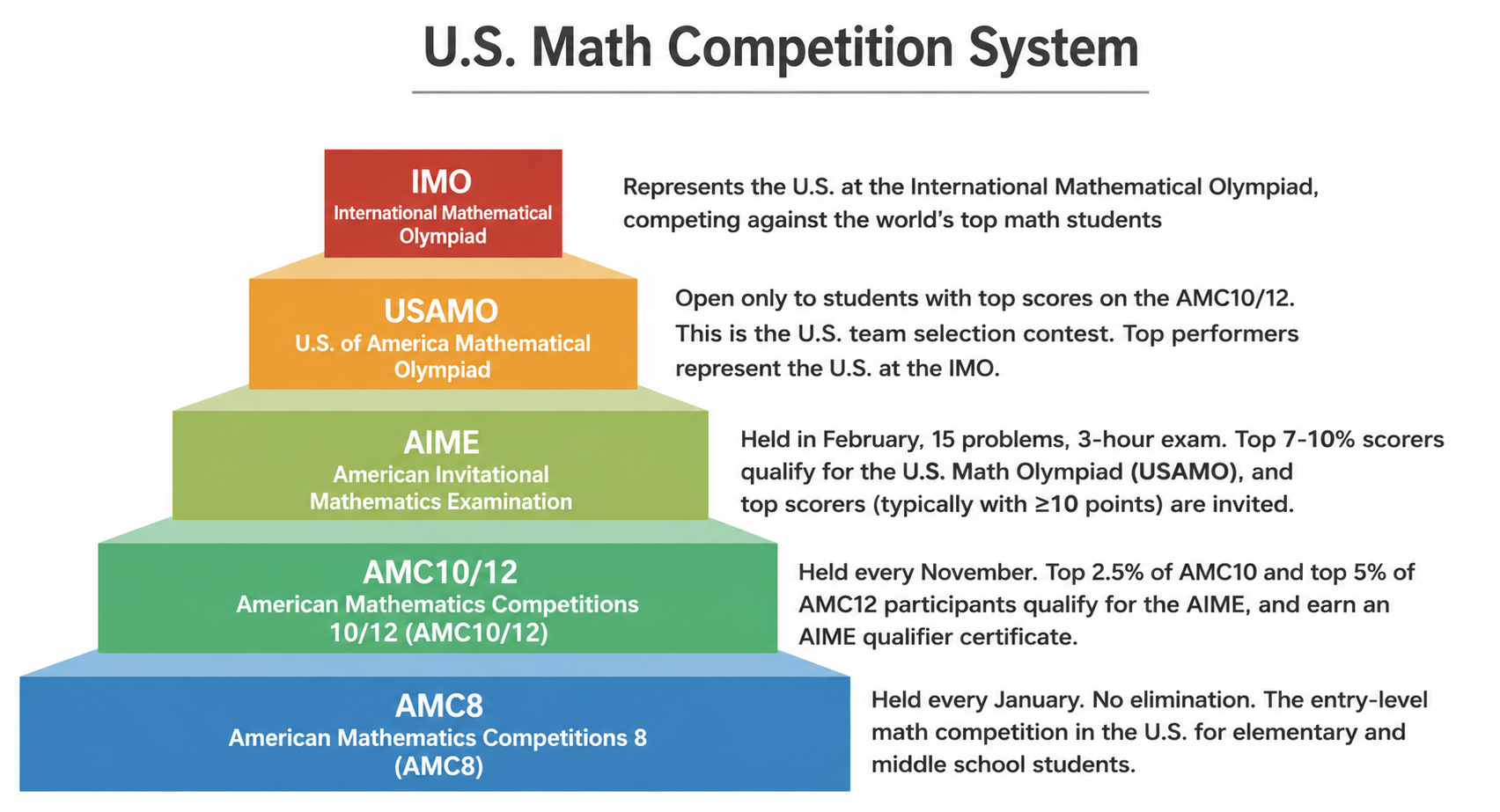
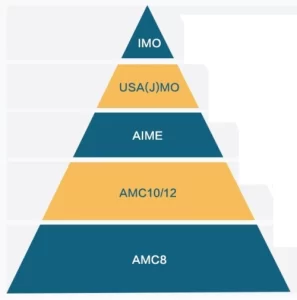
AMC 8: The AMC competition for middle school students.
AMC 10/12: The AMC competitions for high school students.
American Invitational Mathematics Examination (AIME): An invitational competition hosted by the AMC for top-scoring participants in the AMC 10/12.
United States of America Mathematical Olympiad (USAMO) and USA Junior Mathematical Olympiad (USAJMO): The AMC's premier invitational competitions for top-scoring participants in the AIME.
History of the AMC
In 1950, the first mathematics competition—sponsored by the Metropolitan New York Section of the Mathematical Association of America (MAA)—was held; it was originally designed for high school students. At its inception, the competition was offered to approximately 6,000 students across about 200 schools, exclusively within the New York region.
As the competition gained popularity and recognition, it underwent several transformations. In 1957, the contest expanded to include middle school students, reflecting a commitment to nurturing mathematical talent from an early age. Over time, the competition evolved to encompass multiple rounds of varying difficulty levels. Today, the program has grown to involve over 300,000 students from more than 6,000 schools annually.
The United States hosts numerous mathematics competitions. Among them, only the AMC → AIME → USAMO series serves as the pathway to the IMO (International Mathematical Olympiad)—the world's most prestigious mathematics competition for high school students!
How Difficult Are the AMC Math Competitions?
The difficulty level of the AMC math competitions varies depending on the specific round and grade level.
AMC 8: Tailored specifically for students in Grade 8 and below, this exam consists of 25 multiple-choice questions to be completed within 40 minutes, covering topics such as pre-algebra, algebra, geometry, counting, and probability. Serving as an introductory stage, the AMC 8 acts as a stepping stone for younger participants.
AMC 10 and AMC 12: Designed for students in Grade 10 and below, and Grade 12 and below, respectively. Both exams feature 25 multiple-choice questions covering subjects such as algebra, geometry, number theory, combinatorics, and probability, and must be completed within 75 minutes.
AIME: Exceptional performance on the AMC 10 or AMC 12 can open the door to the American Invitational Mathematics Examination (AIME)—a more challenging, 15-question, proof-based exam. The AIME serves as an intermediate stage between the AMC 10/12 and the subsequent rounds.
USAMO: The highest-scoring AMC 12 participants (based on a combined score from the AMC 12 and AIME) are invited to take the USAMO. This is a six-question, proof-based examination—accessible only to those who have excelled on the AIME—and represents the pinnacle of high school mathematical achievement in the United States.
Competition Format
| Competition Categories | Competition Format |
| AMC8 | The AMC 8 is a 25-question, 40-minute multiple-choice examination. |
| AMC 10/12 (A) | Both the AMC 10A and 12A are high school mathematics exams consisting of 25 multiple-choice questions to be completed within 75 minutes. |
| AMC 10/12 (B) | Features the same exam format as the AMC 10/12A. |
| AIME | AIME is a 15-question, 3-hour exam. |
| USA (J)MO | The USA (J)MO is a six-problem, two-day, nine-hour written examination. |
Examination Syllabus
The following are the topics covered in every American Mathematics Competitions test.
| theme |
| Arithmetic |
| Algebra |
| Probability |
| Number Theory |
| Geometry |
| Combinatorics |
Algebra: Solving equations and inequalities, manipulating algebraic expressions, and working with functions are examples of this area.
Geometry: This encompasses the properties of lines, angles, and polygons, as well as basic trigonometric functions.
Number Theory: The characteristics of integers, divisibility, prime numbers, and modular arithmetic are all included.
Counting and Probability: This covers counting techniques—such as permutations and combinations—as well as probability concepts, such as independent and dependent events.
Logic: This involves applying deductive and inductive reasoning to solve problems and understand the structure of mathematical proofs.
How to Prepare for the AMC?
Understand the Syllabus: Familiarize yourself with the topics covered in the competition, focusing particularly on areas that may require additional practice.
Practice Regularly: Solve a variety of math problems on a regular basis to hone your problem-solving skills and reinforce your understanding of key concepts.
Use Past Papers: Access past AMC competition questions and papers to understand the format and types of questions asked. This can help you identify patterns and areas that require improvement.
Join a Study Group: Collaborate with peers who are also interested in the AMC. Discussing problems and solutions with others can offer fresh perspectives and insights.
Seek Guidance: If you find specific topics challenging, do not hesitate to seek guidance from teachers, tutors, or online math courses. Understanding the nuances of complex concepts is crucial for success.
Time Management: Practice time management during your study sessions to ensure that you can solve all problems within the allotted time frame during the actual exam.