
AMC12 is open to students in grade 12 and below, who are under 19.5 years of age. Although the eligibility is broad, considering the knowledge coverage, preparation time window, and college application timeline, students in different grades should adopt significantly different preparation strategies.
I. Recommendations by Grade: Timing is Key to Success
| Grade | Suitability | Prerequisites | Core Goals | Remarks |
| Grade 9 | Cautiously Challenge | - Extremely solid math foundation - Have systematically completed core high school content (algebra, geometry, trigonometry) - Have AMC10 experience |
Familiarize with AMC12 question types and pacing, build early competition record | Not recommended to aim primarily for AIME qualification, focus on experience and exploration. |
| Grade 10 | Best Starting Period | - High school math knowledge gradually complete - Plenty of time, no standardized test pressure |
Target top 5% (AIME qualification), systematically gain high-value competition experience | Participating now lays a solid foundation for aiming high in grade 11. |
| Grade 11 | Golden Sprint Period | - Knowledge fully covers AMC12 syllabus - Relatively ample preparation time |
Target top 1% (DHR), ensure AIME qualification, and use the results for early/regular college applications | This is the most strategically valuable time to take the exam. |
| Grade 12 | Not Recommended for First-Time Participants | - Only suitable for students with an AIME foundation who wish to improve their scores | Improve existing scores for use as supplementary materials in regular applications | Scores may not meet early application deadlines, and preparation time is severely squeezed by college applications. |
Key conclusion: Grades 10-11 are the golden window for taking the AMC12. Build a foundation and aim for AIME in grade 10; aim for high scores and achieve success in grade 11.

II. AMC12 Difficulty Analysis: "Curriculum Extension" and "Thinking Breakthrough" of the Four Major Modules
The difficulty of AMC12 does not come from out-of-syllabus knowledge (calculus is not involved), but rather from the deep exploration, flexible combination, and creative application of high school mathematics knowledge. Its core examines four major modules:
1. Algebra Module: From "Solving Equations" to "Building Models"
Basic part (synchronized with domestic but more profound): quadratic function extrema, absolute value inequalities, parameter discussions, etc., often intersecting with polynomials and sequences.
Advanced difficulties (weak area in domestic systems): complex numbers (polar coordinates, De Moivre's theorem), comprehensive applications of logarithms and exponents. This is a significant "score-losing disaster area" for many students.
2. Geometry Module: The "Main Battlefield" for Score Gaps
Basic part: properties of triangles, circles, and quadrilaterals, emphasizing flexible application rather than rote memorization of formulas.
Advanced difficulties: solid geometry (spatial imagination), analytic geometry (comprehensive conic sections), and less common but efficient tools like Ptolemy's theorem, power of a point theorem. For example, problems involving cyclic quadrilaterals often require combining area method or Ptolemy's theorem to solve.
3. Number Theory Module: A "Special Difficulty" for Domestic Students
Core content: divisibility, congruences, prime factorization, divisor function and sum of divisors theorem.
Characteristics: extremely flexible problems requiring rigorous logical reasoning. For example, deducing properties of the least common multiple by analyzing prime factorization. This part is hardly covered in domestic high schools and is the key to distinguishing average students from high-scoring ones.
4. Combinatorics Module: A Test of "Thinking Outside the Box"
Core content: permutations and combinations, probability, stars and bars method, inclusion-exclusion principle.
Characteristics: novel problems that do not rely on complex calculations but rather on the cleverness of the problem-solving approach. Often "easy to understand at first glance, but prone to errors when attempted", severely testing on-the-spot adaptability and model-building ability.
Our AMC10/12 Four-Module Short-Term Course is very suitable for students who want targeted improvement!
III. Actionable Advice for Students in Different Grades
Grade 9 students: If you want to challenge early, make sure you can consistently score above 100 on the AMC10 and systematically study trigonometry and basic complex numbers.
Grade 10 students: Start preparing for AMC12 immediately, focusing on strengthening number theory and combinatorics (two weak modules domestically), and begin learning complex numbers and advanced geometric theorems.
Grade 11 students: Undergo high-intensity, realistic mock training, aim directly for 130+ points (DHR), and simultaneously prepare for AIME to form a complete competition achievement chain.
Grade 12 students: Unless you already have AIME experience, focus your energy on SAT/ACT, essays, and college applications to avoid putting the cart before the horse.
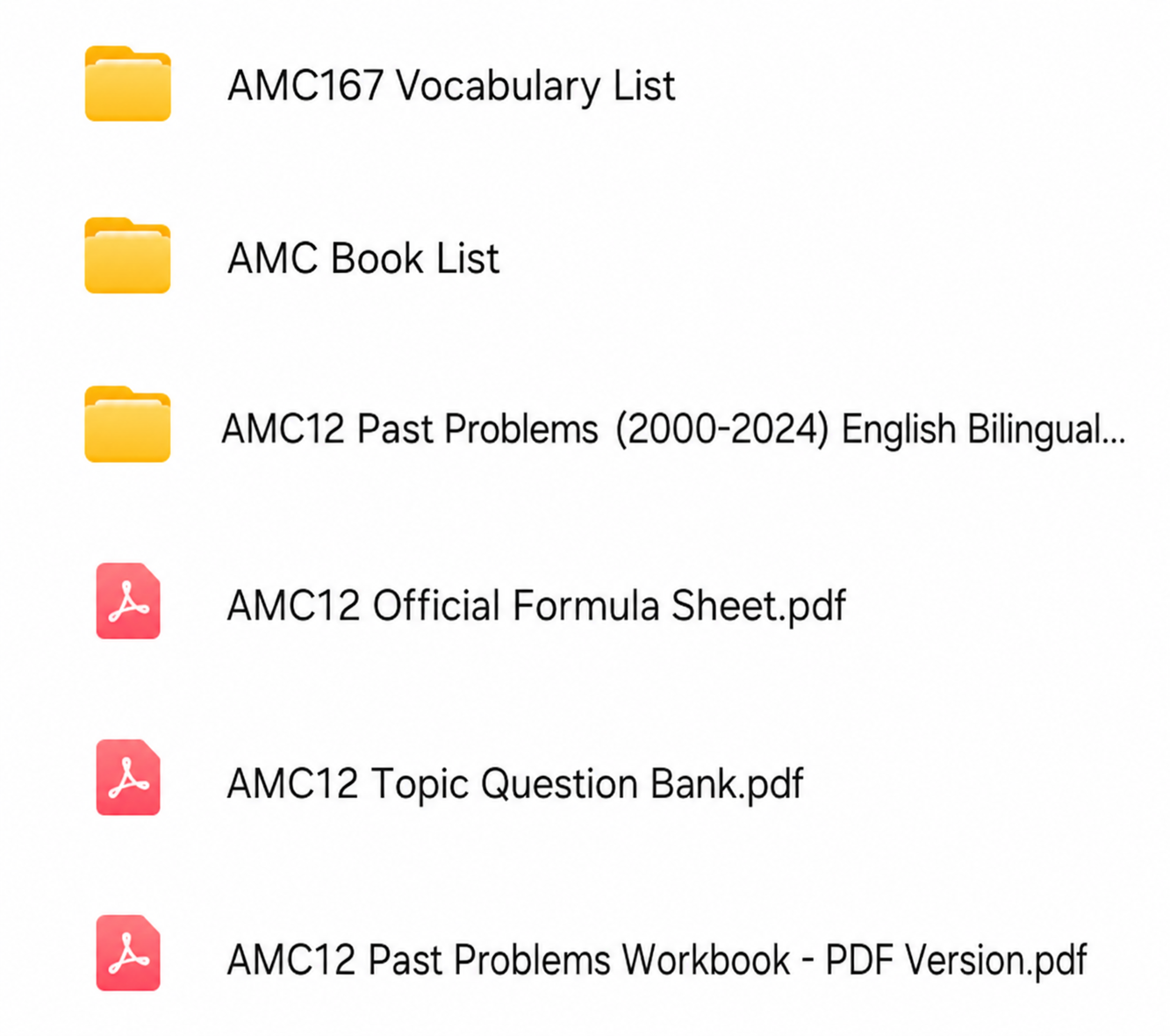
Scan the QR code for free AMC 12 preparation materials ⇓
(Includes past AMC 12 papers + solutions + book list + formulas, etc.)