

The Essential Mathematical Knowledge You Need for the AMC 12: A Topic-by-Topic Breakdown

The AMC 12 covers a wide range of mathematical topics, from algebra and geometry to number theory and combinatorics. Success on the exam requires not just familiarity with these topics but a deep, working understanding of the key concepts, formulas, and techniques within each area. In this comprehensive guide, we break down the essential mathematical knowledge you need to master for the AMC 12, organized by topic. Whether you are building your foundation or polishing your skills, this reference will serve as your roadmap to competition success.


Essential mathematical knowledge for AMC 12
Mastering the core topics is the foundation of AMC 12 success.
推荐

1. Algebra

Algebra is the backbone of the AMC 12, appearing in roughly 8–10 questions on every exam. Here are the essential algebra topics you must master:
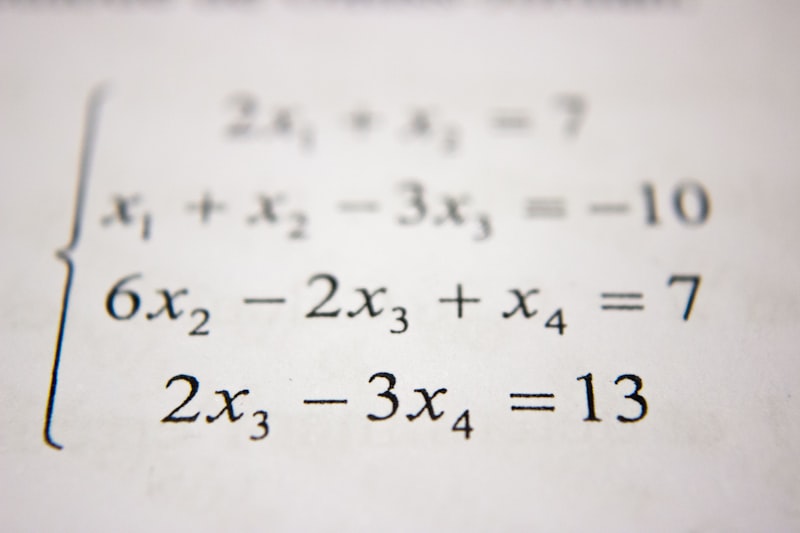
Algebra concepts for AMC 12
Algebra is the most heavily tested topic on the AMC 12.

Linear and Quadratic Equations

Quadratic Formula: For ax² + bx + c = 0, x = (-b ± √(b² - 4ac)) / 2a

Discriminant: b² - 4ac determines the nature of roots (positive = 2 real roots, zero = 1 repeated root, negative = 2 complex roots)

Vieta's Formulas: For ax² + bx + c = 0 with roots r and s: r + s = -b/a and r·s = c/a

Completing the Square: A powerful technique for solving quadratics and finding maximum/minimum values

Polynomials

Factor Theorem: If P(a) = 0, then (x - a) is a factor of P(x)

Remainder Theorem: When P(x) is divided by (x - a), the remainder is P(a)

Rational Root Theorem: Rational roots of a polynomial with integer coefficients must be of the form p/q, where p divides the constant term and q divides the leading coefficient

Polynomial Division: Long division and synthetic division techniques

Functions and Their Properties

Function Composition: (f ∘ g)(x) = f(g(x))

Inverse Functions: If f(g(x)) = x and g(f(x)) = x, then f and g are inverses

Absolute Value: |x| = x if x ≥ 0, -x if x < 0

Piecewise Functions: Functions defined by different rules on different intervals

Sequences and Series

Arithmetic Sequences: a_n = a_1 + (n-1)d; Sum = n/2 · (a_1 + a_n)

Geometric Sequences: a_n = a_1 · r^(n-1); Sum = a_1 · (1 - r^n) / (1 - r)

Infinite Geometric Series: Sum = a_1 / (1 - r) when |r| < 1

Telescoping Series: Series where most terms cancel out

Advanced Algebra Topics

Complex Numbers: i² = -1; operations with complex numbers; complex conjugates

Logarithms: Properties of logarithms; change of base formula; solving exponential equations

Exponential Functions: Properties and graphs; solving exponential equations

Inequalities: AM-GM inequality; Cauchy-Schwarz inequality (occasionally)

2. Geometry

Geometry is another major topic, appearing in 6–8 questions per exam. The AMC 12 covers both coordinate geometry and Euclidean geometry, including trigonometry.

Geometry topics for AMC 12
Geometry requires both formula knowledge and spatial reasoning.

Triangles

Special Triangles: 30-60-90 (sides in ratio 1:√3:2) and 45-45-90 (sides in ratio 1:1:√2)

Law of Sines: a/sin(A) = b/sin(B) = c/sin(C)

Law of Cosines: c² = a² + b² - 2ab·cos(C)

Area Formulas: 1/2 · b · h; 1/2 · a · b · sin(C); Heron's formula: √(s(s-a)(s-b)(s-c)) where s = (a+b+c)/2

Triangle Inequality: The sum of any two sides must be greater than the third side

Circles

Arc Length: s = rθ (θ in radians)

Area of a Sector: A = 1/2 · r² · θ

Inscribed Angles: An inscribed angle is half the central angle that subtends the same arc

Power of a Point: For a point P and a circle, if two lines through P intersect the circle at A,B and C,D respectively, then PA·PB = PC·PD

Tangent Lines: A tangent to a circle is perpendicular to the radius at the point of tangency

Coordinate Geometry

Distance Formula: d = √((x₂-x₁)² + (y₂-y₁)²)

Midpoint Formula: M = ((x₁+x₂)/2, (y₁+y₂)/2)

Slope: m = (y₂-y₁)/(x₂-x₁)

Equation of a Line: y - y₁ = m(x - x₁) or y = mx + b

Equation of a Circle: (x-h)² + (y-k)² = r²

Parallel and Perpendicular Lines: Parallel lines have equal slopes; perpendicular lines have slopes that are negative reciprocals

Three-Dimensional Geometry

Volume Formulas: Prism/Cylinder: V = B·h; Pyramid/Cone: V = 1/3·B·h; Sphere: V = 4/3·πr³

Surface Area: Know formulas for common solids (cubes, cylinders, spheres, etc.)

Distance in 3D: d = √((x₂-x₁)² + (y₂-y₁)² + (z₂-z₁)²)

3. Trigonometry
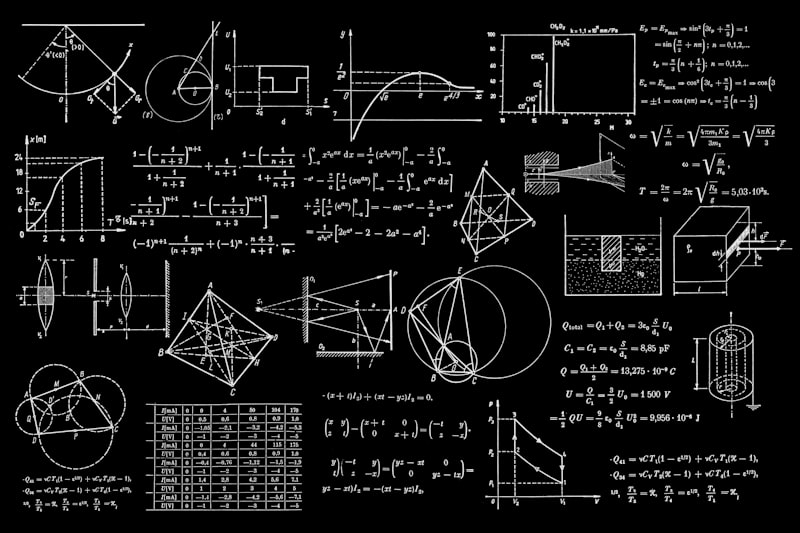
Trigonometry concepts for AMC 12
Trigonometry is a key differentiator between the AMC 10 and AMC 12.

Trigonometry is one of the topics that distinguishes the AMC 12 from the AMC 10. You can expect 2–4 trigonometry questions per exam.

Basic Trigonometric Functions

Definitions: sin(θ) = opposite/hypotenuse; cos(θ) = adjacent/hypotenuse; tan(θ) = sin(θ)/cos(θ)

Reciprocal Functions: csc(θ) = 1/sin(θ); sec(θ) = 1/cos(θ); cot(θ) = 1/tan(θ)

Unit Circle: Know the values of sin, cos, and tan for common angles (0°, 30°, 45°, 60°, 90° and their radian equivalents)

Trigonometric Identities

Pythagorean Identity: sin²(θ) + cos²(θ) = 1

Other Identities: 1 + tan²(θ) = sec²(θ); 1 + cot²(θ) = csc²(θ)

Double Angle Formulas: sin(2θ) = 2sin(θ)cos(θ); cos(2θ) = cos²(θ) - sin²(θ)

Sum and Difference Formulas: sin(A ± B) = sin(A)cos(B) ± cos(A)sin(B); cos(A ± B) = cos(A)cos(B) ∓ sin(A)sin(B)

Graphs of Trigonometric Functions

Period and Amplitude: For y = A·sin(Bx + C) + D, amplitude = |A|, period = 2π/|B|, phase shift = -C/B, vertical shift = D

Graph Properties: Know the shapes of sin, cos, and tan graphs and their transformations

推荐

4. Number Theory

Number theory questions test your ability to work with integers and their properties. You can expect 3–5 number theory questions per exam.

Number theory concepts for AMC 12
Number theory requires creative thinking and pattern recognition.

Divisibility and Primes

Divisibility Rules: Know rules for 2, 3, 4, 5, 6, 8, 9, 10, 11

Prime Factorization: Every integer greater than 1 can be uniquely expressed as a product of primes

Prime Testing: To test if n is prime, check divisibility by all primes up to √n

GCD and LCM

Greatest Common Divisor: Use the Euclidean algorithm or prime factorization

Least Common Multiple: LCM(a,b) = (a·b) / GCD(a,b)

Properties: GCD and LCM are useful in problems involving divisibility, remainders, and scheduling

Modular Arithmetic

Basic Properties: If a ≡ b (mod m), then a + c ≡ b + c (mod m) and a·c ≡ b·c (mod m)

Remainders: The remainder when a is divided by m is a mod m

Applications: Useful in problems involving cycles, last digits, and divisibility

Other Number Theory Topics

Number of Divisors: If n = p₁^a₁ · p₂^a₂ · ... · pₖ^aₖ, then the number of divisors is (a₁+1)(a₂+1)...(aₖ+1)

Sum of Divisors: The sum of divisors can be calculated using the prime factorization

Digit Problems: Problems involving the digits of numbers (e.g., sum of digits, reversing digits)

5. Counting and Probability

Counting and probability questions are among the most challenging on the AMC 12, often appearing in the later questions (20–25). You can expect 4–6 questions in this area.

Basic Counting Principles

Addition Principle: If there are m ways to do one thing and n ways to do another (and they are mutually exclusive), there are m + n ways to do either

Multiplication Principle: If there are m ways to do one thing and n ways to do another (in sequence), there are m·n ways to do both

Permutations and Combinations

Permutations: P(n,r) = n! / (n-r)! — the number of ways to arrange r items from n items where order matters

Combinations: C(n,r) = n! / (r!·(n-r)!) — the number of ways to choose r items from n items where order does not matter

Permutations with Repetition: The number of arrangements of n items where some are identical is n! / (n₁!·n₂!·...·nₖ!)

Probability

Basic Probability: P(A) = (number of favorable outcomes) / (total number of outcomes)

Complementary Probability: P(not A) = 1 - P(A) — often the easiest way to solve "at least" problems

Conditional Probability: P(A|B) = P(A and B) / P(B)

Independent Events: If A and B are independent, P(A and B) = P(A)·P(B)

Expected Value: E(X) = Σ(xᵢ · P(xᵢ))

Advanced Counting Techniques

Inclusion-Exclusion Principle: |A ∪ B| = |A| + |B| - |A ∩ B|; for three sets: |A ∪ B ∪ C| = |A| + |B| + |C| - |A ∩ B| - |A ∩ C| - |B ∩ C| + |A ∩ B ∩ C|

Pigeonhole Principle: If n+1 objects are placed into n boxes, at least one box must contain at least 2 objects

Casework: Breaking a problem into mutually exclusive cases and summing the results

Complementary Counting: Count the complement and subtract from the total

6. Putting It All Together: Problem-Solving Strategies

Problem-solving strategies for AMC 12
Combining knowledge from multiple topics is key to solving the hardest AMC 12 problems.

The hardest AMC 12 problems often require combining knowledge from multiple topics. Here are some general strategies:

Identify the Topic: Before solving, ask yourself: "What topic does this problem fall under? What tools do I have for this type of problem?"

Draw a Diagram: For geometry problems (and many others), a well-labeled diagram can reveal insights that are not obvious from the text alone.

Try Small Cases: For counting and number theory problems, try small examples to identify patterns before attempting the general case.

Use Multiple Approaches: If one approach is not working, try a different one. Many problems can be solved in multiple ways.

Check Your Work: If time permits, verify your answer by plugging it back into the problem or using a different method.

Final Thoughts: Mastery Takes Time

The AMC 12 covers a broad range of mathematical topics, and mastering all of them takes time and consistent effort. Do not try to learn everything at once. Focus on building a strong foundation in each topic, and then gradually work on more challenging problems. Use this guide as a checklist to ensure you have covered all the essential knowledge areas, and refer back to it as you prepare.

Remember, the goal is not just to memorize formulas but to develop a deep, intuitive understanding of the mathematics. When you truly understand a concept, you can apply it creatively to solve problems you have never seen before — and that is the hallmark of a successful AMC 12 competitor.

What topics do you find most challenging? Share your thoughts in the comments below and help build a community of learners supporting each other on the path to AMC 12 success!

推荐

AMC 10 vs. AMC 12: A Comprehensive Comparison to Help You Choose the Right Exam

One of the most common questions students and parents ask when entering the world of math competitions is: "Should I take the AMC 10 or the AMC 12?" Both exams are organized by the Mathematical Association of America (MAA) and serve as the first step in the competition math pipeline, but they differ significantly in content, difficulty, and strategic implications. In this comprehensive guide, we break down every key difference between the AMC 10 and AMC 12 to help you make an informed decision about which exam is right for you — and whether you should consider taking both.

AMC 10 vs AMC 12 comparison
Understanding the differences between the AMC 10 and AMC 12 is crucial for strategic planning.

Overview: What Are the AMC 10 and AMC 12?

Both the AMC 10 and AMC 12 are 25-question, 75-minute multiple-choice mathematics competitions administered twice per year (in November). They share the same format, scoring system (6-1.5-0), and are designed to promote mathematical reasoning and problem-solving ability. However, they target different grade levels and cover different mathematical content.

Feature AMC 10 AMC 12
Eligible Grades Grade 10 and below Grade 12 and below
Age Limit Under 17.5 years Under 19.5 years
Number of Questions 25 25
Time Limit 75 minutes 75 minutes
Scoring System 6-1.5-0 (max 150) 6-1.5-0 (max 150)
Calculators Not permitted Not permitted

Key Difference #1: Mathematical Content

Mathematical topics covered in AMC 10 vs AMC 12
The AMC 12 covers more advanced topics than the AMC 10, including trigonometry and advanced algebra.

The most significant difference between the AMC 10 and AMC 12 is the range of mathematical topics covered.

AMC 10 Topics

The AMC 10 covers mathematics typically taught in grades 9–10, including:

Elementary Algebra: Linear equations, quadratics, polynomials, functions, inequalities, sequences and series.

Elementary Geometry: Triangles, circles, coordinate geometry, area and volume (but no trigonometry).

Elementary Number Theory: Divisibility, primes, GCD/LCM, basic modular arithmetic.

Elementary Counting & Probability: Permutations, combinations, basic probability.

The AMC 10 does not include trigonometry, advanced algebra (such as complex numbers or logarithms), or precalculus-level topics.

AMC 12 Topics

The AMC 12 covers all of the AMC 10 topics plus additional material typically taught in grades 11–12:

Trigonometry: Unit circle, trig identities, graphs of trig functions, laws of sines and cosines.

Advanced Algebra: Complex numbers, logarithms, advanced polynomials, rational functions.

Precalculus: Advanced functions, vectors, matrices (basic).

More advanced topics in number theory, counting, and geometry.

Like the AMC 10, the AMC 12 does not include calculus.

Implication: If you have not yet studied trigonometry or advanced algebra, the AMC 10 may be a better fit. If you have completed a full high school math curriculum (through precalculus), the AMC 12 is appropriate.

Key Difference #2: Difficulty Level

Difficulty comparison between AMC 10 and AMC 12
The AMC 12 is more challenging than the AMC 10, especially in the later questions.

Both exams are designed to be progressively difficult, with questions arranged from easiest to hardest. However, the overall difficulty level of the AMC 12 is higher than that of the AMC 10.

Questions 1–10: On both exams, these are relatively accessible to well-prepared students. The AMC 12 questions in this range may be slightly more complex, but the difference is not dramatic.

Questions 11–20: The gap begins to widen. AMC 12 questions in this range often require deeper insight or more advanced techniques.

Questions 21–25: The hardest problems on the AMC 12 are significantly more difficult than the hardest problems on the AMC 10. They often involve sophisticated problem-solving strategies and advanced mathematical concepts.

Implication: If you are a strong math student who enjoys challenges, the AMC 12 may be more engaging. If you find competition math already challenging, the AMC 10 may provide a better experience while still pushing you to improve.

Key Difference #3: AIME Qualification

Both the AMC 10 and AMC 12 serve as qualifiers for the American Invitational Mathematics Examination (AIME), but the qualification criteria are different.

AIME qualification criteria for AMC 10 and AMC 12
The qualification criteria for AIME differ between the AMC 10 and AMC 12.

AMC 10 → AIME

Score 120 or higher (out of 150), or

Place in the top 2.5% of all AMC 10 test-takers.

The AMC 10 cutoff for AIME qualification is typically around 100–110 points, though it varies slightly each year.

AMC 12 → AIME

Score 100 or higher (out of 150), or

Place in the top 5% of all AMC 12 test-takers.

The AMC 12 cutoff for AIME qualification is typically around 90–100 points, though it varies slightly each year.

Strategic Insight: The AMC 10 has a higher score requirement for AIME qualification (120 vs. 100), but the problems are easier. The AMC 12 has a lower score requirement (100 vs. 120), but the problems are harder. Which is "easier" to qualify through depends on your strengths. If you are very strong in the AMC 10 topics but have not learned trigonometry, the AMC 10 may give you a better chance. If you have a broad math background and are comfortable with advanced topics, the AMC 12 may be more favorable.

Key Difference #4: Awards and Recognition

Both exams offer certificates and awards, but the recognition levels are calculated separately.

AMC 10 Awards

Honor Roll: Top 5% of scorers at each grade level.

Distinguished Honor Roll: Top 1% of all scorers.

Global Honor Roll: Top 2.5% of international scorers.

Certificate of Achievement: For students in grade 8 or below who score well.

AMC 12 Awards

Honor Roll: Top 5% of scorers at each grade level.

Distinguished Honor Roll: Top 1% of all scorers.

Global Honor Roll: Top 2.5% of international scorers.

Certificate of Achievement: For students in grade 10 or below who score well.

Note: The AMC 12 Certificate of Achievement is awarded to students in grade 10 or below who perform well. This means that if you are in grade 10, you can take the AMC 12 and still earn recognition for competing "above your level."

Can I Take Both the AMC 10 and AMC 12?

Taking both AMC 10 and AMC 12
If eligible, taking both exams can maximize your chances of AIME qualification.

Yes! If you are eligible for both exams (i.e., you are in grade 10 or below and meet the age requirements), you can take both the AMC 10 and the AMC 12. Here is how it works:

You can take the AMC 10 on one date (e.g., AMC 10A) and the AMC 12 on the other date (e.g., AMC 12B), or vice versa.

You can also take both the AMC 10A and 10B, or both the AMC 12A and 12B.

Your scores on the two exams are considered independently for AIME qualification. If you qualify on either exam, you advance to the AIME.

Strategic Advantage: Taking both exams gives you two chances to qualify for the AIME. This is especially beneficial if you are unsure whether the AMC 10 or AMC 12 is better suited to your strengths. Many top students take both exams to maximize their opportunities.

Which Should You Choose? A Decision Framework

Here is a simple framework to help you decide:

Choose the AMC 10 if:

You are in grade 10 or below.

You have not yet studied trigonometry or advanced algebra (complex numbers, logarithms, etc.).

You are more comfortable with the AMC 10 topics and want to maximize your score.

Your goal is to qualify for the AIME, and you believe you have a better chance of scoring 120+ on the AMC 10 than 100+ on the AMC 12.

Choose the AMC 12 if:

You are in grade 11 or 12 (and thus ineligible for the AMC 10).

You are in grade 10 or below but have already studied trigonometry and advanced algebra.

You enjoy challenges and want to test yourself against harder problems.

You believe you have a better chance of scoring 100+ on the AMC 12 than 120+ on the AMC 10.

You want to earn the AMC 12 Certificate of Achievement (if you are in grade 10 or below).

Take Both if:

You are eligible for both exams.

You want to maximize your chances of AIME qualification.

You are unsure which exam is better suited to your strengths.

You have the time and energy to prepare for both exams.

Preparation Differences: AMC 10 vs. AMC 12

Preparation strategies for AMC 10 vs AMC 12
Preparation strategies should be tailored to the specific exam you are taking.

If you decide to take both exams, here are some preparation tips:

For the AMC 10: Focus on mastering the fundamentals of algebra, geometry, number theory, and counting/probability. Practice speed and accuracy on the easier problems (1–15), as you will need a high score (120+) to qualify for the AIME.

For the AMC 12: In addition to the AMC 10 topics, make sure you are comfortable with trigonometry and advanced algebra. Practice the harder problems (16–25) extensively, as these will distinguish you from the pack.

Overlap: Many preparation resources (AoPS textbooks, past exams, online courses) cover both exams. You can use the same core materials and supplement with exam-specific practice.

Common Misconceptions

Let us clear up some common misconceptions about the AMC 10 and AMC 12:

Misconception #1: "The AMC 12 is only for seniors." False. Any student in grade 12 or below who meets the age requirement can take the AMC 12. Many freshmen and sophomores take the AMC 12 to challenge themselves.

Misconception #2: "Taking the AMC 12 looks better on college applications than the AMC 10." Not necessarily. Colleges care more about your score and AIME qualification than which exam you took. A high AMC 10 score is just as impressive as a moderate AMC 12 score.

Misconception #3: "If I take the AMC 10, I cannot take the AMC 12 later." False. You can take the AMC 10 in one year and the AMC 12 in a later year. There is no restriction.

Misconception #4: "The AMC 12 is twice as hard as the AMC 10." False. The AMC 12 is more challenging, especially in the later questions, but the difference is not that dramatic. Many students who score well on the AMC 10 can adapt to the AMC 12 with additional preparation.

Final Thoughts: Choose What Is Right for You

The AMC 10 and AMC 12 are both wonderful opportunities to challenge yourself, grow as a mathematician, and connect with a community of like-minded students. Neither exam is inherently "better" than the other — the right choice depends on your grade level, mathematical background, goals, and personal preferences.

If you are unsure, consider taking a practice exam for each and see which one feels like a better fit. Talk to your math teacher or AMC coordinator for personalized advice. And remember: the most important thing is not which exam you take, but how much effort you put into preparing for it.

Whichever path you choose, embrace the challenge, enjoy the process, and take pride in your progress. The AMC 10 and AMC 12 are not just competitions — they are opportunities to discover the beauty and power of mathematics. Good luck!

Have you taken both the AMC 10 and AMC 12? Share your experience and advice in the comments below!

Online Customer Service
Contact Customer Service