
AMC10 vs AMC12: Don't Just Look at Difficulty, These Three Points Are Key!

On the path to applying for top-tier American and British undergraduate programs in STEM fields, the AMC (American Mathematics Competition) has long become a form of "hard currency". However, faced with the two options of AMC10 and AMC12, many students and parents are confused: Can a 10th grader only take AMC10? Is AMC12 more difficult and therefore more valuable?

In fact, choosing the wrong track can make even the hardest work counterproductive. What truly determines whether you can stand out isn't just the difficulty of the problems, but three key dimensions most people overlook: knowledge scope, problem structure, and competitive pool.

推荐

I. Knowledge Scope: AMC12 is Indeed "Broader", but Not Necessarily "More Suitable"

AMC10 is for students in grade 10 or below and does not involve trigonometry, logarithms, complex numbers, advanced number theory, etc. AMC12 covers all high school mathematics knowledge (excluding calculus), including core precalculus content. This means:

✅ If you haven't systematically studied high school math, forcibly challenging AMC12 will likely cause you to stumble frequently within the first 15 questions.

✅ But if you have already mastered the core knowledge of high school algebra, trigonometry, functions, etc., AMC12 can actually help you avoid the "overly competitive red sea" of AMC10.

The key is not "can I learn it", but "does it match my current knowledge system".

II. Problem Structure: Perceived Difficulty ≠ Actual Scoring Efficiency

Although both exams use a "easy first, hard later" stepped design, students' actual experiences are very different:

AMC10: The first 15 questions are relatively basic, but the difficulty of questions 16–25 jumps significantly, often requiring creative thinking. Many students spend too much time on the basic questions, leaving no time to think about the final challenging problems.

AMC12: The middle-section questions (11–20) are more smoothly distributed. As long as your knowledge coverage is complete, it's easier to steadily score points, making it especially suitable for students with solid logic and accurate calculation skills.

In other words: AMC10 tests your ability to break through "from knowing to cleverness", while AMC12 tests your ability to control "from completeness to stability".

III. Competitive Pool: Who You Compete Against Is More Important Than the Problems Themselves

This is the most underestimated point—the competition in the high-score range of AMC10 is far more intense than in AMC12. Why? Because a large number of competition-oriented top students in grades 9–10 concentrate on taking AMC10, with a clear goal: to achieve the top 1% (DHR) or qualify for AIME. The test-taker pool for AMC12 is more dispersed, including some "trial" or "retake" participants, which may create a "low-lying area effect" in the high-score range.

Even more critically: The cutoff score for qualifying for AIME from AMC10 (approximately the top 2.5%) is usually higher than from AMC12. This is because the organizing committee hopes to guide students to progress step by step—AMC12 is inherently more difficult, so if its qualifying score were even higher, it would discourage lower-grade students.

推荐

IV. How to Choose Scientifically? Decide Based on Grade + Foundation + Goal

Grades 9–10 Students:

Average foundation / New to competitions: Prioritize AMC10. Goal: Familiarize yourself with question types, gain experience, and aim for the top 5% (Distinction).

Solid math skills / Already completed core high school content: Challenge AMC10 directly. Advantage: Use higher-level scores to impress admissions officers, and competition pressure may be lower.

Time and energy permit? Register for both AMC10 and AMC12! Use the time difference between A and B papers (usually two weeks apart), take AMC10A first to secure a baseline, then aim for AMC12B to maximize your chances of qualifying.

Grades 11–12 Students: You can only take AMC12, so be sure to give it your all. Focus on breaking through questions 16–25, aim for the top 5% or AIME qualification, and add a key asset to your application season.

AMC12 Preparation Courses

Our instructors all graduated from top universities worldwide. With precise curriculum planning and full-course learning tracking, we escort you all the way to improving scores and winning awards! Scan the code to learn about AMC10/12 competition courses. You can also receive a free self-developed, well-edited lecture handout. Online customer service. WeChat consultation.
推荐

What is the Difficulty Level of AMC12 Compared to Chinese Math? How Can Students from Different Backgrounds Prepare Efficiently?

The AMC12 is often mistakenly regarded as "just an English version of the Gaokao math," but the truth is quite the opposite: in terms of knowledge structure, depth of thinking, and logical reasoning, it far exceeds the Gaokao and is on par with the Chinese High School Mathematics League (High School League) level. This article will accurately benchmark the AMC12 against the Chinese math curriculum from the three dimensions of knowledge modules, difficulty gradients, and thinking differences, and provide targeted preparation strategies for students from different backgrounds.

推荐

I. AMC12 vs. Chinese Math: Where are the Essential Differences?

Dimension Chinese Gaokao Mathematics AMC12
Core Objective Select students with a solid foundation and accurate calculations Identify potential talents with advanced mathematical thinking and innovative abilities
Knowledge Focus Functions and derivatives (30%+), solid geometry, probability and statistics Algebra 30% + Geometry 25% + Number Theory 20% + Combinatorics 25%
Special Content Derivative applications, linear regression Number theory (congruences, modular arithmetic), combinatorics (counting, probability models), complex numbers, logarithmic function graphs
Computational Load High (emphasizes complete steps and accurate results) Low (focuses on approach, less on heavy computation)
Problem-Solving Path Relatively fixed (strongly based on routines) Flexible and varied (multiple solutions to one problem, encouraging construction, proof by contradiction, and extreme principles)

Key conclusions:

Questions 1–15 ≈ Gaokao's intermediate-level problems (but with a greater emphasis on model-based thinking)

Questions 16–20 ≈ Round 1 of the Chinese High School Mathematics League (requires reverse thinking and classification)

Questions 21–25 ≈ Round 2 of the Chinese High School Mathematics League in strong provinces (cross-module synthesis, highly innovative)

II. Difficulty Breakdown of AMC12 (25 Questions = 3 Battlefields)

Question Number Difficulty Level Chinese Benchmark Ability Requirements
1–15 Basic Gaokao Q17–20 Quickly identify models (e.g., symmetry, recurrence), avoid calculation errors
16–20 Intermediate-Difficult Challenging problems in Round 1 of High School League Integrate multiple knowledge points (e.g., algebra + geometry), employ unconventional approaches (construction method, proof by contradiction)
21–25 Finale Problems First two problems of Round 2 in High School League Cross-disciplinary integration (number theory + combinatorics), innovative modeling, extreme thinking

III. How Can Students from Different Backgrounds Prepare Efficiently?

1. Students with Excellent Performance in the Chinese Curriculum (School Score 90+)

Strengths: Strong computational skills, proficient with basic formulas

Weaknesses: Weak in number theory/combinatorics, slow to understand English problem statements

Strategies:

Focus on reinforcing "Introduction to Number Theory" and "Fundamentals of Combinatorics";

Read and annotate 2 AMC12 problems in English daily, underlining keywords (e.g., "distinct integers", "at least one");

Force yourself to solve basic problems without heavy calculations (e.g., elimination method, special value method).

2. Chinese Math Competition Participants (With Experience in Junior/High School League)

Strengths: Familiar with competition-level thinking, strong pressure resistance

Weaknesses: Unaccustomed to multiple-choice formats, tend to overlook the "leave blank" strategy

Strategies:

Train fast decision-making: within 10 seconds, assess problem type → identify method → decide whether to skip;

Learn AMC-specific techniques: e.g., parity analysis of options, unit verification;

Strictly implement "leave blank if unsure" in mock exams (getting 1.5 points > guessing incorrectly for 0 points).

3. International School Students (IB/A-Level/AP Curriculums)

Strengths: Fluent in English reading, strong inquiry-based learning mindset

Weaknesses: Insufficient depth in algebra/geometry (especially proofs)

Strategies:

Supplement core Chinese high school content: trigonometric identities, power of a point theorem, polynomial factorization;

Use "AoPS Geometry" to systematically train geometric proofs;

Focus on practicing past 5 years of exams, and break down by module (e.g., dedicate one week to "Combinatorics & Probability").

推荐

IV. AMC12 Preparation Tips: Resources + Techniques + Pitfalls to Avoid

Core Preparation Resources

Type Recommended Resources
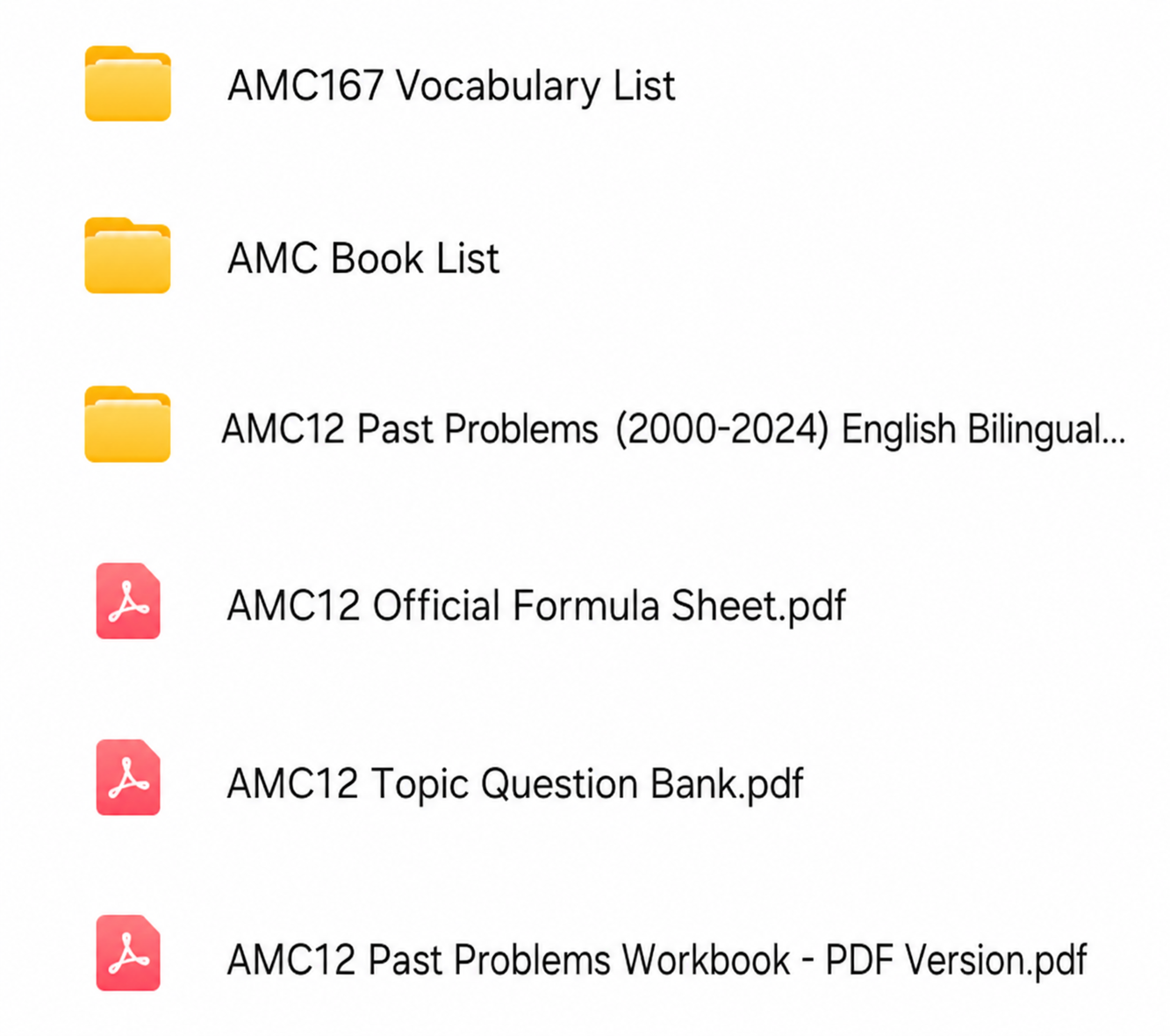
Past Papers Past 10 Years of AMC12 A/B Papers (Must-do), AIME Past Papers (Advanced)
Textbooks AoPS Volume 2, Intermediate Counting & Probability, Plane Geometry in Mathematical Competitions
Tools AoPS Official Website (Free Problem Bank), Desmos (Dynamic Geometry Verification), Anki (Mistake Memorization Cards)

Four Major Problem-Solving Techniques

Special Value Method: Substitute x=0, 1, -1 or extreme values (e.g., infinity) to quickly verify options.

Elimination Method: Use dimensionality, range, or parity to eliminate unreasonable options (e.g., length cannot be negative).

Reverse Thinking: Work backwards from the answer choices, especially useful for "existence" problems.

Time Allocation:

Questions 1–10: ≤20 minutes (aim for perfect score)

Questions 11–20: ≤35 minutes (minimize mistakes)

Questions 21–25: ≤20 minutes (aim to solve 2)

Common Pitfalls to Avoid

Mistake Correct Approach
Blindly practicing without reflection For each wrong answer, label: knowledge gap / logical flaw / misreading of the problem
Ignoring basic problems Questions 1–15 are the foundation for a high score; aim for zero mistakes
Guessing answers randomly Remember: Leave blank = 1.5 points, wrong answer = 0 points! Leave it blank if unsure.
Poor time management Set timers: 20′ / 55′ / 75′, move on immediately when the alarm goes off.

AMC12 Tutoring Courses

Our instructors are graduates of top global universities. With precise curriculum planning and comprehensive learning tracking, we guide you all the way to score improvement and awards!

推荐

Online Customer Service
Contact Customer Service