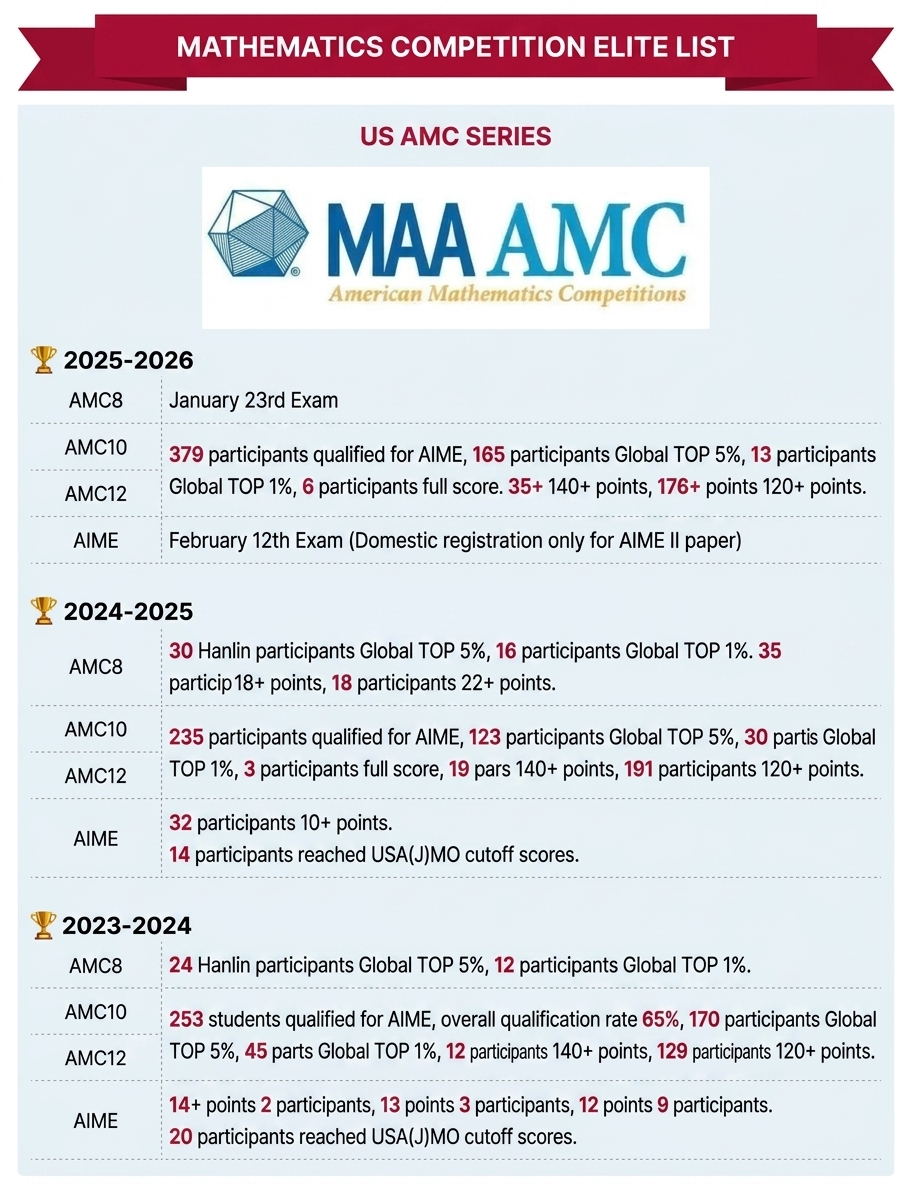

AMC12 is an international math competition organized by the Mathematical Association of America (MAA), open to students in grade 12 and below.
Its difficulty is roughly equivalent to the mathematics level of Chinese Grades 11-12, and it matches the difficulty of the preliminary round of the Chinese High School Mathematics League. This article will provide a detailed analysis of the AMC12's knowledge point distribution, question difficulty levels, differences from Chinese math, and preparation suggestions for students with different foundations.
I. Distribution of AMC12 Knowledge Points
1. Algebra Module (35%-40%)
This module has the highest proportion. In addition to foundational content like polynomials, functions, and sequences, it focuses more on advanced extensions. Special attention should be given to new topics: complex numbers, trigonometric identities and transformations, and advanced inequalities.
2. Geometry Module (25%-30%)
It builds on plane and solid geometry, increasing complexity. Key content includes: triangles, circles, polygons, and spatial geometry.
3. Number Theory Module (15%-20%)
This is a key module for differentiating scores, with high logical demands and subtle problem settings. Covers theoretical tools like Euler's theorem, advanced applications of the remainder theorem, advanced methods for solving indefinite equations, and properties of number-theoretic functions.
4. Combinatorics Module (15%-20%)
Another key differentiating module, often featuring innovative problems based on real-world scenarios. Covers advanced topics such as generating functions, advanced inclusion-exclusion principle, conditional probability, and expected value calculations.

II. Difficulty Distribution of AMC12 Questions
1. Basic Questions (1-10): Lower difficulty, primarily testing basic concepts and calculation abilities.
Goal: Most students can easily score points; focus on ensuring accuracy and speed.
2. Intermediate Questions (11-15): Difficulty increases slightly, but overall requirements are moderate, with a high scoring rate.
Goal: Master conventional problem-solving ideas and techniques, maintain a steady mindset, and avoid unnecessary point loss.
3. Difficult Questions (16-20): Difficulty increases significantly, often involving the integrated application of multiple knowledge points.
Goal: Students aiming for Top 5% or Top 1% awards must focus on these questions and ensure accuracy.
4. Challenge Questions (21-25): The most difficult part of the test, requiring extremely high levels of integrated knowledge application, logical reasoning, and creative thinking.
Goal: Suitable for students aiming for the Top 1% to fully tackle; other students should prioritize securing points on front questions.
III. Differences Between AMC12 and Chinese Math
1. Broader Knowledge Coverage: The Chinese Gaokao mathematics syllabus has a clear scope, while the AMC12 is "full coverage."
Example: Complex numbers might be a simple multiple-choice question in Gaokao, but in the AMC12, they can combine with trigonometry and geometric transformations into a challenging final problem.
2. More Flexible Problem-Solving Logic: Chinese math problems often have fixed problem-solving templates. AMC12 problems, however, embed hidden conditions, requiring techniques like the elimination method, special value method, and symmetry analysis to solve quickly.
3. Top Summer School Selection Standard: International high school students looking to apply for top summer programs like the Ross Mathematics Program (ROSS) or Stanford University Mathematics Camp (SUMaC) find that AMC12/AIME scores are a core selection criteria. High scores can even exempt students from preliminary screenings.
4. Advantages for Mainstream Chinese High School Students: Preparing for the AMC12 not only solidifies and improves math abilities but also expands mathematical thinking, building a solid foundation for future academic development.
IV. How to Prepare for the AMC12 with Different Foundations?
Weaker Foundation (AMC10 Score < 90): Extend the foundational phase (6 months). First, review all AMC10 content. Then, learn the new AMC12 topics (complex numbers, trigonometry, logarithms).
Average Foundation (AMC10 Score 90–110): Follow a standard 12-month plan, with emphasis on strengthening questions 11-20 to improve problem-solving speed and accuracy.
Strong Foundation (AMC10 Score ≥ 110): Shorten the foundational phase (2 months). Advance to past paper and challenge question training early. Aim for the Top 1% and fully tackle questions 21-25.
AMC12 Tutoring Courses
Our instructors are graduates of top global universities. Through precise curriculum planning and comprehensive learning monitoring, we guide you all the way to score improvement and awards!
Scan to learn about AMC10/12 competition courses!
Free self-developed intensive teaching materials available