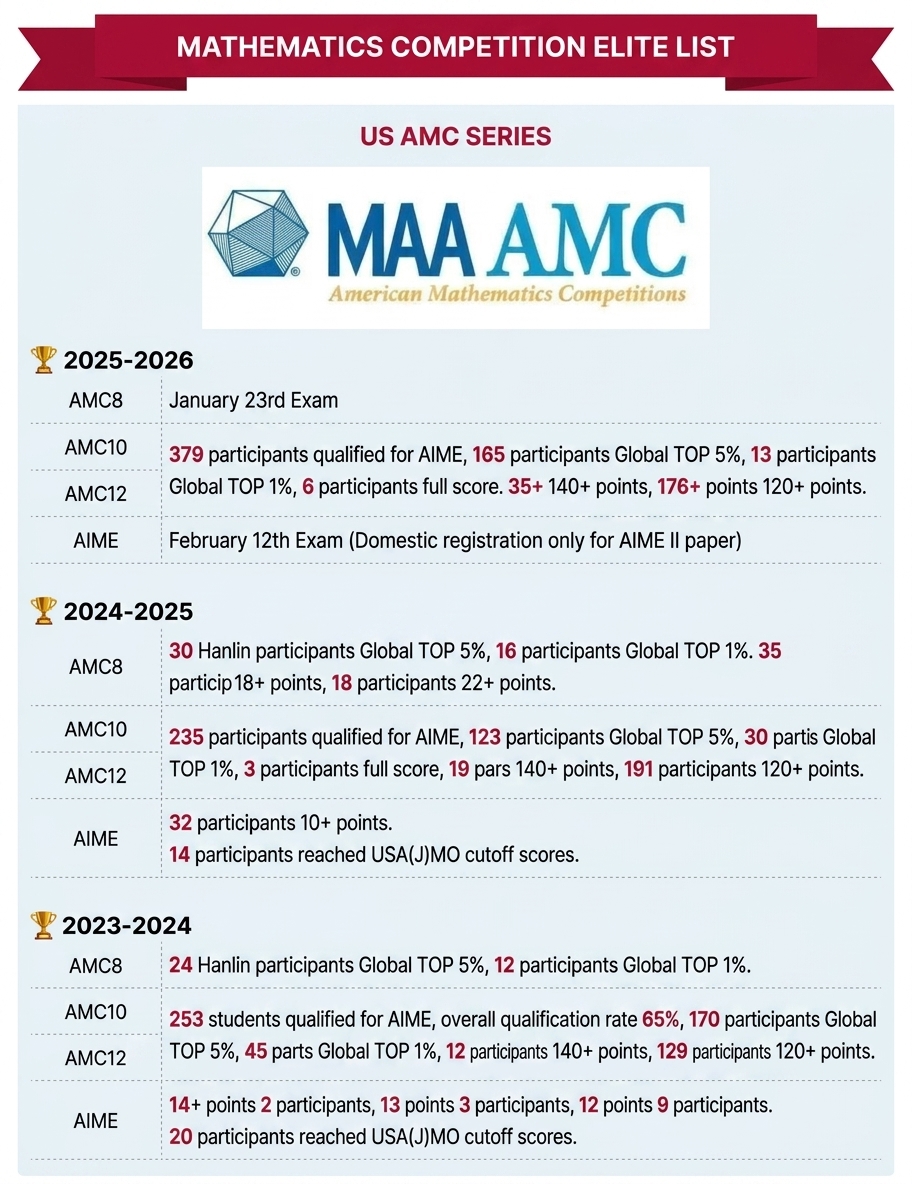

Short-Term, Targeted Breakthrough! AMC10/12 Four-Module Custom Course Helps You Sprint to a High Score

For students preparing for the AMC10/12, tight schedules and heavy workloads are common challenges. With a vast body of knowledge and varied individual weaknesses, the traditional "one-size-fits-all" review often yields half the result with twice the effort. To address this, we have precisely launched the AMC10/12 Math Competition Module Short-Term Course. Based on the four core modules, we tailor a customized short-term breakthrough plan for you, hitting the target directly and improving scores efficiently.

推荐

I. Core of the Course: Four Modules, Precise Guidance

The AMC10/12 competition content can be clearly categorized into four major knowledge areas: Algebra, Geometry, Number Theory, and Combinatorics. This course adopts a unique modular teaching system, scientifically deconstructing the vast competition knowledge. Based on your own diagnostic assessment, you can freely choose one or more weak modules for targeted reinforcement, achieving "precision strikes and targeted elimination," closing the most important gaps in the least amount of time.

Four Course Highlights, Forging an Efficient Score-Improving Experience

1. Scientific Grading and Modular Teaching System

We avoid vague generalizations, deeply subdividing each core module by difficulty and constructing a progressive learning path from basic to advanced levels. A precise ability assessment is conducted upon enrollment, matching you with a dedicated learning process to ensure every step is solid and powerful.

2. Targeted Breakthrough of High-Frequency Test Points and Difficult Points

The teaching team deeply analyzes recent past papers, extracting classic question types and problem-solving difficulties that are mandatory, frequently tested, and error-prone in each module. The course content is highly focused, concentrating efforts on conquering these "high-loss areas," imparting core ideas and techniques to achieve an essential improvement in problem-solving ability.

3. High-Intensity, Immersive Training Mode

The short-term course adopts a "detailed explanation + intensive practice" training mode, creating a highly immersive learning environment. Through dense past-paper exercises, timed tests, and thinking reinforcement, it quickly improves your problem-solving proficiency, on-the-spot reaction speed, and computational stability, reshaping your competition rhythm.

4. Refined Learning Support and Personalized Service

We provide comprehensive learning support beyond the classroom. Dedicated teaching assistants track learning progress and answer questions in real-time. We also provide modular exercise sets, personal error notebooks, and phased evaluation feedback, flexibly adjusting training focus based on your dynamic learning profile to ensure personalized needs are constantly addressed.

推荐

II. Who Is This Course For?

Those with Obvious Weaknesses: Students preparing for the AMC10/12 but with significant weak areas in specific knowledge domains (e.g., Geometry or Combinatorics), in urgent need of remediation.

Those Needing Targeted Reinforcement: Students wishing to focus their energy on reinforcing a core module within a certain time frame, seeking deep breakthroughs and skill elevation.

Short-Term Sprinters: Students with limited preparation time who need high-intensity, focused training before the competition to break through bottlenecks and quickly enhance problem-solving abilities and confidence.

III. Course Schedule

Scan to trial the course! Learn more details!
推荐

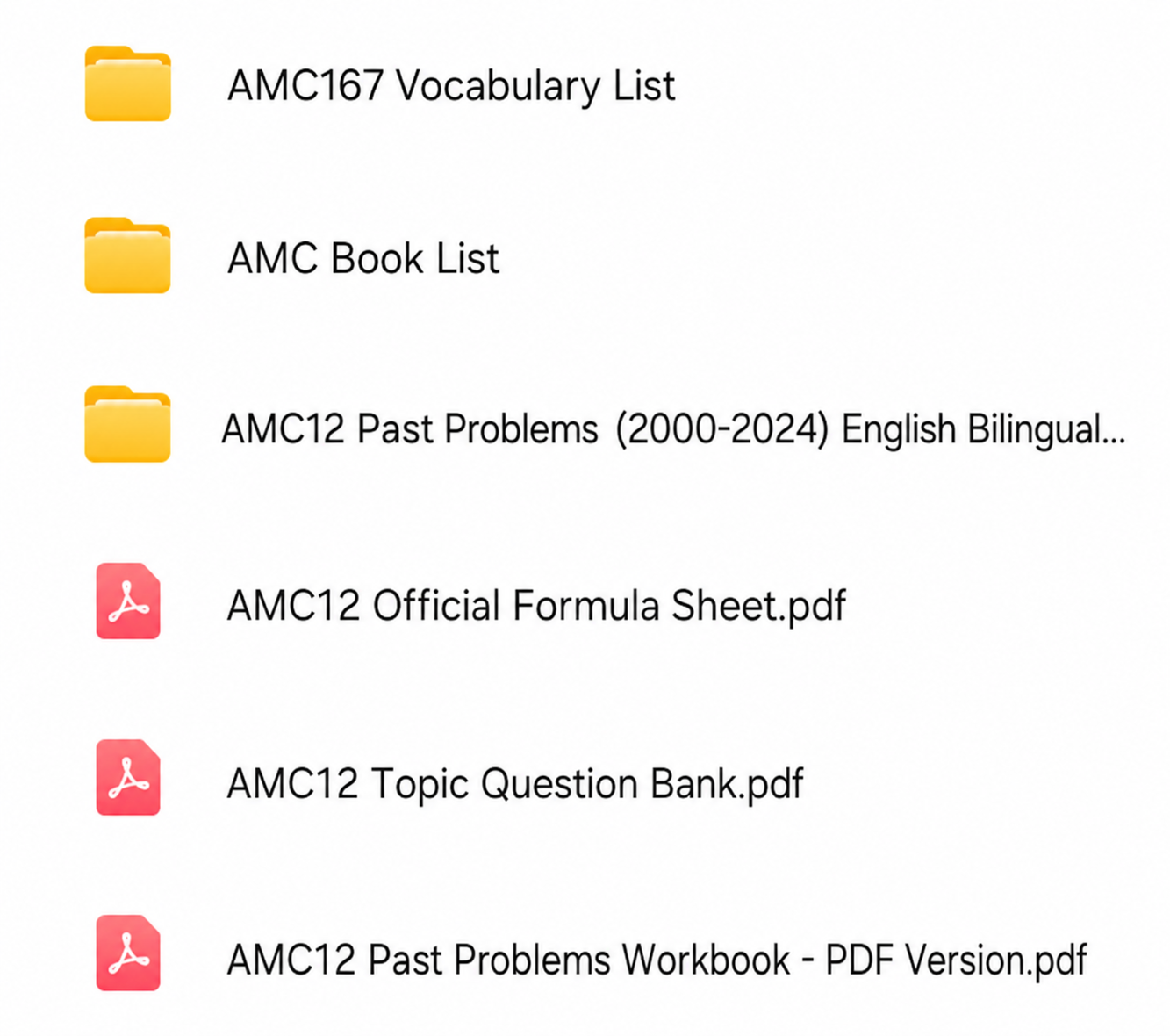
What Makes AMC12 Past Papers Difficult? How Should Students from Different Curricula Prepare Targeted Strategies?

On the ladder of international mathematics competitions, the AMC12 is a key stepping stone to the American Invitational Mathematics Examination (AIME) and even the USA Mathematical Olympiad (USAMO). Compared to the AMC10, the AMC12 not only adds higher-level content such as complex numbers, trigonometric identities, logarithms, and complex plane geometry in terms of knowledge coverage, but also imposes almost "stringent" requirements on the depth of thinking.

For students from different curriculum systems, the pain points when facing the AMC12 are different. To successfully break through in the 2026 season, one must first identify the "difficulty" of the past papers and then find one's own "path".

I. In-Depth Analysis: What Makes AMC12 Past Papers Truly Difficult?

1. "Full Coverage" and "Higher-Level" of Knowledge Points

The syllabus for the AMC12 includes all high school mathematics except calculus.

Difficulties: Past papers frequently feature complex numbers and their geometric interpretations, triple-angle formulas, change-of-base formulas for logarithms, and complex polar coordinate systems. For many students who have not yet completed Precalculus, the knowledge gap is the first hurdle.

2. "Dimensionality Reduction Strike" of Number Theory and Combinatorics

This remains the most challenging part of the AMC series for students, but in the AMC12, its examination leans more towards structure.

Difficulties: Problems are no longer just simple counting but incorporate recursive sequences, the binomial theorem, simplified versions of the Chinese Remainder Theorem, etc. Students need strong mathematical intuition to quickly abstract rigorous mathematical models from chaotic numerical relationships.

3. "Multi-Step Leaps" in Logical Paths

The mid-to-late questions of the AMC12 (Questions 16-25) are often comprehensive.

Difficulties: One problem may simultaneously test trigonometric functions and complex numbers, or combine probability and statistics with recursive sequences. It requires students to have a global perspective and seamlessly switch between different mathematical tools within a single problem.

推荐

II. Targeted Solutions: Preparation Strategies for Students from Different Curriculum Systems

Due to differences in curricula and focus, students from different backgrounds need different "reinforcement plans" when facing the AMC12.

1. AP System Students: Reinforce "Number Theory" and "Geometric Proofs"

Current Situation: Students in the AP system (such as AP Precalc) have strong computational abilities and are very familiar with functions and logarithms, but number theory and classical geometry are notable weaknesses.

Preparation Suggestions: Specialized Training: Focus on conquering the number theory module (congruences, prime factorization) and combinatorial counting (stars and bars, inclusion-exclusion principle) during the summer.[reference:10] Deep Expansion: Enhance the application level of geometric theorems, not just being satisfied with calculating areas.[reference:11]

2. A-Level System Students: Adapt to "Logical Flexibility" and "No-Calculator Mode"

Current Situation: A-Level students have a solid grasp of fundamentals, but react relatively slowly when facing "non-standard" question types and rely heavily on calculators.[reference:12]

Preparation Suggestions: Mindset Shift: Practice arithmetic with large numbers and estimation without a calculator.[reference:13] Question-Type Accumulation: A-Level questions are often guided, while AMC12 questions are more jumpy. Students need to practice with Questions 16-20, learning how to autonomously find solution paths without step-by-step guidance.[reference:14]

3. IB System Students: Strengthen "Knowledge Depth" and "Speed"

Current Situation: The IB curriculum, especially Math AA HL, covers a wide and deep range of knowledge that aligns well with the AMC12. However, due to IB's emphasis on essay writing and in-depth thinking, students often disadvantage themselves when it comes to rapid problem-solving.[reference:15]

Preparation Suggestions: Timed Practice: IB students need to engage in extensive 75-minute mock exams to develop quick judgment under pressure.[reference:16] Internalize Formulas: Turn various formulas learned in IB (such as Euler's formula, the geometric meaning of complex number multiplication) into muscle memory.[reference:17]

4. Students from Mainland Chinese System: Overcome "Competition Language" and "Syllabus Discrepancies"

Current Situation: Very strong mathematical foundation and unrivalled calculation ability, but unfamiliar with English problem statements and some less common test points (e.g., physics-context problems).[reference:18]

Preparation Suggestions: Context Adaptation: Accumulate mathematical academic vocabulary and adapt to AMC problem-solving logic by reading original English textbooks (such as Art of Problem Solving).[reference:19] Checkpoint Alignment: Supplement knowledge points like the complex plane and spherical geometry which are less emphasized in the domestic curriculum.[reference:20]

III. AMC12 Study Plan for the 2026 Season

Phase 1 (Summer): Knowledge Mapping and Review

Regardless of your curriculum, take 1-2 months to thoroughly understand complex numbers, number theory, advanced trigonometry, and permutations and combinations according to the AMC12 syllabus.[reference:21]

Phase 2 (September–October): Thematic Breakthrough

Categorize past paper questions by topic and practice over 20 problems per model until you develop a "reflex arc" upon seeing the problem context.[reference:22]

Phase 3 (Before November): Full Simulation

Strictly train under a 75-minute time limit. Focus on honing the "answering game"—zero mistakes on the first 15 questions, steadily secure questions 16–20, and appropriately abandon questions 21–25.[reference:23]

推荐

Online Customer Service
Contact Customer Service