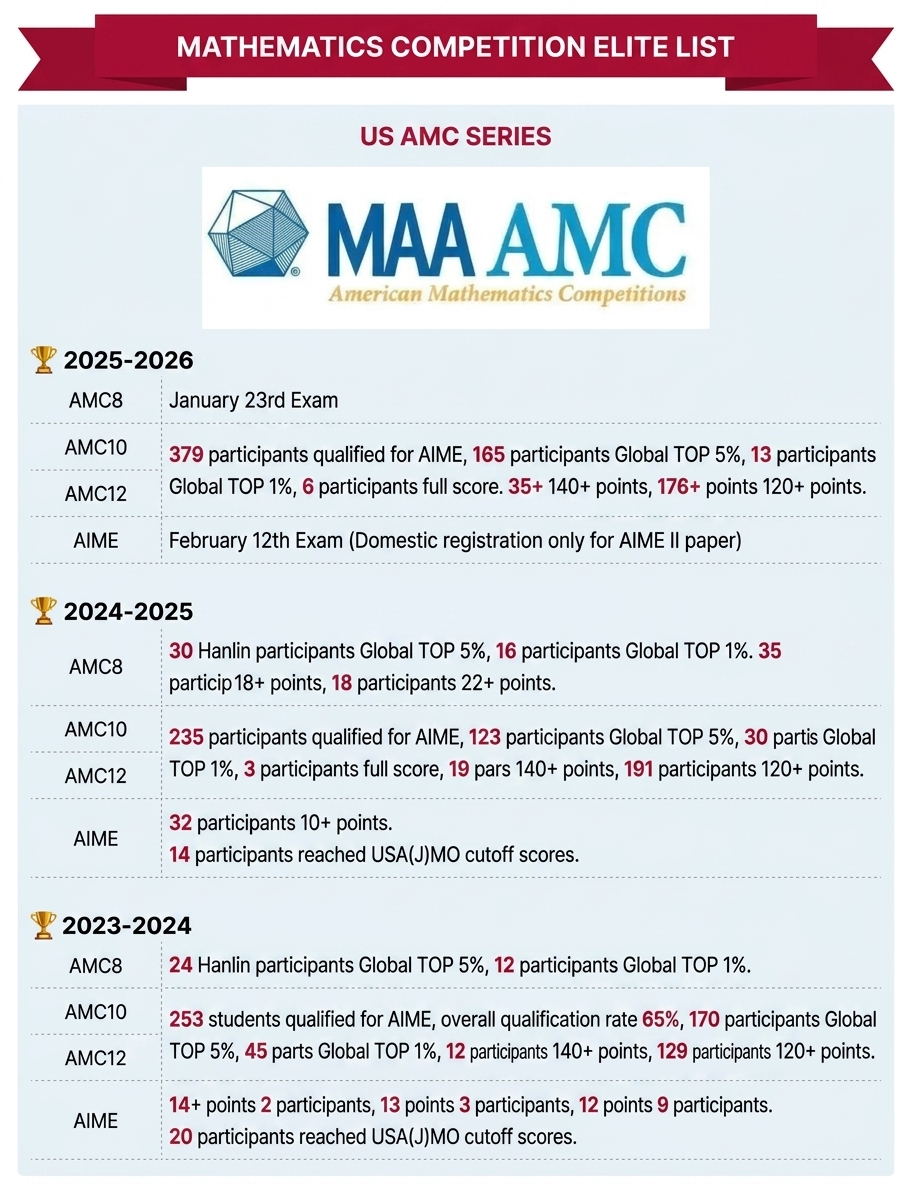

The 2025 AMC12 competition has concluded, with its two versions—Exam A and Exam B—showing characteristics of "stability with variation, innovation and escalation" in question type distribution, module focus, and problem-design style. Overall, Exam B was slightly more difficult than Exam A, placing higher demands on students' breadth of knowledge, mental flexibility, and cross-module integration skills. This article combines the latest exam analysis to provide precise preparation advice for students in different grades.
I. 2025 AMC12 Exam A vs Exam B: Exam Comparison
| Dimension | Exam A | Exam B |
|---|---|---|
| Overall Difficulty | Medium-low, friendly structure | Medium-high, high thinking intensity |
| Algebra Proportion | 44% (core), intuitive problems, focuses on basic operations | Focuses on functions, polynomials, sequences, emphasizes abstract transformation and symbolic manipulation |
| Number Theory Assessment | Almost no standalone questions, significantly weakened | Introduces new concepts (e.g., "sum-free sets"), emphasizes logical reasoning and just-in-time learning ability |
| Combinatorics Module | Increased proportion (due to reduced number theory), medium difficulty | Integration of probability and geometry, requires multi-step modeling, high-intensity case analysis |
| Geometry Module | Stable number of questions, moderate difficulty | Notably difficult: includes solid/analytic geometry, problems require complex constructions and heavy computation |
| Problem-Setting Trend | Adjusted module structure, tests breadth of revision | "Emphasis on application, strong innovation", highlights mathematical modeling and visual analysis |
• The "de-emphasis on number theory" in Exam A is a significant signal: you cannot only focus on high-frequency modules, you must cover everything comprehensively.
• Exam B introduced new concepts (such as "balanced numbers" and "sum-free sets"): testing quick comprehension and transferability.
• Geometry becomes a key differentiator: especially the last 5 questions of Exam B, which require both spatial imagination and algebraic computation.

II. How Can Students in Different Grades Prepare Scientifically?
Grade 9 (Middle School 3): Build Foundation + Explore the Path
Current Status: Just finished middle school math, possesses AMC10 foundation, but has not systematically encountered high school topics (trigonometry, complex numbers, logarithms).
Strategy: Focus on experience; do not force qualification, emphasize building confidence.
Action Plan:
Do 3–5 AMC12 past problems daily (prioritize questions 1–15), practicing by algebra/geometry modules;
Use six months (November 2025 – May 2026) to preview core high school content: functions, trigonometric identities, basic sequences;
You may also take AMC10 in parallel to double‑check your ability.
Advantage: Ample time, low trial‑and‑error cost, paving the way for aiming at AIME in 10th grade.
Grades 10–11 (High School 1–2): Golden Sprint Period
Current Status: Have completed most high school math content, knowledge system is complete, no immediate university application pressure.
Strategy: Fill the gaps in competition topics (combinatorics, number theory, advanced geometry); transition from "can solve" to "fast, accurate, stable".
Action Plan:
Systematically study AoPS Volume 2 and Intermediate Counting & Probability;
Complete 2 timed mock exams per week (alternating between Exam A and Exam B), focusing on problems 16–25;
Build a "mistake – knowledge point – solution model" triple‑entry file to fill gaps in a targeted way.
Goals:
Grade 10: AMC12 ≥ 95 points (secure AIME qualification);
Grade 11: AMC12 ≥ 125 points (aim for Honorable Mention / Distinction).
Key Reminder: This stage is critical for shaping your application profile; AMC12 scores directly affect eligibility for summer programs and research projects.
Grade 12 (High School 3): Final Sprint + Consolidate Achievements
Current Status: Facing university applications, time is fragmented, but knowledge is most complete.
Strategy: Focus on efficiency. Abandon overly tricky or uncommon problems, focus on high‑frequency core topics and classic problem types.
Action Plan:
Daily timed practice with one set of past problems from the last 3 years (strictly 75 minutes);
Consolidate answering rhythm: first 20 questions ≤ 55 minutes, aim to solve 2 of the last 5 questions;
Strengthen the "skip strategy": if uncertain, it is better not to answer (get 1.5 points).
Goal: Ensure AIME qualification or an Honorable Mention award, as a strong supplement to your application materials.
Note: This is your last opportunity to take the exam. Plan your time carefully to avoid conflicts with standardized tests.
AMC12 Preparation Courses
Our instructors are all graduates of top global universities. With precise curriculum planning and full‑course learning tracking, we support you all the way to improving scores and winning awards! Scan the QR code to learn about AMC10/12 competition courses. You can also receive a free, carefully prepared lecture handout. Online customer service. WeChat consultation.