
AMC12 is an international mathematics competition for high school students, designed to identify students with exceptional mathematical talent. This article provides a detailed overview of the AMC12 exam schedule, an analysis of historical score trends, and a scientific preparation plan to help you efficiently aim for an award.

I. AMC12 Exam Schedule
1. Exam Language
Bilingual (Chinese/English): Suitable for students from different language backgrounds.
2. Exam Dates
Versions A/B: Mid to late November 2026 (specific dates to be announced by the official organization).
Difference between Version A and Version B: Same difficulty and scope, but different exam dates and test papers. Candidates may choose to take either Version A or B, or take both; the highest score will be used for award ranking and AIME qualification.
3. Exam Location
In-person: Specific test centers will be determined by local organizers.
4. Eligibility
Grade Requirement: Students in grade 12 (senior year of high school) or below.
Age Restriction: Under 19.5 years of age (age calculated up to the day of the competition).
5. Exam Format
Individual Test: 25 multiple-choice questions.
Scoring: 6 points for each correct answer, 1.5 points for each unanswered question, no deduction for wrong answers. Total possible score: 150 points.
II. Historical AMC12 Score Analysis
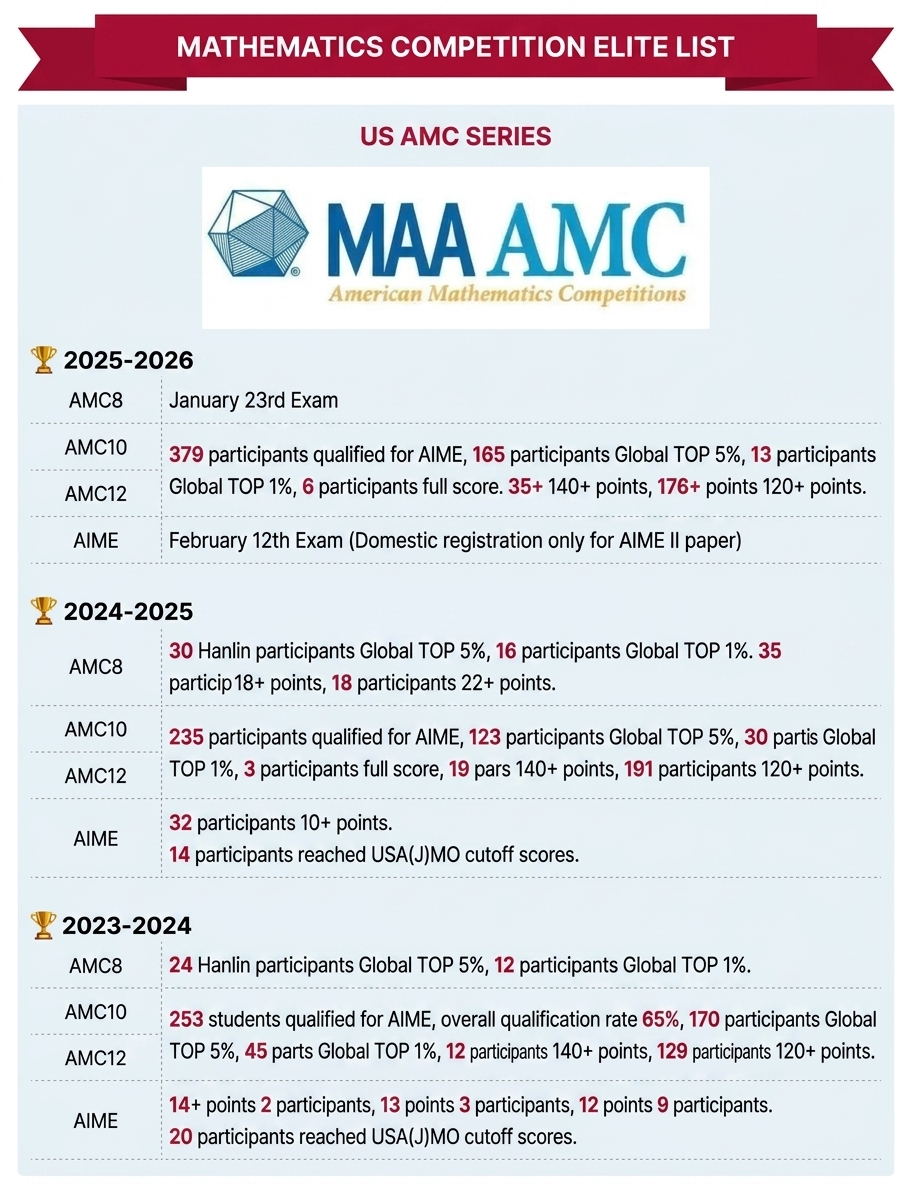
1. AIME Qualification Cutoff (Top 5%)
| Year | Version A Cutoff | Version B Cutoff |
|---|---|---|
| 2025 | 96 | 100.5 |
| 2024 | 76.5 | 88.5 |
| 2023 | 85.5 | 88.5 |
| 2022 | 85.5 | 85.5 |
2. Award Score Thresholds
| Award | Score Requirement (2025 Reference) |
|---|---|
| AIME Qualification | ≥96 (Version A) / ≥100.5 (Version B) |
| Honorable Roll (Top 5%) | ≥125 |
| Distinguished Honor Roll (Top 1%) | ≥135 (Version A required a perfect 150 in 2025) |
• Aim for AIME: ≥95 (Version A) / ≥100 (Version B)
• Aim for Top 5%: ≥125
• Aim for Top 1%: ≥135 (Perfect 150 needed for Version A in 2025)
III. AMC12 Award Preparation Plan
Phase 1: Foundation Building (Now – June)
Goal: Systematically review high school math concepts and fill gaps in competition extension topics (complex numbers, number theory, combinatorics, etc.).
Action Plan:
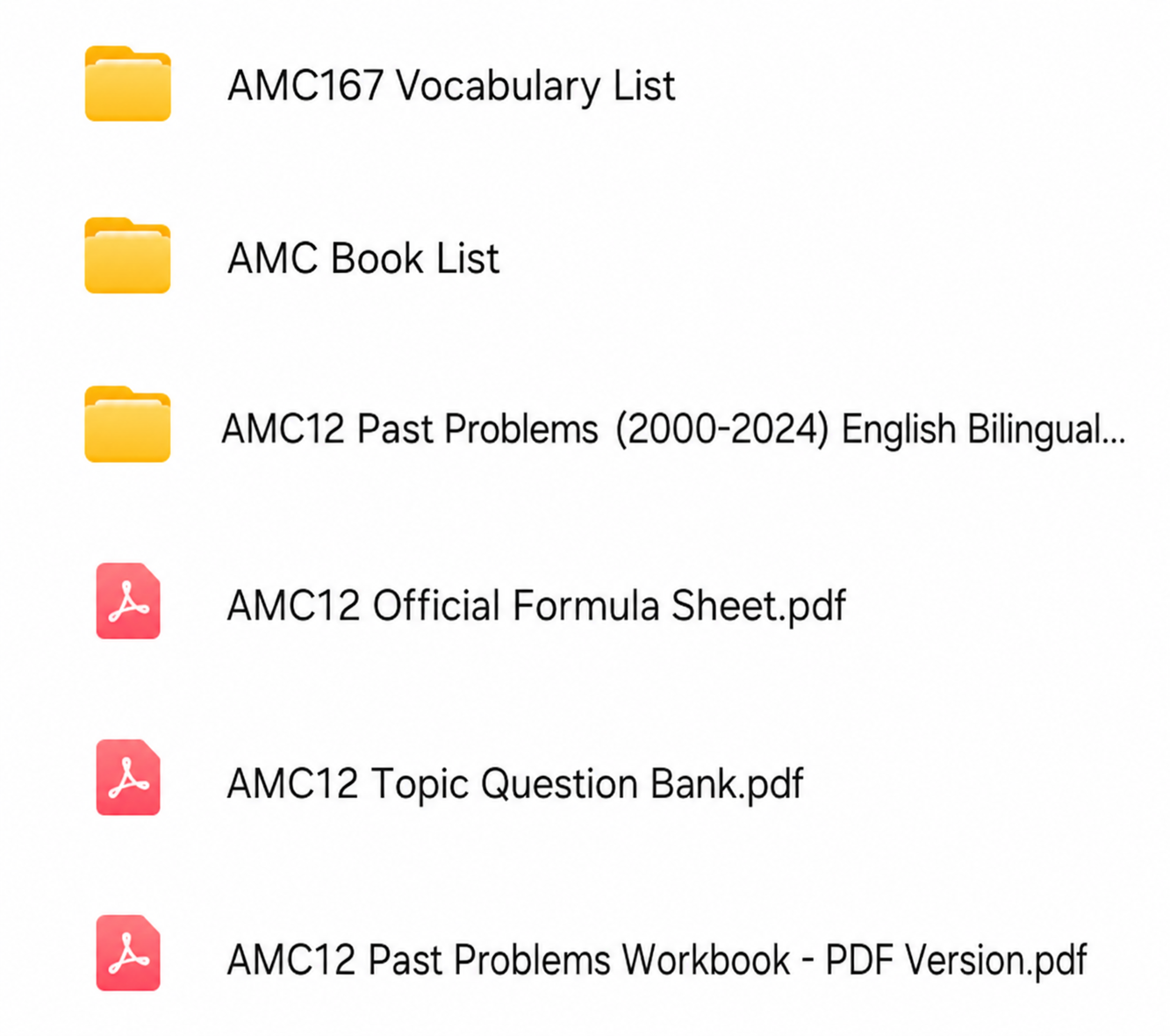
Recommended Textbooks: Art of Problem Solving Volume 2, Intermediate Counting & Probability
Practice: Targeted basic problem drills, 2–3 basic sets per week, review mistakes.
Time Allocation: 2 hours per day, modular focus on Algebra/Geometry/Number Theory/Combinatorics.
Phase 2: Topic Reinforcement (July – September)
Goal: Solve past 10 years of real exams, summarize high-frequency question types and problem-solving patterns, improve speed and pressure resistance.
Action Plan:
Practice Strategy: Solve past 10 years of real exams, summarize high-frequency types and patterns (e.g., combining numbers with shapes, construction methods, congruence simplification).
Focused Breakthrough: Algebraic inequalities, circle powers in geometry, congruence in number theory, combinatorics counting.
Timed Training: 1 full real exam per week (75 minutes), improve speed and pressure resistance.
Time Allocation: 3 hours per day, combining topic review and timed mock exams.
Practical Tips: Simulate exam conditions, strictly enforce timing, develop a sense of test-taking rhythm; conduct detailed review after each mock exam to identify weak areas.
Phase 3: Final Sprint (October – Before Exam)
Goal: Intensively review real exams from 2015–2025, focus on questions 21–25, break down problem-solving steps to secure every point.
Action Plan:
Intensive Review: Re-solve real exams from 2015–2025, focus on questions 21–25, break down steps.
Full-Length Mock Exams: 2–3 full mock exams per week, strictly timed, practice time allocation.
Triple Review of Mistakes: Categorize errors (calculation/conceptual/trap-based) to avoid repeated point loss.
Time Allocation: 4–5 hours per day, combining mock exams, mistake review, and final tough problems.
Sprint Strategy: Ensure all of the first 20 questions are correct to save time for the later ones.