
AMC10/12 (American Mathematics Competitions) has long transcended the realm of "just another exam" to become one of the world's most influential mathematics assessment systems for secondary school students. It serves not only as a litmus test of mathematical proficiency but also as a strategic tool for applying to top global universities and planning a STEM academic path. The following provides a comprehensive analysis from four dimensions: skill enhancement, college admissions value, target audience, and efficient preparation strategies.

I. Three Core Values of Taking AMC10/12
1. Systematically Enhance Mathematical Literacy
AMC does not test obscure or overly tricky questions; rather, it deeply assesses the ability to comprehensively apply knowledge learned in the classroom:
Algebra: Functions, equations, inequalities, sequences
Geometry: Triangles, circles, coordinate systems, spatial visualization
Number Theory: Congruences, divisibility, modular arithmetic
Combinatorics: Counting principles, probability, logical reasoning
Through preparation, students connect isolated knowledge points into a cohesive network, truly understanding "why" rather than just "how."
2. Cultivate Advanced Thinking and Innovation Skills
Problem design emphasizes the integration of multiple knowledge points, open-ended solutions, and unconventional approaches. For example: solving algebra problems using geometric methods, or optimizing computational paths through combinatorial thinking. This training directly enhances:
Logical rigor
Problem decomposition skills
Creative modeling thinking
These skills are applicable not only to mathematics but also transfer to all quantitative fields such as physics, computer science, and economics.
3. Highly Recognized by Top Global Universities
Prominent institutions including MIT, Stanford, Caltech, Oxford, and Cambridge explicitly consider AMC scores in their admissions processes:
MIT's official website lists AMC as the top "recommended competition."
Admissions officers view AIME qualification as a key signal of "readiness for college-level STEM coursework."
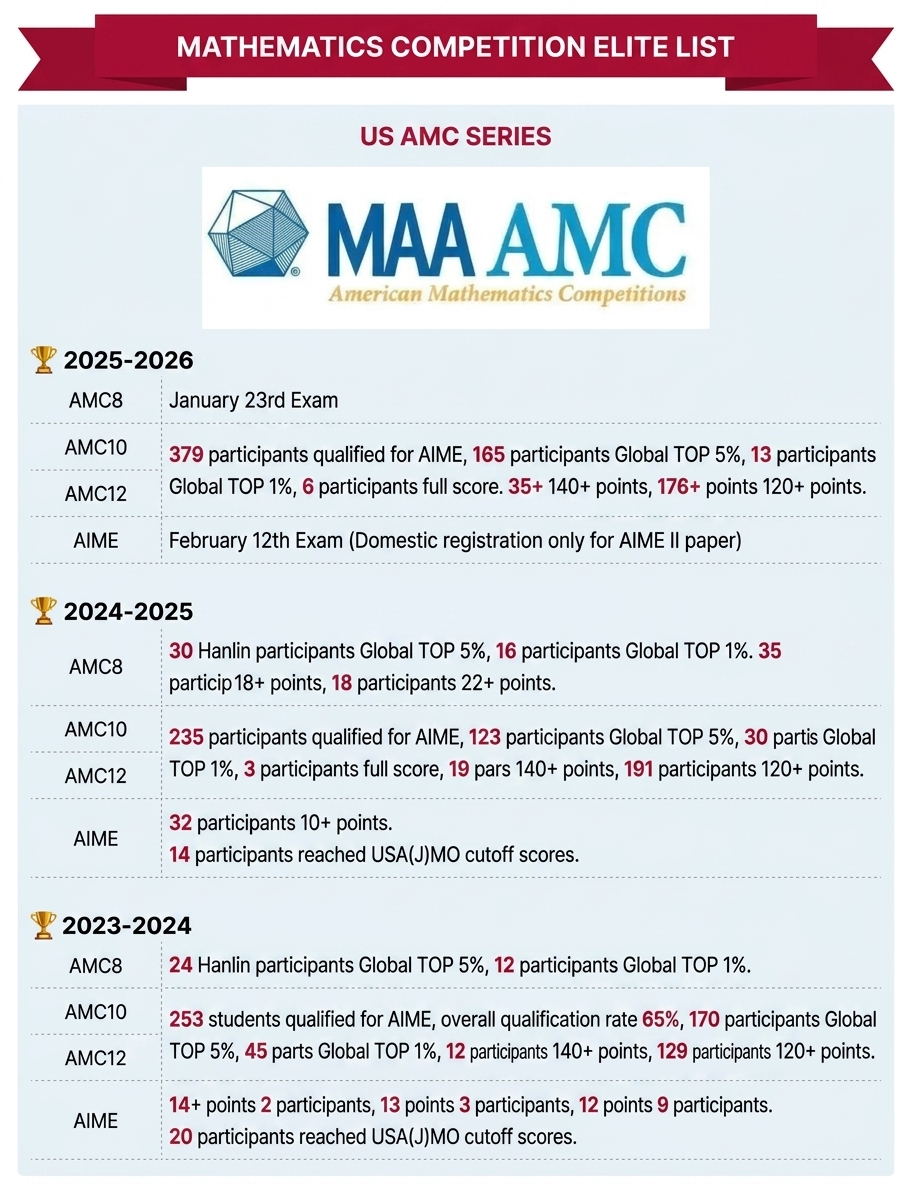
In an era where standardized test scores are increasingly high, AMC top 5% or top 1% awards have become the "hard currency" distinguishing "excellent" from "outstanding."
II. Which Students Should Start Preparing Early? (Recommended 6–12 Months Minimum)
| Student Profile | Preparation Timeline | Reason |
|---|---|---|
| Strong in-school math but no competition experience | 6–12 months in advance | Need to shift from "problem solving" to "problem deconstruction" and develop competition mindset |
| Knowledge gaps (e.g., combinatorics/number theory not yet studied) | 9–12 months in advance | Closing gaps and training take time; avoid last‑minute cramming |
| Aiming for AIME qualification | 8–10 months in advance | Need ≈17 correct for AMC10, ≈18 for AMC12; requires targeted breakthrough on challenging final questions |
| Fragmented preparation time | Extend timeline, steady progress | Consistent daily accumulation (30–60 min/day) is better than intensive cramming |
| Planning to apply to Ivy League / Top 30 STEM programs | Start as early as 8th or 9th grade | Build a progressive track: AMC10 → AMC12 → AIME → Research |
III. Three-Phase Efficient Preparation Strategy (Adaptable to Different Foundations)
Phase 1: Build Knowledge System + Basic Problem‑Type Training (3–6 months)
Goal: Cover the four modules (Algebra, Geometry, Number Theory, Combinatorics) and master the logical approach to problems 1–20.
Action:
Systematically study using the Art of Problem Solving textbook series.
Daily practice: 10–15 basic real exam questions (problems 1–15).
Maintain an error log, flagging specific knowledge gaps.
Phase 2: Real Exam Simulation + Mindset Upgrade (2–3 months)
Goal: Adapt to the exam rhythm, tackle problems 16–20, and recognize traps.
Action:
One full‑length mock exam per week (75 minutes, no electronic devices).
Deeply review mistakes: Categorize as calculation errors, conceptual misunderstandings, or flawed reasoning.
Summarize high‑frequency techniques (e.g., substituting special values, leveraging symmetry, elimination for speed).
Phase 3: Sprint Mocks + Strategy Reinforcement (1 month)
Goal: Achieve stable performance, strategically secure points, and make wise decisions on which problems to attempt.
Action:
2–3 sets of real exams from the past 3 years each week, strictly timed.
Reinforce pacing strategy:
Problems 1–10: ≤15 minutes (aim for all correct).
Problems 11–20: ≤35 minutes (minimize errors).
Problems 21–25: ≤20 minutes (aim for solving 2).
Use the "skip strategy" wisely: For uncertain questions, leaving them blank (1.5 points) is better than answering incorrectly (0 points).