
As one of the most influential high school mathematics competitions in the world, the AMC12's question design not only covers all the core knowledge of high school mathematics but also focuses on testing students' logical reasoning and flexible adaptability under time constraints. To stand out in this 75-minute intellectual contest, a clear understanding of its question structure, test point distribution, and problem-solving strategies is essential.

I. AMC12 Question Structure and Core Test Points
The AMC12 consists of 25 multiple-choice questions, with a 75-minute time limit and a total score of 150 points. This means that the average time for thinking and answering each question is only 3 minutes, placing extremely high demands on problem-solving speed. Its assessment scope covers four core sections of high school mathematics, with significant in-depth expansion based on the AMC10:
Advanced Algebra: Includes not only complex inequalities (e.g., harmonic inequality, cyclic inequality, Cauchy inequality) but also in-depth examination of complex functions (inverse functions, composite functions), the sum-to-product and product-to-sum identities of trigonometric functions, complex numbers and the complex plane (Euler's formula), as well as mathematical induction and sequence limits.
Advanced Geometry: Moves from circle-related geometry to the combination of numbers and shapes, involving the functional representation and advanced analytic geometry of 2D and 3D figures, while also requiring mastery of irregular figure processing methods and the application of 2D and 3D vectors.
Advanced Number Theory: This is a blind spot for many students, with a focus on quadratic residues, higher-order residues, Fermat's Little Theorem, and solutions to various types of Diophantine equations.
Advanced Combinatorics: Involves the calculation of random processes and expectations, as well as problem-solving techniques for various complex combinatorial problems.
II. Differences Between AMC12 Version A and Version B
The AMC12 offers two test-taking opportunities each year: Version A and Version B, which are equally valid and typically scheduled one week apart. Although the official statement declares that their difficulty levels are similar, their emphases in actual question-setting may differ slightly (e.g., Version A may focus more on basic applications, while Version B may emphasize depth of thinking). Consequently, the qualifying cutoffs may fluctuate slightly from year to year. Candidates may choose to take only one version or both, with the higher score ultimately used for awards and advancement.
III. Core Strategies for Improving Problem-Solving Speed on the AMC12
Under the scoring rules of the AMC12 (6 points for a correct answer, 1.5 points for no answer, 0 points for an incorrect answer), maintaining a scientific answering rhythm is far more important than mindlessly practicing numerous problems. It is recommended to follow the three-step strategy below:
Keep Basic Questions Steady, Gain Time: The first 10 questions are typically foundational "giveaway" questions. These must be answered quickly with zero errors. Avoid repeatedly overthinking and checking these questions; save valuable exam time for the medium and final challenging questions.
Use Clever Methods on Medium-Difficulty Questions, Widen the Gap: Questions 11 to 20 are the critical range for making a difference in scores. When solving these, flexibly use shortcuts such as combining numbers and shapes, substituting special values, and eliminating answer choices. Avoid tedious brute-force calculations to reduce mistakes and steadily secure these core points.
Make Wise Trade-offs on Final Challenging Questions, Cut Your Losses Rationally: When facing the high-difficulty final problems (questions 21–25), avoid obsessing and getting stuck. First, identify the core test points of each problem. If you find a line of thought, proceed step by step; if you have no idea at all, skip it in time or choose to leave it blank (securing 1.5 points as a safety net), prioritizing the accuracy of the preceding questions.
IV. Key Focus Areas for AMC12 Preparation
To prepare efficiently, we recommend focusing on the following three dimensions:
Target High-Frequency Modules: Algebra, complex numbers and sequences, geometry, and combinatorics & probability account for the vast majority of points on the test. These core sections must be systematically mastered.
Focus on Error-Prone Question Types: Diligently practice past mistakes and easily confused questions, understand the logic of the trap setting by question designers, and avoid common point deductions.
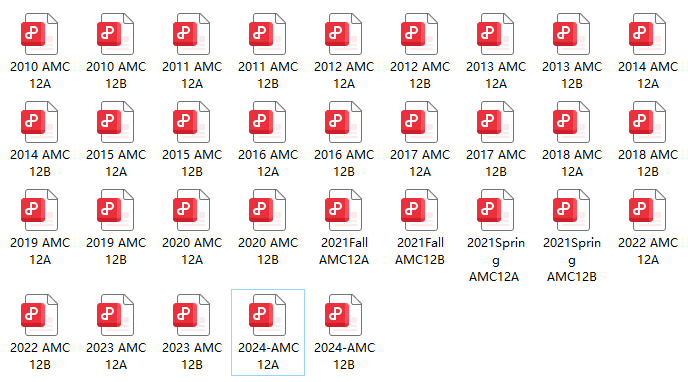
Stay Current with the Latest Exam Trends: The proposition trends of the AMC12 are adjusted slightly every year (e.g., an increase in cross-topic comprehensive questions). Focus on practicing with past papers from the last 5–10 years for preparation; avoid practicing overly esoteric or odd problems, ensuring your training remains closely aligned with the current difficulty level of the exam.