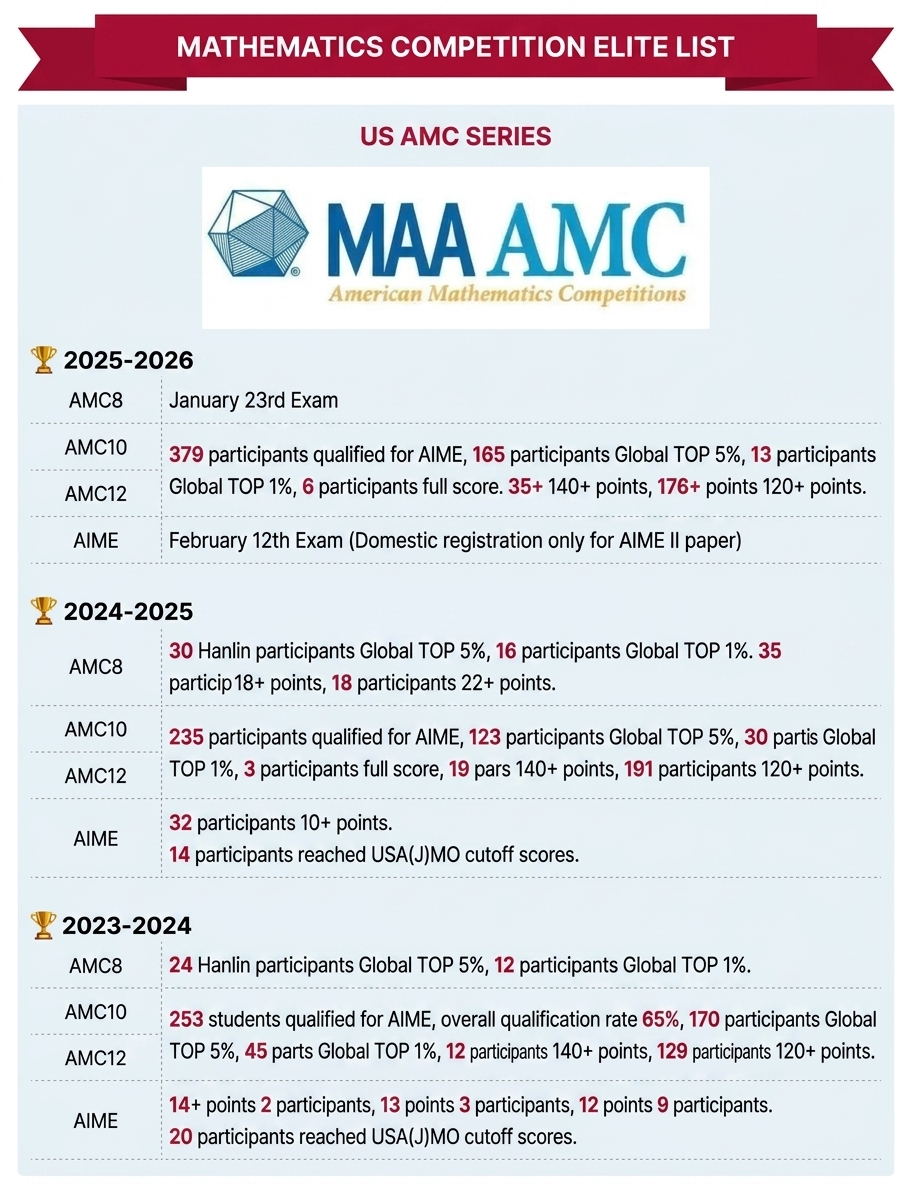

In math competition planning, choosing the right track is half the battle. Although AMC 10 and AMC 12 both belong to the American Mathematics Competitions system, they differ fundamentally in terms of depth of assessment, advancement logic, and weight in college applications.

I. AMC 10 vs AMC 12: Core Differences at a Glance
| Dimension | AMC 10 | AMC 12 |
|---|---|---|
| Grade restriction | Grade 10 and below | Grade 12 and below |
| Scope of topics | Core knowledge from Grade 9 to Grade 10 (no trigonometry/logarithms) | Complete high school mathematics (including trigonometry, complex numbers, logarithms) |
| Way of thinking | Logical reasoning and basic applications | Highly abstract, cross-disciplinary integration of multiple knowledge points |
| Advancement threshold | Extremely competitive (high scores required) | Slightly higher tolerance for mistakes |
| College applications value | "Gateway" demonstrating foundational math ability | "Powerful endorsement" for top STEM universities |
II. How to choose your exam? Three key decision-making logics
Grades 9-10 students: It is recommended to prioritize AMC 10. If you can consistently score above 100 points in mock tests, you may consider challenging AMC 12 at the same time to raise your academic ceiling; otherwise, your primary goal should be to secure an award in AMC 10.
Grades 11-12 students: You can only take AMC 12. At this point, your focus should be directly on qualifying for AIME, which is a necessary asset for applying to top universities.
Grade 8 and below students: If you already have a foundation in middle school competition math, you may try challenging AMC 10. Qualifying for AIME at a lower grade level is a highly compelling academic highlight in your application.
III. 3-stage advanced preparation method (6-12 month cycle)
When starting from zero, do not blindly tackle problems. Instead, follow the process from "building knowledge" to "forming a competitive mindset."
Stage 1: Foundation Building (1-3 months)
Task: Systematically organize the four major modules: Algebra, Geometry, Number Theory, and Combinatorics.
Recommended resources: The "Art of Problem Solving (AoPS)" textbook series, or conduct a thorough review using the AMC topic checklist.
Key points: Ensure no gaps in the middle school math knowledge system, especially similarity and circles in geometry, and congruences/prime factorizations in number theory.
Stage 2: Topic Strengthening (4-6 months)
Task: Practice past exam papers from the last 5-10 years by module, and create a "thinking bottleneck notebook."
Focus: Number theory and combinatorics are the "score separation zones" for most Chinese students and must be targeted for breakthroughs. Learn to control the time spent on a single problem within 3 minutes.
Stage 3: Simulation Sprint (1-2 months before the exam)
Task: Strictly follow a 75-minute timed mock exam.
Strategy drill:
First 15 questions: Keep a steady pace, aiming for 100% accuracy on foundational problems.
Last 10 questions: Adopt a "precise skip" strategy. For problems you get stuck on for more than 2 minutes or are completely unfamiliar with, decisively choose to leave them blank, because "getting 1.5 points for a blank answer" is far more cost-effective than "getting 0 points for a random guess."
IV. Scientific grade-level planning recommendations
Grades 7-8 (Foundation Exploration): Use Pre-AMC 10 as the textbook system, master the essence of middle school mathematics through systematic learning, and cultivate competition intuition.
Grade 9 (Golden Preparation Year): Go all out to qualify for AIME. Securing the AIME ticket at this stage will build strong academic confidence for future applications to top universities.
Grade 10 (Peak Sprint): Aim for Global Top 1% (130-135 points). This is compelling evidence for admission to STEM programs at top universities.