
For new high school freshmen attending top international schools such as BASIS, with aspirations for world-renowned universities, starting AMC12 competition preparation early is not only a key part of academic planning but also a core strategy to pull ahead of peers.

I. Three Core Advantages of Starting AMC12 in Freshman Year
1. A "Hard Currency" for Top University Applications
AMC12 is a globally recognized mathematics competition, and its scores are explicitly included as references in applications to top universities worldwide, including MIT, Yale, Oxford, Cambridge, and the University of Hong Kong. Achieving a high score on AMC12 and advancing to AIME (top 5% globally qualifies for advancement) serves as a core academic credential for students pursuing STEM and business fields, allowing admissions officers to clearly see a student's "potential."
2. Deep Complementarity with International Curricula
Taking IB Mathematics (AA/AI HL) as an example, it emphasizes logic and application, while AMC12's core topics—such as number theory, combinatorics, complex numbers, and others—serve as important supplements to the advanced content of international curricula.
- Solidifying Foundations: AMC12's algebra and geometry training strengthens in-school problem-solving abilities, enabling students to tackle open-ended questions with greater ease.
- Expanding Depth: Competition-style thinking supports academic pursuits such as IB EE (Extended Essay) and enriches academic portfolios.
- Aligning Progress: Freshman year marks the introductory phase of international curricula; preparing for AMC12 in parallel allows for seamless integration of knowledge points, avoiding the time constraints and last-minute rush of sophomore or junior years.
3. Seizing the Golden Period – Early Preparation Brings Early Rewards
Starting AMC12 preparation in freshman year provides ample time to build a knowledge framework and refine problem-solving techniques. If preparation is delayed until sophomore year, students must juggle heavy international coursework while sprinting for competition, making it easy to lose balance. Winning awards in freshman year allows students to focus subsequently on AIME and higher-level competitions, layering their competitiveness for college admissions.
II. Three Core Challenges for International Students Preparing for AMC12
1. Disconnect Between International Curriculum and AMC12 Knowledge Points
- IB System: Emphasizes conceptual understanding, modeling, and application, tending towards real-life scenarios, while downplaying pure technical derivation. Topics that are frequently tested in AMC12—such as number theory, advanced combinatorics, polynomial transformations, complex number geometry, and indeterminate equations—are rarely covered in school.
- A-Level System: Focuses on calculus, trigonometry, and analytic geometry, but lacks number theory, combinatorics, and interesting logic problems. Nearly 30% of AMC12 questions are concentrated in combinatorics and number theory, which are common weaknesses for students in the Cambridge system.
2. Diverse Question Types and Anti-Rote-Learning Designs
In-school exam question types are fixed, and students can score well by memorizing templates and practicing repeatedly. However, AMC12 competition questions have distinct characteristics: they do not explicitly state the tested concepts, requiring quick interpretation of the problem and translation into mathematical models. Additionally, the question-setting style adjusts slightly each year, and a single knowledge point can give rise to dozens of variations, making it easy to fall behind the latest question trends.
3. Different Mindsets and Problem-Solving Strategies
International curricula emphasize step-by-step problem-solving, whereas AMC12 competitions require rapid problem-solving, demanding proficiency in specialized techniques such as substitution of special values and elimination methods. The requirements for problem-solving speed and mental flexibility are extremely high.
III. Systematic AMC12 Preparation Solutions
Targeting the pain points of international students, a scientific preparation plan should include the following key steps:
1. Assessment and Customized Course
Before the course begins, a professional academic assessment is conducted. Based on the student's mathematical foundation and target score, a personalized learning plan is developed, precisely planning the annual preparation rhythm, addressing weak knowledge areas in a targeted manner, and avoiding wasted time on blind practice.
2. In-Class Intensive Lectures on Difficult Points
Taught by competition mentors from top overseas universities, classes break down all AMC12 test points, frequently occurring difficult questions, and problem-solving techniques, while organizing a complete knowledge framework. Instruction is available in pure English or bilingual Chinese-English, perfectly suiting both domestic and international students.
3. Practice, Grading, and Gap-Filling
After class, dedicated practice materials are provided, and homework is graded individually to precisely locate gaps in knowledge. Targeted explanations are given for incorrect answers, ensuring no knowledge blind spots remain and steadily improving accuracy.
4. Real-Exam Simulation and Practical Training
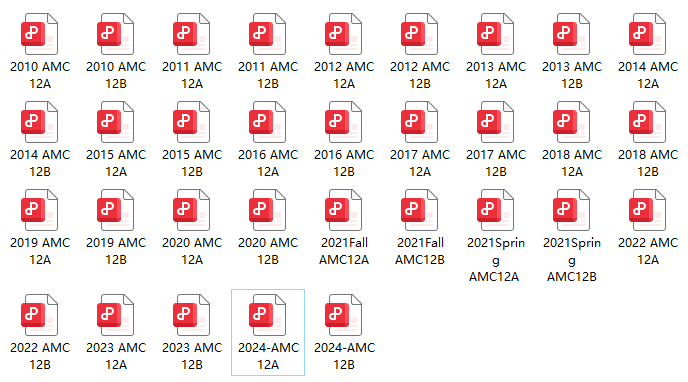
Complete sets of past AMC12 exam papers are provided, and full-proctored mock exams are organized regularly to recreate the authentic competition atmosphere. Special emphasis is placed on training problem-solving speed and answering rhythm, helping students perform stably before the exam.
We are an authorized AMC test center and offer free registration assistance!
Scan the code to inquire about AMC 12 registration for the 2026 season ⇓
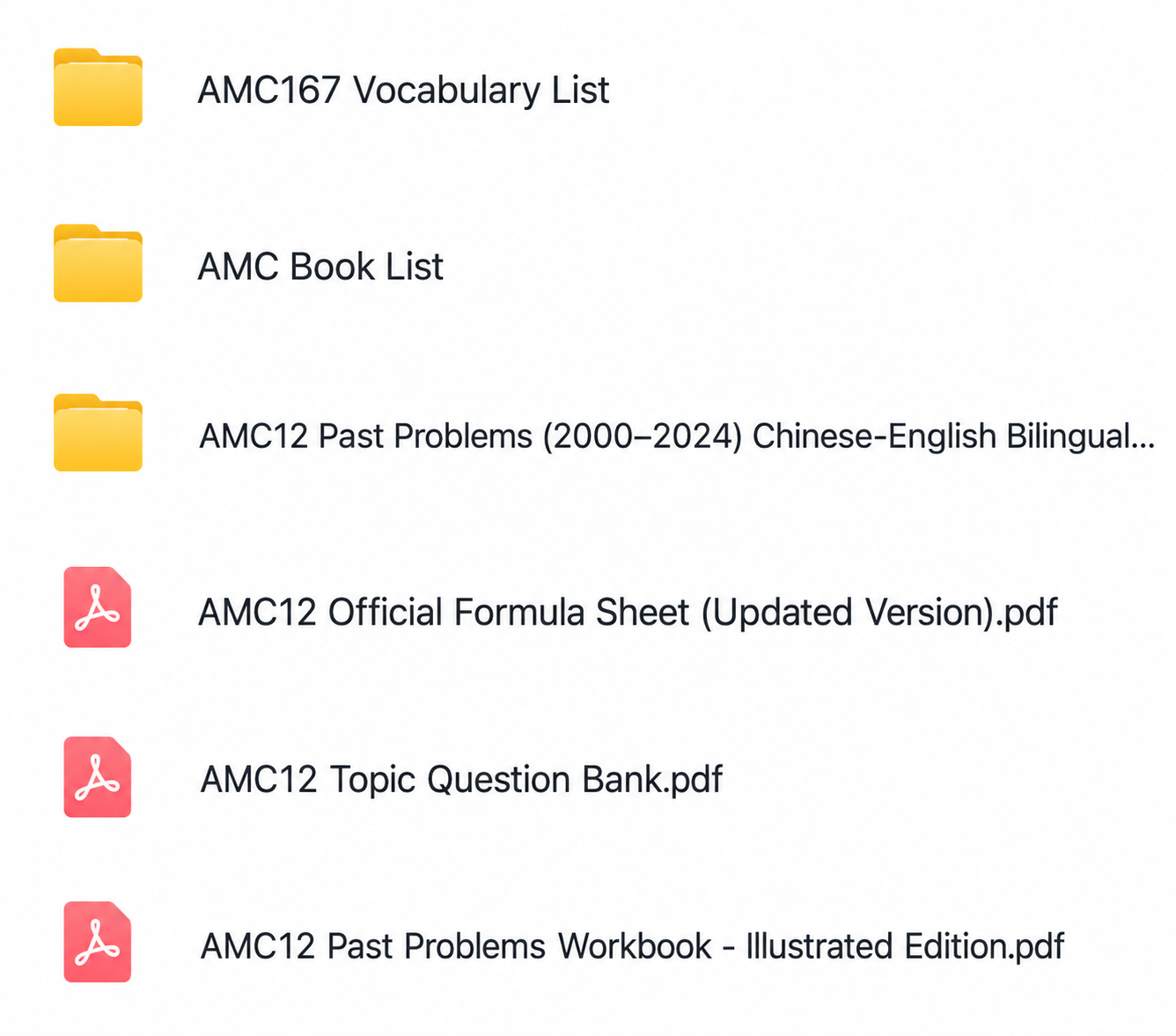
Scan the QR code to get free AMC 12 prep resource pack
(Includes past AMC 12 exam papers with solutions, reading lists, formula sheets, and more)