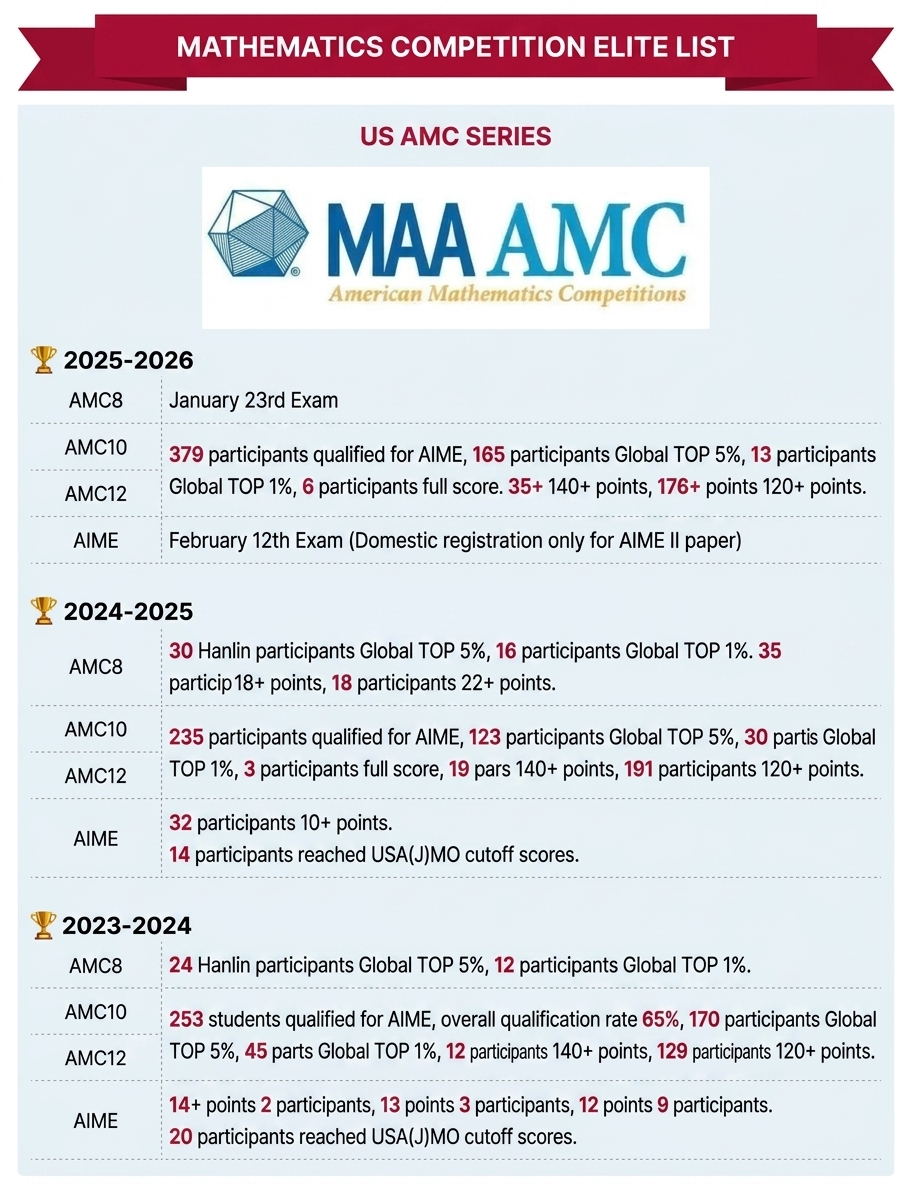

As one of the most authoritative international mathematics competitions at the high school level, a core goal of the AMC12 is to select the top 5% of students worldwide to advance to the AIME (American Invitational Mathematics Examination). In recent years, with intensifying competition, the qualifying threshold has continued to rise, making a scientifically set score goal the key to success.

I. AMC12 to AIME Qualification: Score Trends and Goal Setting
Scoring Rules: Full score 150 (25 questions). +6 points for correct answers, +1.5 points for blank answers, 0 points for incorrect answers.
Qualification Ratio: Approximately the top 5% of students globally qualify for AIME.
Significant Increase in Recent Cutoff Scores: 2025: AMC12A: 96, AMC12B: 100.5. Historical range: For many years, the cutoff score fluctuated between 85 and 95 points.
Suggested Score Targets for Preparation:
| Target Level | Score Target | Number of Correct Answers | Strategy Description |
|---|---|---|---|
| Basic Target | ≥90 | 15-16 questions | Reach the historical average, ensure accuracy on basic and intermediate questions. |
| Safe Target | ≥100+ | 17-18 questions | Address the continuous rise in cutoffs, significantly increasing the certainty of qualification. |
| Excellent Target | ≥130+ | 22+ questions | Achieve top 1% (Distinguished Honor Roll), creating a core highlight for top-tier university applications. |
Key Tip: Due to the "+1.5 points for no answer" rule, a strategic guess or leaving a question blank can often be more beneficial than a random guess.
II. Why is AMC12 a "Hard Currency" in Applications? Five Core Values
A Globally Recognized Academic Benchmark: Sponsored by the Mathematical Association of America (MAA), AMC12 scores are regarded by top global universities as a gold standard for measuring a student's mathematical reasoning and problem-solving abilities.
Strong Endorsement for Top-Tier College Admissions: AIME qualification (top 5%) is a basic prerequisite for applicants to strong STEM schools like MIT, Stanford, and Caltech. DHR (top 1%) is a common and highly distinguishing highlight on applications to Ivy League and top STEM universities.
Proof of Academic Ability Beyond the Curriculum: AMC12 covers all high school mathematics fields except calculus (number theory, combinatorics, complex numbers, advanced geometry, etc.), emphasizing creative thinking and surpassing the difficulty of standard school exams.
A Gateway to Premier Resources and Opportunities: Top math summer programs like Ross and SUMaC give preference to high AMC12 scorers. Universities like Duke offer special scholarships for AIME qualifiers. Excellent scores provide quantitative evidence for teachers writing strong academic letters of recommendation.
Competitive Advantage for Non-STEM Majors: A high AMC12 score can strongly demonstrate strong quantitative analysis capabilities, even for students applying to majors like Economics, Finance, or Social Sciences. For instance, the University of Chicago's Economics department explicitly suggests submitting math competition scores to showcase a well-rounded "liberal arts and sciences" profile.
III. Three Core Strategies for Efficient AMC12 Preparation
Strengthening Foundational Knowledge: Focus on "Uncovered" Areas
Although AMC12 does not cover calculus, it delves deeply into content often less emphasized in many high school curricula:
Number Theory: Divisibility properties, congruence equations, Fermat's Little Theorem, prime factorization techniques.
Combinatorics: Comprehensive permutations and combinations, the stars and bars method, Principle of Inclusion-Exclusion (PIE), recurrence relations.
Complex Numbers: Polar form, De Moivre's Theorem and its applications.
Geometry: Triangle centers, power of a point theorem, Ptolemy's theorem, complex solid geometry.
Method: Study chapter by chapter, focusing on understanding principles, not rote memorization of formulas.
Training in Problem-Solving Techniques: Mastering a High-Frequency "Weaponry"
For different modules, skillfully applying specific techniques can double your efficiency:
Algebra: Factorization, substitution, graphical methods.
Geometry: Similar triangles, coordinate method, area dissection method, Ptolemy's theorem.
Number Theory: Congruence theorems, Euler's totient function, divisor count and sum formulas.
Combinatorics: The stars and bars method for distribution problems, PIE for counting overlapping cases.
Method: Pair each technique with 3-5 classic examples to thoroughly understand its application scenarios.
Intensive Practice and Simulation: Realistic Training, Strategy Optimization
2-4 weeks before the exam: Complete 3-5 high-quality mock tests, strictly timed.
Main Goal: Adapt to the exam pace and adjust your mindset.
Filling Gaps: Precisely locate weak knowledge points through review.
Practice "No-Answer" Strategy: Learn to decisively skip difficult questions, investing time in questions you are more confident about to maximize the benefit of the "+1.5 points for no answer" rule.
Scan the QR code to get free AMC...