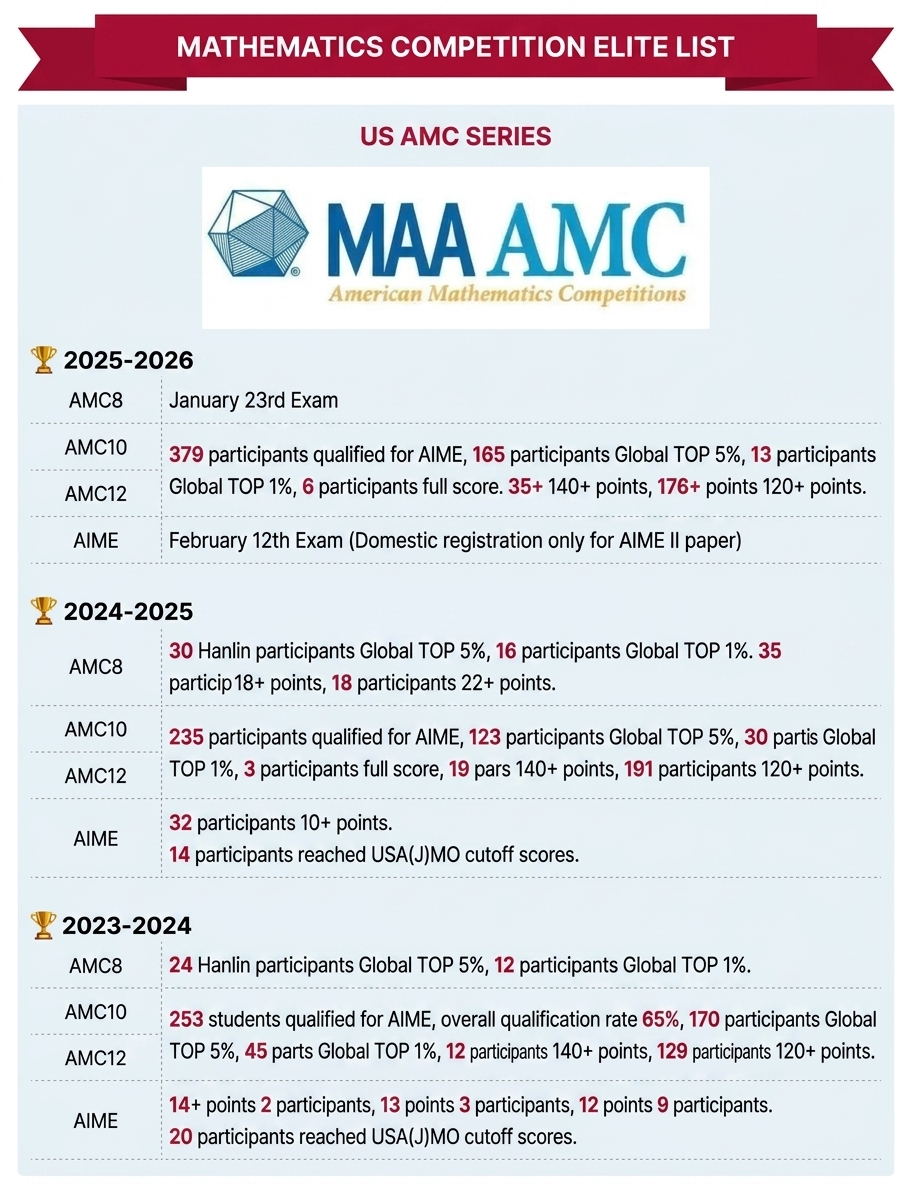
The AMC12, a prestigious competition hosted by the Mathematical Association of America (MAA), is not only a required step towards the International Mathematical Olympiad (IMO) but also a crucial benchmark for top global universities to measure a student's mathematical talent. With the qualifying score for the 2025 AIME reaching a ten-year high, the competition for the AMC12 has entered an intense, "high-level competition" phase. Faced with this increasingly fierce competition, the core question is no longer "whether to take the exam," but "how to scientifically plan your preparation time."
I. Seize the Two Golden Windows for AMC12 Preparation
The AMC12 exam is held every November (with the A and B versions about a week apart). To prepare calmly, you must seize the following two key time windows:
Window 1: The Summer Intensive Sprint Period (Summer of Grade 10)
The summer of Grade 10 is the absolute golden period for AMC12 preparation. At this time, A-Level students have typically completed their core AS content, and IB students have built a strong modeling ability during the MYP phase. It is recommended to use these 2-3 months to systematically review the complete high school mathematics curriculum (e.g., complex numbers, logarithms, number theory, and other modules less covered in school) and complete the first round of comprehensive knowledge coverage.
Window 2: The School-Year Thematic Reinforcement Period (September to October of Grade 11)
After school starts, you should officially enter the "thematic reinforcement + past paper practice" stage. It is recommended to complete 2 sets of past 10-year exam papers each week, strictly timed at 75 minutes per simulation. A strict time allocation is recommended: first 10 questions ≤ 15 minutes, questions 11–20 ≤ 35 minutes, questions 21–25 ≤ 20 minutes, to deliberately train your problem-solving pace.
️Special Reminder: The second half of Grade 11 is typically a critical period for IB IA (Internal Assessment) or A-Level final exams. If you wait until November to start preparing, scheduling conflicts are inevitable. Starting a systematic knowledge building process a year in advance is the only way to face the application season with ease.
II. How to Leverage the School Curriculum System for AMC12 Preparation and Transform Advantages
Different international curriculum systems have distinct advantages and blind spots when it comes to AMC12 preparation. You need to play to your strengths and address your weaknesses accordingly:
A-Level System: C1-C4 covers a large amount of algebra and geometry tools, with no language barrier in mathematics. The blind spots are that number theory is almost non-existent, combinatorics is only superficially covered in Further Math, and the habit of "showing step-by-step working" is not suited to the quick problem-solving required for multiple-choice questions.
IB System: The broadest knowledge coverage, with comprehensive mastery of complex numbers, vectors, matrices, and probability distributions. IA investigations cultivate strong logical modeling skills. Blind spots include fragmented number theory content (only appearing in the Options section) and generally slow problem-solving pace.
Mainland Chinese Curriculum / Gaokao System: Strong foundation in functions, trigonometry, and solid geometry, with strong calculation abilities. The blind spot is an almost zero foundation in number theory (e.g., modulo arithmetic, Fermat's Little Theorem are completely blank).

III. Core Challenges and Key Areas in AMC12 Preparation
Focus on Core High-Frequency Modules: Prioritize mastering the four mandatory topics: Algebra, Complex Numbers & Sequences, Geometry, and Combinatorics & Probability, as they constitute the vast majority of the exam points.
Specialize in High-Frequency, Error-Prone Question Types: Targeted practice on past errors and confusing questions. Thoroughly understand the solutions to identify the traps set by the problem makers and avoid typical deduction points.
Follow the Latest Exam Trends: Only practice recent past papers to adapt to new question type changes. Firmly avoid practicing overly tricky or off-topic questions to stay perfectly aligned with the exam's difficulty.
Recommended Authoritative Resources for Preparation
Textbook Choice: The AOPS (The Art of Problem Solving) series is the recognized gold standard textbook by the AMC official organization. "Volume 2" covers the core difficulty of AMC12, and "Intermediate Counting & Probability" is ideal for tackling combinatorics and number theory weaknesses.
Past Paper Bank: Practicing past 10–15 years of AMC12 exams (alternating between A and B versions, twice) is key to improving your score.
Course Support: Especially for weak areas common in many domestic systems like number theory and combinatorics, the systematic breakdown and problem-solving modeling provided by professional competition training courses can save you considerable time that would otherwise be spent fumbling on your own.