

The award cutoff scores for the 2025 AMC12 competition show a significant increase in overall difficulty in winning awards. In particular, the cutoff for the top 1% reached a perfect score, indicating extremely fierce competition. Facing such a severe situation, how to prepare scientifically and enhance competitiveness has become a question every participant must consider. This article will provide you with comprehensive guidance from three aspects: a review of the 2025 competition, an analysis of preparation difficulties, and zero-base preparation strategies.

I. Review of 2025 AMC12 Award Cutoff Scores
Form A Cutoff Scores:
AIME Qualifying Score: 96 points (Due to the invalidation of Question 25, every participant received an additional 6 points)
Distinction Honor Roll (Top 1%): 150 points (Perfect Score)
Honor Roll (Top 5%): 127.5 points
Form B Cutoff Scores:
AIME Qualifying Score: 100.5 points
Distinction Honor Roll (Top 1%): 145.5 points
Honor Roll (Top 5%): 127.5 points
Special Reminder:
The invalidation of Question 25 on Form A in 2025 and the additional 6 points awarded to every participant have led to a rise in cutoff scores compared to previous years. The cutoff for the top 1% reaching a perfect score indicates that the competition among top-tier participants has intensified.
II. Analysis of Difficulties in AMC12 Preparation
① Increase in the Number and Quality of Participants
Surge in Participants: In 2025, nearly 40,000 participants took the AMC12, but only 6,000 successfully qualified for the AIME, a qualification rate of only 15%.
High Recognition by Prestigious Schools: AMC12 scores are widely recognized by top institutions such as MIT and Stanford, becoming a "standard" for applications, which has significantly improved the quality of participants.
② Escalation in Difficulty and Depth of Knowledge Points
Higher Demand for Comprehensive Application: In recent years, the AMC12 has placed more emphasis on cross-module integration of knowledge points. For example, the 2025 exam featured ellipse foci and more innovative types of combinatorics problems.
Enhanced Testing of Innovative Thinking: Problem designs are flexible and varied, no longer confined to fixed patterns, testing students' creative problem-solving abilities.
Key Discovery: The four major modules of Algebra, Geometry, Number Theory, and Combinatorics no longer exist in isolation but are interwoven; new concepts frequently appear (e.g., "sum-free sets"), requiring students to quickly understand and apply them.
III. Zero-Base Preparation Guide for AMC12
1. Comprehensive Knowledge Review (3–6 Months)
Goal: Systematically learn all knowledge points within the AMC12 syllabus.
Recommended Textbooks:
AoPS Volume 2
Intermediate Counting & Probability
Plane Geometry in Mathematical Competitions (Relevant Chinese title)
Action Steps:
Dedicate 1-2 hours daily to learning fundamental knowledge by module.
Use past papers for targeted practice, ensuring flexible application of each knowledge point.
2. Module-Specific Breakthrough (2–3 Months)
Goal: Deeply understand the common question types and problem-solving techniques for each knowledge point in the competition.
Specialized Training in the Four Major Modules:
Algebra: Function transformations, polynomial properties, sequence summation
Geometry: Triangle center properties, power of a point theorem, solid geometry volume calculation
Number Theory: Congruences, divisibility, modular arithmetic
Combinatorics: Counting principles, probability models, permutations and combinations
Action Suggestions:
Complete 2 sets of specialized practice questions per week, marking weak areas.
Summarize high-frequency test points and problem-solving techniques, establishing a "Mistake-Knowledge Point-Solution Model" triple archive.
3. Thoroughly Practice Past Papers (2 Months)
Goal: Master the scoring rules and learn strategic trade-offs in simulations.
Core Resources: AMC12 past papers from the last 10-15 years (Forms A and B)
Action Steps:
Conduct one full-length mock exam per week (strictly 75 minutes), using a standard answer sheet.
Record the thinking time for each question and analyze whether the time allocation is reasonable.
Solidify your answering pace: First 10 questions ≤ 15 minutes (ensure correctness), Questions 11-20 ≤ 35 minutes (minimize errors), Questions 21-25 ≤ 20 minutes (aim to solve 2 questions).
4. Review Mistakes and Difficult Problems (Throughout the Process)
Goal: Achieve the transition from "solving a single problem" to "mastering a class of problems".
Action Suggestions:
Conduct in-depth reviews of mistakes and overly time-consuming problems from each mock exam.
Summarize the underlying mathematical concepts and processing methods behind the problems to avoid repeating similar mistakes.
Use tools like Anki to organize a mistake notebook and review it regularly.
AMC12 Tutoring Courses
Our instructors are graduates of top global universities. With precise curriculum planning and comprehensive learning tracking, we guide you all the way to score improvement and awards!
Scan the QR code to learn about AMC10/12 competition courses
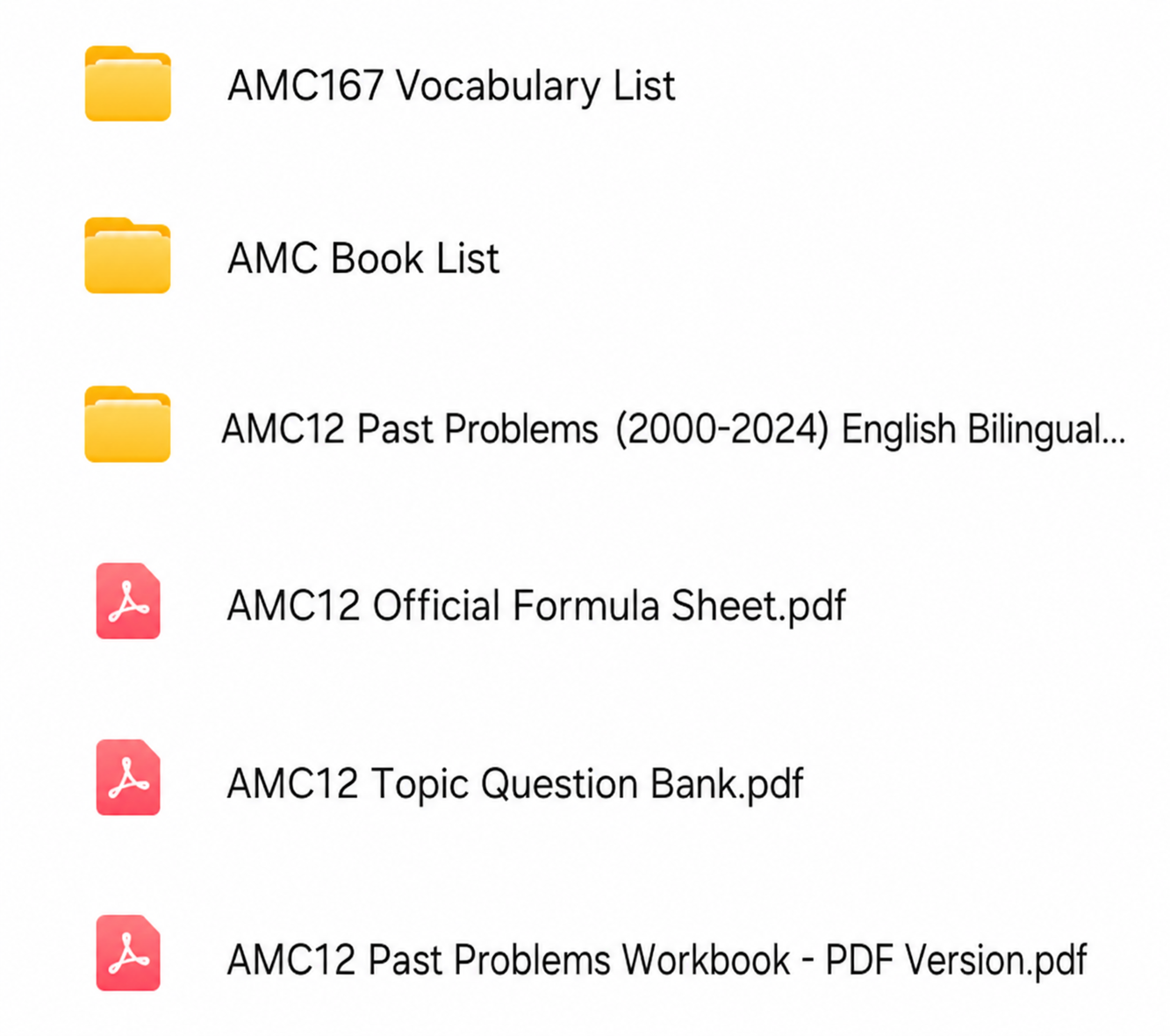
Free self-developed intensive teaching materials available