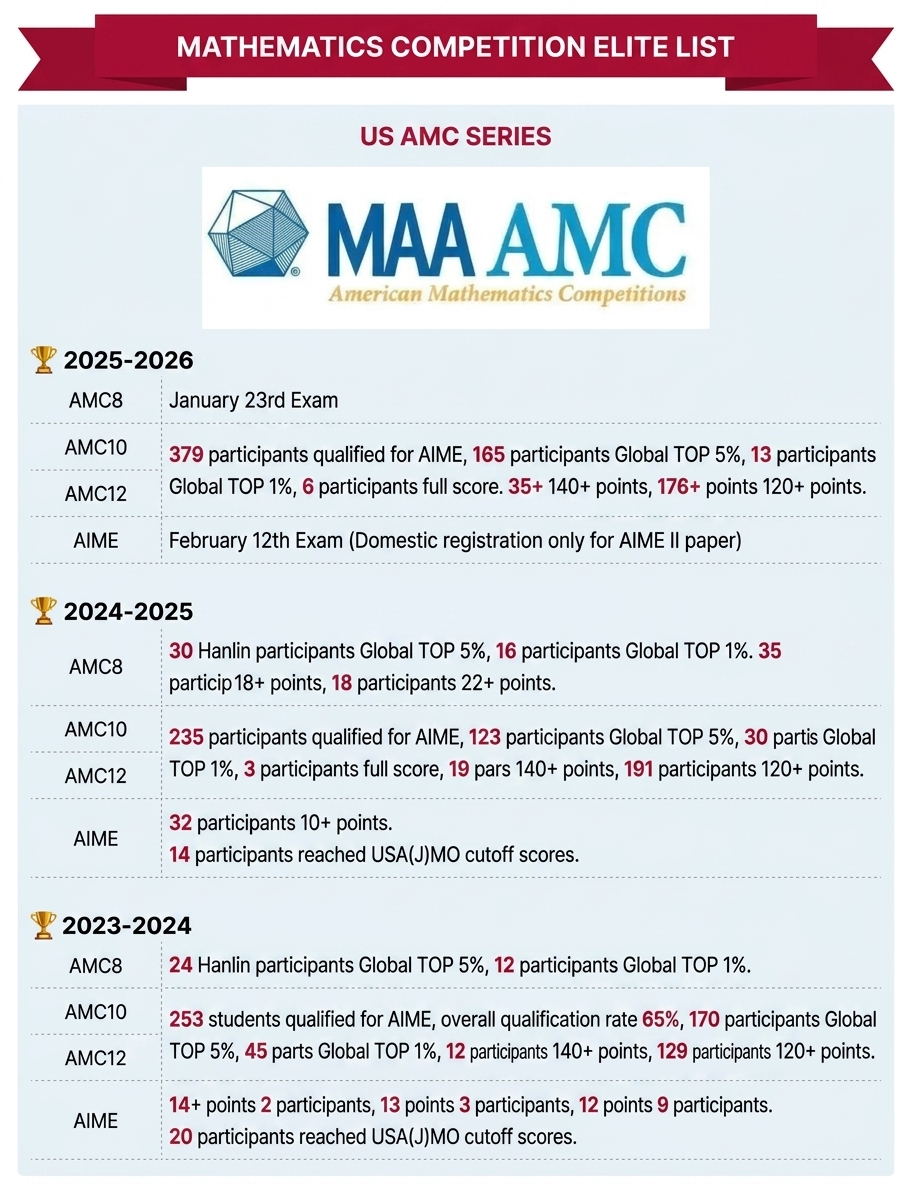

AMC12 is a world-class mathematics competition for students in grade 12 and below, with a maximum score of 150 points and 25 multiple-choice questions to be completed in 75 minutes. It is not only a key stepping stone to AIME and USAMO, but also an important academic credential for applying to top STEM institutions such as MIT, Stanford, and Princeton. However, many students mistakenly believe that "AMC12 is just an extension of school mathematics"—in reality, the competition for the top 1% (Distinguished Honor Roll) has already entered the arena of "mathematical thinking competition." This article will reveal the true path to high scores from three perspectives: question difficulty gradient, depth of knowledge, and dimensions of ability.

I. The "Four-Stage" Difficulty Ladder of AMC12
| Question Range | Difficulty Level | Target Strategy |
|---|---|---|
| Questions 1–10 | Foundation Consolidation Zone | Must get all correct! Tests algebraic operations, basic geometry, fundamental probability; mistakes = self-sabotage |
| Questions 11–15 | Ability Watershed | Key to distinguishing "average" from "good"; requires proficiency in intermediate techniques (e.g., Vieta's formulas, trigonometric transformations) |
| Questions 16–20 | Main Battlefield for Awards | Multi-knowledge point integration (e.g., "Number Theory + Combinatorics," "Geometry + Algebra"), requires cross-module associative ability |
| Questions 21–25 | Top-Tier Showdown Zone | Close to Olympiad style, often includes constructive proofs, extremal principle, symmetry insights; top 1% contenders are decided here |
• Target Top 5% (≈127.5 points): Ensure ≤1 mistake in questions 1–15, solve 2–3 of questions 16–20.
• Target Top 1% (≈135+ points): At most 2 mistakes in questions 1–20, and fully solve at least 1 of questions 21–25.
II. What Level Is Needed to Reach the Top 1% in AMC12?
AMC12 does not test obscure or tricky problems, but requires the flexible application of knowledge to real problems. The following are the core content areas that high-scoring students must thoroughly master:
1. Algebra
Polynomials: Vieta's formulas, Remainder Theorem, factorization techniques
Complex Numbers: Modulus and argument, Euler's formula
Trigonometry: Sum-to-product/difference formulas, double-angle formulas, graph properties
Inequalities: AM-GM, Cauchy-Schwarz, comprehensive application of rearrangement inequalities
2. Geometry
Plane Geometry: Ptolemy's theorem, Heron's formula, Power of a Point theorem, advanced similarity and congruence
Solid Geometry: Properties of regular polyhedra, distance and volume in coordinate space
Analytic Geometry: Standard equations of ellipses/hyperbolas, intersection analysis of lines and conic sections
3. Number Theory
Modular Arithmetic: Chinese Remainder Theorem, Fermat's Little Theorem, Euler's theorem
Diophantine Equations: Linear (e.g., ax + by = c) and nonlinear (e.g., sum of squares problems)
Primes and Factors: Fundamental theorem of arithmetic, properties of GCD, perfect square determination
4. Combinatorics & Probability
Counting Techniques: Stars and bars method, inclusion–exclusion principle (advanced level), recurrence relations
Probability Models: Conditional probability, expected value calculation, geometric probability
Combinatorial Identities: Applications of binomial theorem, Pascal's triangle properties
III. High Scores ≠ Volume of Practice, But "Quality of Thinking"
Students in the top 1% are not those who solve the most problems, but those who think most deeply.
1. Problem-Solving Speed: Build "Rhythm"
Time Allocation Recommendations:
Questions 1–10: ≤25 minutes
Questions 11–15: ≤20 minutes
Questions 16–20: ≤20 minutes
Questions 21–25: ≥10 minutes (selective)
Training Method: Weekly timed mock exams, use a timer to enforce strict time segmentation, avoid "spending 5 minutes stuck on one question."
2. Thinking Flexibility: Learn "Unconventional Problem-Solving"
Common advanced thinking tools:
Symmetry: Simplify complex structures (e.g., regular polygon problems)
Extremal Principle: Consider maximum/minimum cases (e.g., "at least how many...")
Construct Counterexamples: Quickly eliminate incorrect answer choices
Reverse Thinking: Deduce conditions from conclusions
3. Mistake Review: From "Understanding" to "Internalization"
Establish a mistake notebook, categorize errors into three types:
Calculation errors → Strengthen scratchwork habits
Knowledge gaps → Return to textbook to clarify concepts
Blocked thinking → Accumulate "breakthrough keywords" (e.g., when you see "divisible" → think modular arithmetic)
Online Customer Service | WeChat Consultation