
With the growing trend of "early starts" in the competition community, many students currently in grade 10 (the first year of high school) with a solid mathematical foundation, along with their parents, are facing a forward-looking yet difficult strategic choice: "Is it suitable for grade 10 students to sprint for AMC12, which is originally designed for senior high school students? Would the gap be too large and result in becoming cannon fodder? What exactly is the level of AMC12's exam points and difficulty?"
This article will provide you with the most objective assessment of the value and pros and cons, and thoroughly explain AMC12's exam points and difficulty in one go.
I. Is It Suitable for Grade 10 Students to Sprint for AMC12?
Here is a direct, hardcore strategic assessment: For grade 10 students who are targeting the UK G5 (especially Oxford, Cambridge, Imperial College), US Top 20 prestigious universities, and who have already completed or are ahead in Pre-Calculus, this is not only perfectly suitable but also a highly cost-effective "mismatch competition" strategy.
We can analyze the underlying logic from the following two key dimensions:
1. The "Cutoff Dividend" for Advancing to AIME
This is a "dimensionality reduction" secret that many newcomers to competitions do not know: although the absolute difficulty of AMC12 questions is higher than that of AMC10, historical data shows that the cutoff score for advancing to AIME (American Invitational Mathematics Examination) in AMC12 is often lower than that of AMC10!
Data Comparison: In some difficult years, the AIME cutoff for AMC10 might require 100 or even 105 points or more (meaning you can only get at most 4-5 questions wrong or left blank); in the same year, AMC12 often only requires 85–91 points (answering 12–13 questions correctly and leaving the rest blank) to successfully advance.
For a grade 10 student with advanced mathematical thinking, grinding through AMC10's speed and precision (with extremely low fault tolerance) is less effective than leveraging AMC12's high-difficulty knowledge points to secure a low-score advancement.
2. The "Win-Win" of Application Value and Time Planning
Direct Dimensionality Reduction for Ivy League/Oxbridge: When admissions officers see that you achieved a high score in AMC12 or advanced to AIME in grade 10, the mathematical talent and resilience this represents are incomparable to advancing through AMC10 in grade 10.
Strategic Buffer for Grade 11: If you try AMC12 in grade 10 and fail, you gain invaluable top-level competition experience and still have one last golden opportunity in grade 11 to fill in the gaps. If you wait until grade 11 to take AMC12 for the first time and fail, this section of your application profile will be left blank.
II. Thorough Explanation: What Are the Exam Points and Difficulty of AMC12?
AMC12 also consists of 25 multiple-choice questions, lasts 75 minutes, has a total score of 150, and follows the rule of "no deduction for wrong answers, 1.5 points for blank answers." Although it still does not cover college calculus, it comprehensively introduces the most core and abstract advanced high school modules on top of AMC10.
The core difficulties and new exam points are mainly concentrated in the following four hardcore areas:
1. Advanced Algebra: Complex Numbers, Polynomials, and Higher-Degree Equations (Approx. 35%)
New Core Exam Points: Geometric interpretation of complex numbers and introduction to Euler's formula, De Moivre's theorem, relationships between roots and coefficients of higher-degree equations (advanced Vieta's theorem), conjugate root theorem, rotations and transformations on the complex plane.
Difficulty Breakdown: This is the biggest dividing line between AMC12 and AMC10. AMC10 is limited to the real number system, while AMC12 requires you to be proficient in performing geometric rotations and algebraic simplifications on the complex plane. For example, problems often ask for the area of a polygon formed by the roots of \(z^n = 1\) on the complex plane.
2. Advanced Functions: Extreme Transformations of Trigonometric and Logarithmic Functions (Approx. 25%)
New Core Exam Points: Sum-to-product and product-to-sum formulas for trigonometric functions, deep nesting of double-angle/half-angle formulas; change of base formula for logarithmic functions, logarithmic inequalities, analysis of properties of inverse functions and composite functions.
Difficulty Breakdown: School curricula usually only test direct substitution of formulas, whereas AMC12's trigonometry problems are often combined with geometry and complex numbers. You not only need to memorize those complex trigonometric identities but also possess strong algebraic simplification skills and the ability to observe structural symmetry in expressions.
3. Three-Dimensional Space: Integration of Solid Geometry and Analytic Geometry (Approx. 20%)
New Core Exam Points: Introduction to spatial vectors, three-dimensional coordinate systems, polar and standard equations of conic sections (ellipses, hyperbolas, parabolas), cross-sections of solid figures, and circumscribed/inscribed sphere problems.
Difficulty Breakdown: Compared to AMC10's plane geometry, AMC12 heavily tests students' spatial imagination and computational prowess. Many challenging geometry problems would be very difficult if approached purely with Euclidean geometry (finding auxiliary lines), but in AMC12, students who master spatial analytic geometry (setting up coordinate systems) can directly "break through" with brute-force computation.
4. Advanced Number Theory and Advanced Counting (Approx. 20%)
New Core Exam Points: Chinese remainder theorem, Fermat's little theorem, Euler's totient function, introduction to generating functions, advanced combinatorial identities from the binomial theorem.
Difficulty Breakdown: This section often appears in the challenging positions of questions 15–25 in AMC12. It no longer tests simple permutations and combinations, but requires you to use rigorous recursive relations or congruence theory in number theory to deconstruct seemingly random problems involving games, coloring, or number arrangements.
III. Breakthrough Preparation Strategies for Grade 10 Students Sprinting for AMC12
The biggest enemy for grade 10 students preparing for AMC12 is not IQ, but knowledge gaps. To win this battle, you must execute the following three-step strategy:
1. Step One: Sprint Ahead and Comprehensively Fill in Pre-Calculus Knowledge – 6 Months Before the Exam
Before starting competition problem-solving, you must use the first 2–3 months to self-study or take systematic courses to complete all the foundational knowledge of functions, logarithms, trigonometric functions, complex numbers, and vectors from AP Pre-Calculus, IB DP Math HL (early to mid-stage), or the domestic high school curriculum for grades 11–12. Without this foundation, looking at AMC12 past papers will be like reading a foreign language.
2. Step Two: Grind Through the "Algebra and Functions" Foundation and Secure 80 Points – 3 Months Before the Exam
Since the AMC12 advancement cutoff is low, you don't need to be a master of everything. Algebra, advanced functions, and the geometry foundation left from middle school are your basic pillars. Use 2 months to repeatedly work through the first 12 questions from past papers of the last 10 years, ensuring that you can sweep through the first 12 questions on the actual exam with 100% accuracy within 35 minutes.
3. Step Three: Practice "Strategic Abandonment" and Lock in the AIME Ticket – 1 Month Before the Exam
The last 8 questions of AMC12 are extremely difficult. The iron rule for grade 10 students on exam day is: absolutely do not get stuck on questions 18 and beyond during the exam.
Do the math: if you get the first 13 questions all correct and decisively leave the remaining 12 difficult questions blank, your total score can reach 96 points! In most years, this score is not only enough to securely advance to AIME but also allows you to effortlessly win the Global Top 5% (Honor Roll) award.
We are an authorized AMC test center and offer free registration assistance!
Scan the code to inquire about AMC 12 registration for the 2026 season ⇓

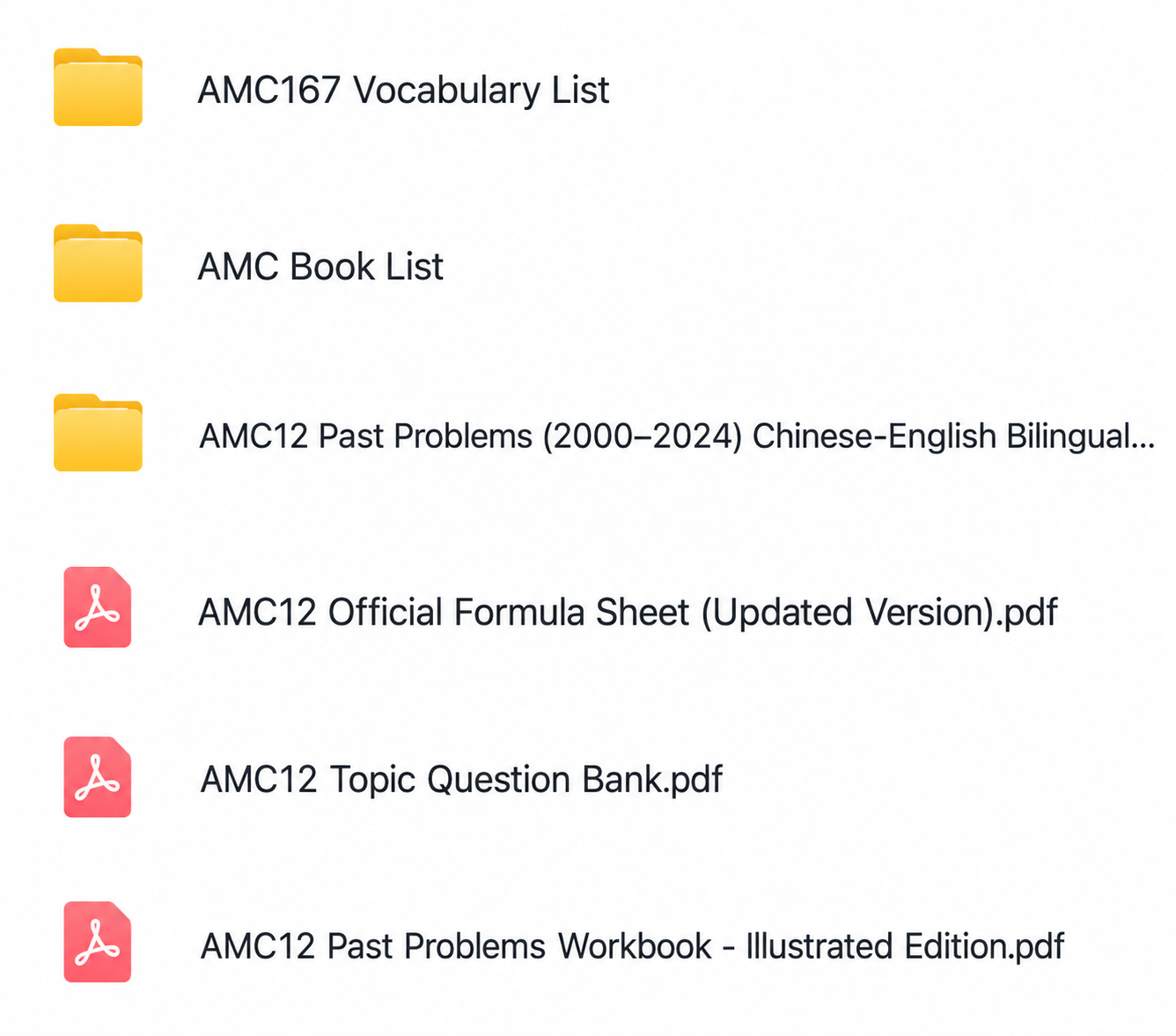
Scan the QR code to get free AMC 12 prep resource pack
(Includes past AMC 12 exam papers with solutions, reading lists, formula sheets, and more)