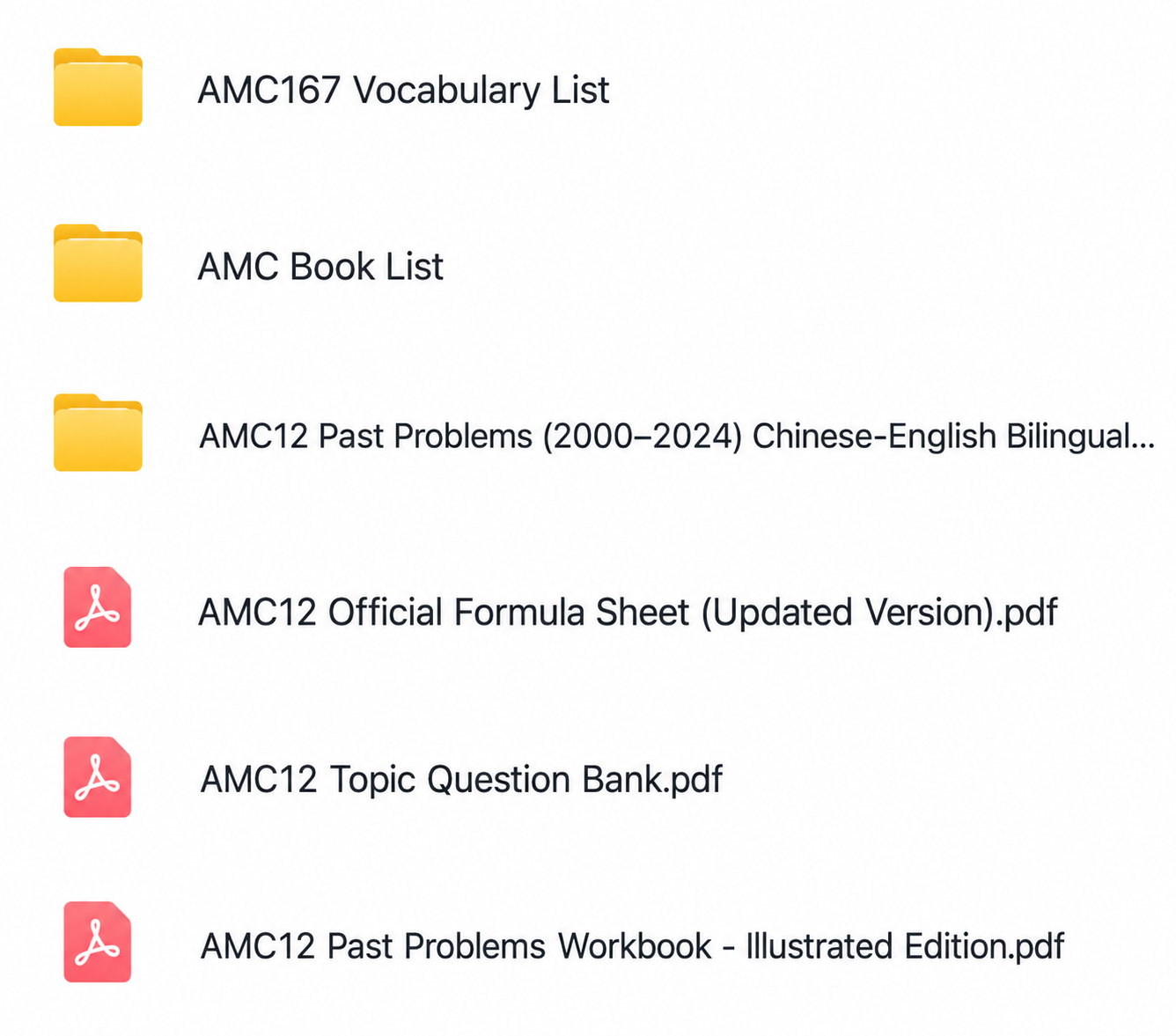

For international students aiming at top overseas universities, AMC12 is not only a high-value academic credential but also a crucial milestone aligning with the application season. However, with the surge in participants and rising cutoff scores in recent years, relying solely on school mathematics to "go in unprepared" is no longer a viable strategy.

I. Why AMC12 is the Top Choice for International Students' Background Enhancement
High recognition from top overseas institutions: AMC12 is organized by the Mathematical Association of America (MAA) and is highly regarded by elite universities such as Harvard, Stanford, and MIT. An outstanding score can quickly demonstrate your STEM potential to admissions officers, helping you stand out among a large pool of applicants.
Perfect alignment with the application timeline: The AMC12 exam is held every November, and score releases coincide with the early phase of the overseas university application season, making the results directly usable as core background material.
The gateway to higher-level competitions: Scoring in the top 5% globally (typically around 100 points) qualifies you for the AIME (American Invitational Mathematics Examination), which in turn opens the door to international top-tier events like the USAMO, creating a positive "competition ladder development" cycle.
II. Core AMC12 Topics and Exam Difficulty Breakdown
AMC12 consists of 25 multiple-choice questions, with a total score of 150 points and a time limit of 75 minutes. The core topics are divided into four major modules:
Algebra (approx. 30%-35%): Polynomials, exponential and logarithmic functions, trigonometric identities and transformations, arithmetic/geometric/recursive sequences, as well as inequalities such as AM-GM and Cauchy-Schwarz.
Geometry (approx. 25%-30%): Plane geometry (circles, triangles, similarity and congruence), solid geometry (volume, surface area, cross-sections), and analytic geometry (conic sections and their properties).
Combinatorics (approx. 20%-25%): Permutations and combinations, classical and conditional probability, expected value, the principle of inclusion-exclusion, and basic graph theory concepts.
Number Theory (approx. 15%-20%): Divisibility and congruence theory, modular arithmetic, distribution of primes, Euler's totient function, and the Chinese Remainder Theorem, among other advanced topics.
III. Four-Stage Scientific Preparation Plan
To successfully cross the qualifying line or even achieve a high score, it is recommended to adopt the following four-stage冲刺 strategy:
Diagnostic and Foundation Stage: Complete one recent past paper for diagnosis, and tally errors by topic. Focus on filling gaps in AMC12-specific knowledge that is less covered in school, such as complex numbers, trigonometric functions, and advanced number theory. Create a quick-reference formula sheet.
Targeted Practice Stage: Practice questions by the four major modules, focusing on intermediate-level comprehensive problems (questions 16-20). Maintain an error log, clearly categorizing mistakes into three types (calculation errors, knowledge gaps, and logical blocks). Conduct one full 75-minute mock test per week.
Full Mock Test Stage: Use the most recent past papers from 2021-2025, completing two full timed tests per week. Solidify time allocation, skip strategies, and blank-filling tactics; review all incorrect questions to ensure no repeated mistakes in similar question types.
Pre-Exam Maintenance Stage: Stop tackling large numbers of new difficult problems. Each day, work on a small number of medium-difficulty questions to maintain momentum, focusing on reviewing formulas, error logs, and typical problem-solving models, while adjusting your exam mindset.
IV. Time Allocation and Scoring Strategy in the Exam Hall
Under the extreme time pressure of 75 minutes, a reasonable strategy is more important than stubbornly wrestling with difficult questions:
Questions 1-15 (≤40 minutes): These are foundational "gimme" questions. Aim for 100% accuracy. Double-check calculations to avoid careless errors.
Questions 16-20 (≤20 minutes): These are intermediate differentiating questions. Prioritize your strongest topics. If you're stuck for more than 2 minutes, mark and skip immediately to avoid losing composure.
Questions 21-25 (remaining time): These are challenging final questions. Answer selectively. If you have no idea within 20 seconds of reading, leave it blank; do not guess blindly.
Score target positioning:
Secure AIME qualification (90-100 points): Minimize errors in the first 15 questions, aim to get 3-4 correct in questions 16-20, and leave all the final questions blank.
Aim for top 5% globally (115-130 points): Maintain a very high accuracy rate in the first 20 questions, and strive to get 2-3 correct in the final questions.
Aim for top 1% globally (140+ points): Perform consistently across the entire paper, skillfully handle cross-module comprehensive problems, and maintain high accuracy throughout.
We are an authorized AMC test center and can provide free proxy registration!