With the ever-intensifying competition for international university admissions, the name "AMC12" is no longer confined to international school circles. More and more top students from the traditional domestic (public high school) system are appearing at AMC testing centers.
Many parents and students question: "We are on the traditional Gaokao (National College Entrance Exam) track, or we're considering transferring to the international track in high school. Is it really necessary to invest energy in preparing for this American math competition? And just how helpful is it for applying to prestigious universities?"
This article will analyze the AMC12 from three dimensions: the natural advantages for domestic system students, its value for applications, and its effect on enhancing academic abilities.

I. The "Natural Advantages" of Domestic System Students for the AMC12
First, it's important to clarify that for domestic system students, taking the AMC12 is not as difficult as it might seem. In fact, the rigorous math education system in China provides an excellent foundation for AMC12 preparation.
1. High Knowledge Overlap
The AMC12 covers the entire high school math curriculum (excluding calculus), including trigonometry, logarithms, complex numbers, and analytic geometry. Advantage: The depth of training in algebra, trigonometry, and solid geometry within the domestic system far exceeds international standards. For a strong student from a domestic high school, the foundational knowledge for the first 15 questions of the AMC12 is almost like "facing a lower-level opponent."
2. Strong Calculation and Problem-Solving Fundamentals
Students in the domestic system undergo intensive math training, developing a powerful "muscle memory" for calculation accuracy and complex logical deduction. Advantage: The AMC12 consists of 25 multiple-choice questions with a 75-minute time limit. When facing the high-intensity calculations under such time pressure, domestic system students often possess stronger mental resilience and execution ability compared to their international school counterparts.
II. The Tangible Benefits of the AMC12 for College Applications
Whether you plan to "pursue both paths" (domestic Gaokao + international application) or aim for world-renowned universities, the AMC12 is an exceptionally valuable asset for your academic profile.
1. The "Hard Credential" for Ivy League and Top STEM Schools
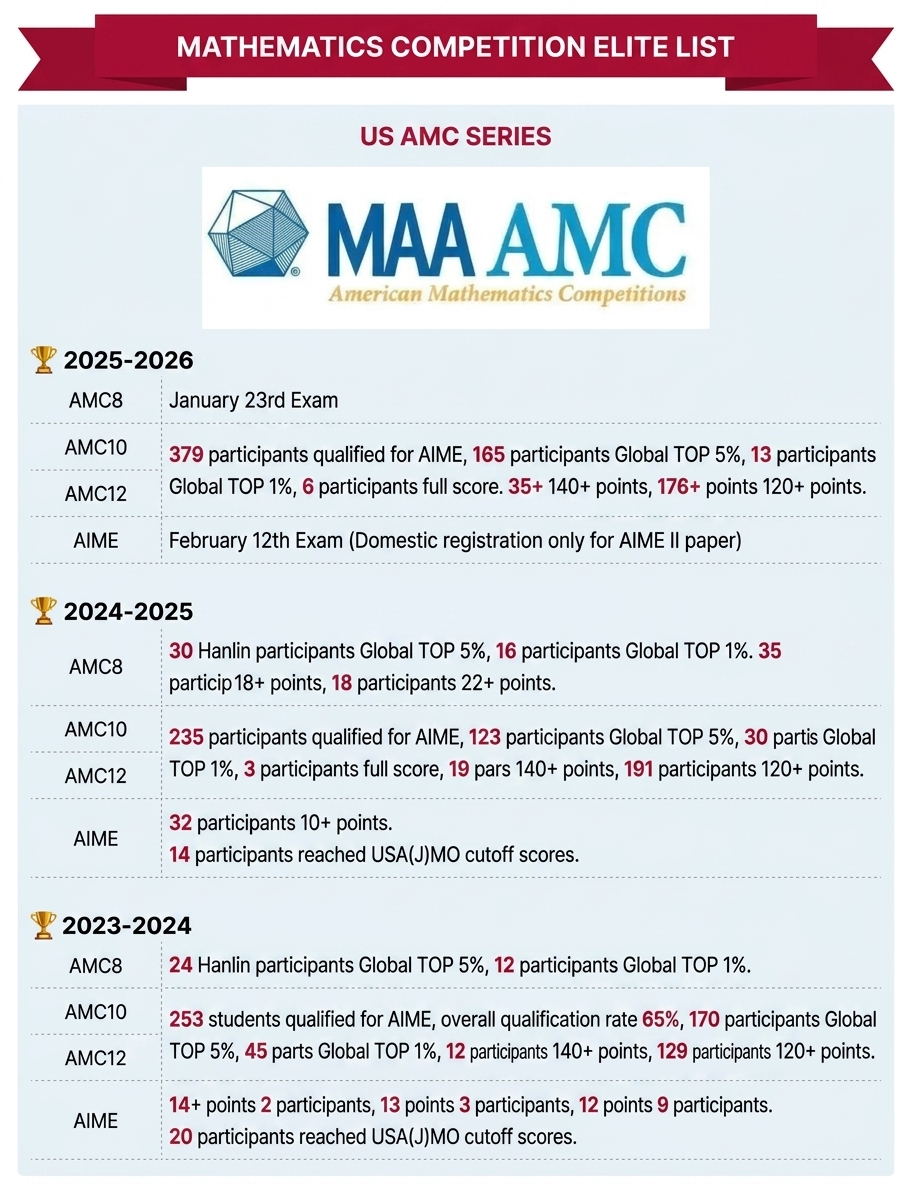
When applying to top institutions like MIT, Caltech, and Carnegie Mellon, application forms often include a specific section to report your AMC and AIME scores. How it helps: Achieving a Distinction (top 5% globally) or qualifying for the AIME (American Invitational Mathematics Examination) is among the most direct evidence of world-class mathematical talent. Among thousands of applicants with perfect GPAs, these scores are a key differentiator. The increasing difficulty of qualification, as seen with the 2025 AIME cutoff for AMC12B climbing to 100.5[reference:0], only makes such a credential more impactful.
2. Bridging the "Transparency Gap" of Domestic Grades (GPA)
Admissions officers at top overseas universities sometimes find it difficult to accurately assess the rigor of a transcript from an unfamiliar domestic high school. How it helps: The AMC12 is a globally standardized test. Its scores carry immense transparency and credibility. An excellent AMC score instantly builds confidence in an applicant's academic mathematics achievements.
3. Preparation for UK Oxbridge Admissions Tests
If you're aiming for mathematics, computer science, or engineering at Oxford or Cambridge, you'll find the logical thinking required for the AMC12 is highly similar to that of their additional admissions tests, like the MAT and STEP. How it helps: The non-algorithmic thinking honed through AMC12 preparation proves invaluable when tackling the complex logic problems presented in Oxbridge interviews.
III. Deep Empowerment for Domestic System Students' Academic Abilities
Beyond being a "door opener" for applications, the AMC12 cultivates a mathematical mindset that the Gaokao simply cannot replicate.
1. Cultivating a "Competition-Grade" Mathematical Intuition
The Gaokao focuses heavily on rigorous problem-solving procedures and established models. The AMC12, by contrast, places greater emphasis on mathematical intuition. How it empowers: In preparing for the AMC12, you'll encounter number theory, combinatorics, and other fascinating topics less emphasized in the domestic curriculum. This breaks the cycle of learning solely for exams and can rekindle a genuine interest in mathematics.
2. An Initial Rehearsal for English Academic Expression
The AMC12 is a bilingual (Chinese and English) exam. This provides an accessible opportunity for domestic system students to become familiar with specialized mathematics vocabulary in English. How it empowers: Mastering this vocabulary and context aids not only in the competition but also lays a crucial linguistic foundation for university-level mathematics studies abroad.
IV. A Preparation Roadmap for Domestic System Students
Month 1: Vocabulary & Context Transfer. Match the math concepts you already know (like complex numbers and logarithms) with their English equivalents. Ensure you don't lose points due to misreading a problem.
Months 2-3: Targeted Attack. Focus on number theory (congruences, advanced prime factorization) and combinatorics (probability models). These topics frequently appear in the last 10 questions of the AMC12 and are the relative weaknesses in the domestic curriculum.
The Final Month: Shift from "Brute-Force Calculation" to "Ingenious Thinking". Practice with past decade's exams. Train yourself in special case substitution, elimination methods, and symmetry analysis. Aim to compress the time spent on the first 15 questions to within 25 minutes, reserving ample thinking time for the final 10 questions.