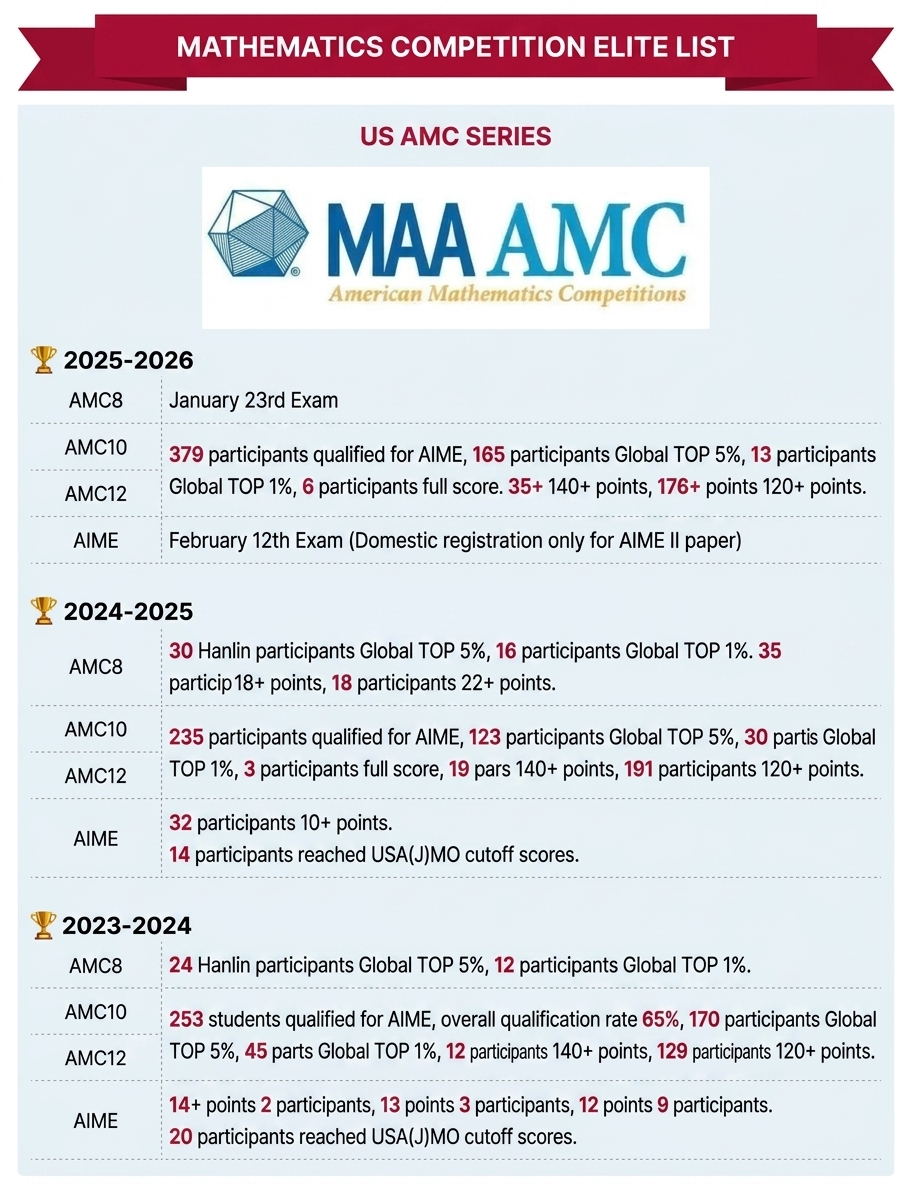

The 2025 AMC10/12 exams have concluded. Students confident of qualifying must immediately begin AIME preparation! Even more critically—the USA(J)MO qualification rules have undergone a significant adjustment in 2026, with AIME weight doubling, making it one of the most valuable math competition results for Ivy League applications.
I. 2026 AIME Key Information Overview
| Item | Details |
|---|---|
| Eligibility | Must achieve the current year's AIME qualifying score on the 2025 AMC10/12 (estimated: AMC10 ≈ 93, AMC12 ≈ 95) |
| Exam Format | Online computer-based exam (China region)|Bilingual Chinese/English test paper |
| Question Type & Scoring | 15 fill-in-the-blank questions|Answers are integers from 000–999|1 point per question, full score 15|No penalty for wrong answers |
| Exam Dates | • AIME I: February 6, 2026 (Thursday) 13:00–16:00 • AIME II: February 12, 2026 (Wednesday) 13:00–16:00 |
| Registration Deadline | January 27, 2026, 23:59:59 (late registration not accepted!) |
II. Major Change: USA(J)MO Qualification Formula Adjusted, AIME Weight Doubled!
Qualification Formula Comparison
| Year | USAJMO (AMC10 Path) | USAMO (AMC12 Path) |
|---|---|---|
| Old Rule (pre-2025) | AMC10 Score + 10 × AIME Score | AMC12 Score + 10 × AIME Score |
| New Rule (starting 2026) | AMC10 Score + 20 × AIME Score | AMC12 Score + 20 × AIME Score |
Strategic Impact Analysis
Each additional AIME point = 20 extra points on the total score! Example: Improving from 6 to 8 points on AIME → Increases the USAJMO Index by 40 points, which can directly determine qualification for USAMO.
AMC high-score advantage is diluted: Even if a student scores 135 on AMC10, but only 5 on AIME, total = 135 + 100 = 235; whereas AMC10 120 + AIME 8 = 120 + 160 = 280 → a comeback!

III. Four Core Difficulty Points of the AIME
1. Deeper Knowledge
Covers all AMC12 content, with deeper exploration:
Number Theory: Higher-degree congruences, Pell equations, Chinese Remainder Theorem
Algebra: Complex roots of unity, trigonometric identities, polynomial roots and coefficients
Combinatorics: Recurrence modeling, expectation calculation, generating function concepts
Geometry: Vector methods, coordinate geometry + conic sections integration
2. High Level of Comprehensiveness
Individual questions often integrate 2–3 modules, for example:
"Using complex numbers to represent geometric rotations, combined with trigonometric identities to find extremes."
"Constructing recurrence relations to solve combinatorial counts, then using modular arithmetic to verify integrality."
3. Heavy Computation and High Precision Requirements
No multiple-choice options to rely on; must calculate accurately down to the unit digit.
Common mistakes: errors in converting decimals to fractions, omitted signs, incorrect modular remainders.
4. Intense Time Pressure
15 questions in 3 hours → average 12 minutes per question.
The challenging problems (questions 11–15) often require more than 20 minutes each, making strategic abandonment necessary.
IV. AIME Problem Difficulty Distribution and Score-Boosting Strategies
| Question Range | Difficulty | Characteristics | Target Group |
|---|---|---|---|
| 1–6 | ⭐⭐☆ | Basic applications, similar to AMC12 questions 1–20 | All qualifiers should aim to get all correct |
| 7–10 | ⭐⭐⭐ | Multi-step reasoning, requires 1–2 key techniques | Key to scoring 7–9 points |
| 11–15 | ⭐⭐⭐⭐⭐ | Highly innovative, close to USAMO level | Essential for scoring 10+ points and qualifying for USA(J)MO |
V. Four Techniques for a High Score on the AIME
1. Look for Numerical Patterns
Simplify the problem into a small case, list the result sequence; observe: Is it arithmetic? Periodic? Fibonacci-like?
2. Try Substituting Simple Values
Let variables be 0, 1, -1, 2, etc., and observe the output; especially useful for functional equations and symmetry problems.
3. Use Diagrams to Aid Understanding
For geometry problems: draw a precise diagram and label known conditions; for combinatorics problems: use tree diagrams or tables to organize states; visualization reduces abstraction.
4. Make Good Use of Symmetry and Extremal Principles
If the problem involves "maximum/minimum," consider boundary cases; if the structure is symmetrical, the answer is often an integer or a special value (e.g., 0, 1, √3).
VI. AIME Past Exam Training Strategy
Recommended Training Process:
Phase 1 (December): Work intensively on past exams from 2015–2020, focusing on questions 1–10.
Phase 2 (January): Tackle past exams from 2021–2025, analyzing the logic of questions 11–15.
Phase 3 (2 weeks before the exam): Full-length mock exams (3 hours/set), training time allocation and calculation stability.
Key points for using past exams:
Don't just look at the answers! Focus on studying "official solutions" and "ingenious solutions."
Create an "error notebook," categorizing mistakes by type (knowledge gaps / calculation errors / flawed reasoning).
For challenging questions, try multiple solution methods to expand your thinking boundaries.
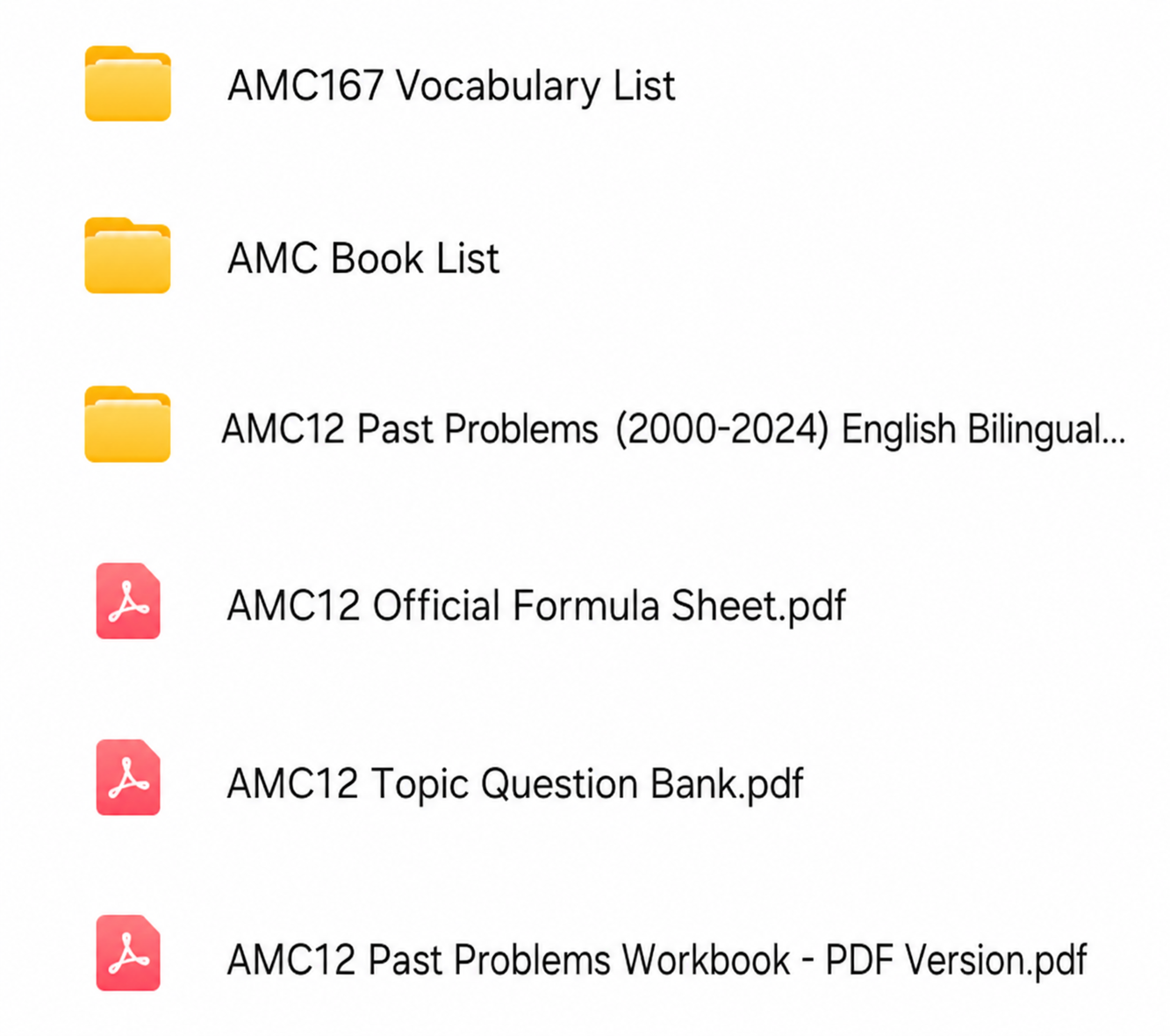
Scan the QR code to get free AIME past exam papers + answer keys + mind maps + categorized question bank (2011–2024) ⇓
Online Customer Service | WeChat Consultation