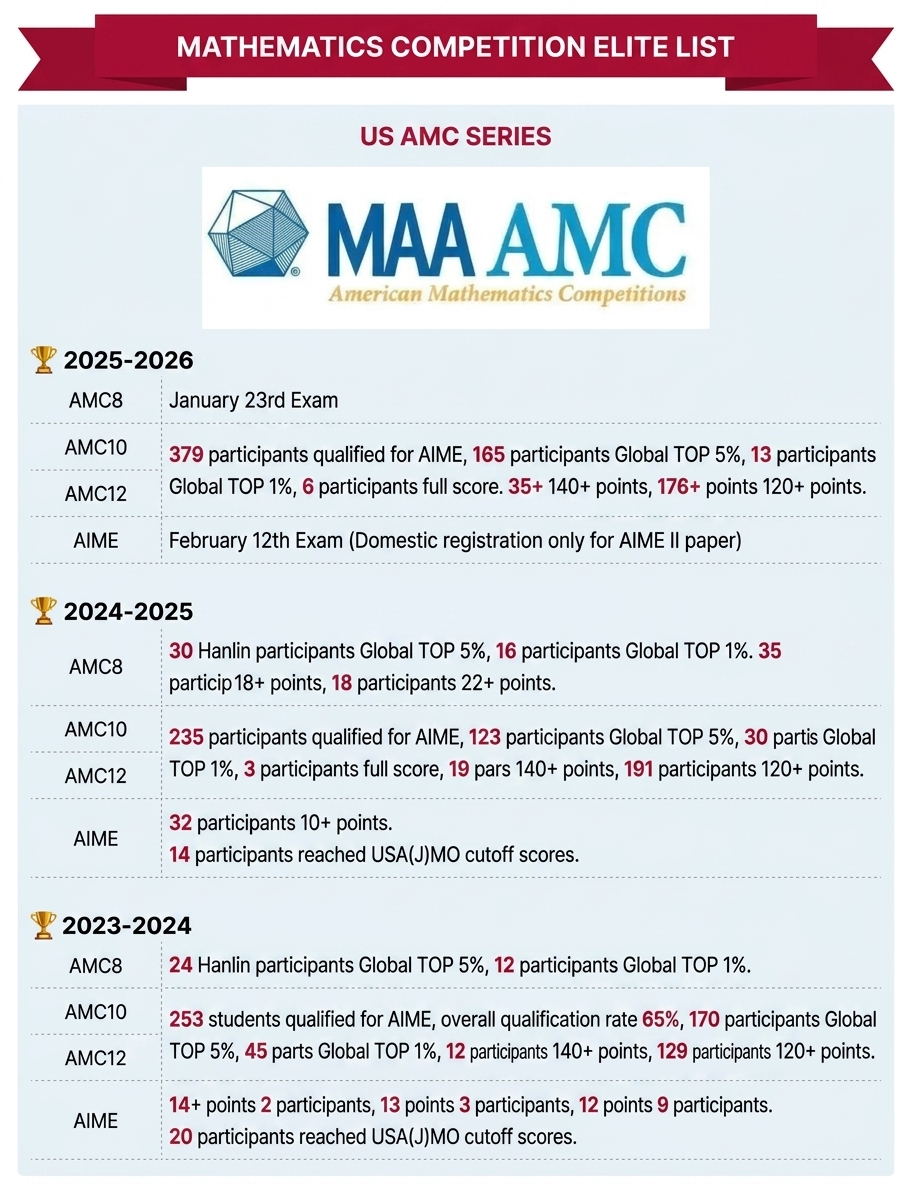

The "zero-error tolerance" trend in the 2025 AMC12 cutoffs (top 1% requiring a perfect score of 150) has sent a clear signal: relying solely on school knowledge or last-minute cramming is no longer enough to stand out in AMC12. Although students from different curriculum systems have their own advantages, gaps in number theory and combinatorics remain common across the board.
This article provides highly customized, phased, and actionable preparation strategies for the five major curriculum systems—Chinese National Curriculum, A-Level, IB, IGCSE, and AP—to help you transform from a "knowledge possessor" into a skilled "competition problem solver."

I. Chinese National Curriculum System
Strengths:
Solid training in functions, trigonometry, and solid geometry; strong computational skills and proficiency in algebraic manipulations.
Blind Spots:
Almost no number theory (congruences, Fermat's Little Theorem, etc.); combinatorics limited to permutation and combination formulas, lacking modeling and recursive thinking.
Three-Phase Breakthrough Path:
| Phase | Timeline | Core Tasks | Recommended Resources |
|---|---|---|---|
| Foundation Building | Now – March 2026 | Fill number theory foundation: • Divisibility, prime factorization • Congruences, modular arithmetic • Introduction to Diophantine equations |
AoPS Introduction to Number Theory Transfer of Chinese Gaokao Diophantine examples |
| Integration Phase | April – August 2026 | Strengthen "Algebra + Geometry" integration: • Power of a Point Theorem + coordinate geometry • Quadratic function extrema (vertex form + special values) • 3D vector rapid modeling |
3 sets of geometry targeted papers per week Categorized practice of AMC12 problems 11–20 from the last 5 years |
| Sprint Phase | September – November 2026 | Full-length mock exams + solidify pacing: • Problems 1–10 ≤15 min (secure 100%) • Problems 11–20 ≤40 min (aim for 80%) • Problems 21–25 ≤20 min (secure 1–2 correct) |
Practice past 5 years of real exams twice: First round by year, second round by topic |
II. A-Level System
Strengths:
C1–C4 cover a wide range of algebra/geometry tools (Vieta's formulas, Law of Sines/Cosines, circle equations); comfortable reading math problems in English.
Blind Spots:
No number theory; combinatorics only touched in Further Math; habit of writing full steps, not adapted to quick multiple-choice solving.
Three Key Preparation Strategies:
Convert A-Level knowledge into "competition tools"
Example: Standard circle equation → combine with Tangent Length Theorem + Pythagorean theorem to solve integrated problems.
Example: Sum-to-product/difference formulas → instantly apply trigonometric expressions without deriving.
Focus on mastering number theory and combinatorics
High-frequency topics: Fermat's Little Theorem, quadratic residues, inclusion–exclusion principle, probability modeling.
Recommended to take specialized courses to systematically break down problem types:
Congruence problems → periodicity / Diophantine equations / modular inverses;
Combinatorial counting → case analysis / recursion / graph theory ideas.
Train "rapid scoring thinking"
Abandon "proof-style" thinking and embrace multiple-choice techniques:
Special value substitution (plug in 0,1,-1);
Process of elimination (using parity, range restrictions);
Estimation and symmetry (especially for geometry problems).
III. IB System: Leverage Transferable Skills to Crack Integrated Hard Problems
Strengths:
Widest knowledge coverage (complex numbers, vectors, matrices, probability distributions); IA exploration fosters strong logic and modeling ability; comfortable reading problems in English.
Blind Spots:
Number theory content scattered (only appears in the Option section); slow problem-solving pace (IB exam timing is more generous); lacks technique training, prone to "correct approach but too slow to finish."
Three Core Actions:
Organize knowledge system to avoid fragmentation
Create a topic-focused mind map for AMC12:
Complex numbers → complex plane + vector rotation + locus problems;
Vectors → spatial geometry + projection + volume calculation;
Probability → conditional probability + expectation + recursive modeling.
Strengthen calculation speed
10 minutes of speed drills daily:
Polynomial factorization;
Rationalizing denominators with radicals;
Trigonometric transformations (target: complete within 1 minute).
Targeted real-exam practice
First round: ensure ≥90% correct on problems 1–20;
Second round: focus on problems 21–25, emphasizing:
Number theory + combinatorics (e.g., prime factorization → integer partition);
Geometry + algebra (e.g., circle + complex numbers + inequalities).
IV. IGCSE System
Strengths:
Solid foundation in basic algebra, geometry, and introductory statistics; good English math vocabulary.
Blind Spots:
Serious lack of depth (no advanced number theory, combinatorics, complex numbers); no exposure to competition thinking (e.g., construction, proof by contradiction, extremal principle).
Preparation Advice:
First transition to AMC10 level: Even for 11th graders, it is recommended to start with AMC10 past exams to identify gaps.
Focus on strengthening:
Number theory: divisibility, congruences, prime properties;
Combinatorics: addition/multiplication principles → inclusion–exclusion → recursion;
Geometry: Power of a Point Theorem, advanced similarity of triangles.
Recommended path:
IGCSE → AMC10 (November 2026) → AMC12 (2027)
V. AP System
Strengths:
AP Calculus: strong skills in function extrema, monotonicity, and graphical analysis;
AP Statistics: deep understanding of probability, permutations/combinations, and expectation.
Blind Spots:
Number theory completely missing; redundant calculus content (AMC12 does not test integration or series); prone to "using advanced tools on basic problems."
Key Preparation Methods:
Filter "applicable AP knowledge"
| AP Content | Application in AMC12 |
|---|---|
| Derivative for extrema | Quick determination of function extrema (without derivative, use vertex form) |
| Probability distributions | Classical probability, conditional probability, expectation calculation |
| Limit thinking | Estimation of large-number behavior (e.g., trends) |
Focus on breaking through number theory
Start with number theory problems from AMC12 problems 1–15;
Gradually move to number theory + combinatorics integrated problems (e.g., 2025 problem 24).
Participate in systematic training
Self-study is inefficient; it is recommended to quickly build the knowledge framework through an AMC12 specialized course.
Online Customer Service | WeChat Consultation