

Why Did AMC12 Cutoff Scores Rise Collectively? Is AMC12 Still Worth Taking? 2026 Long-term Preparation Guide!

AMC12 is an important competition aimed at improving high school mathematical literacy and cultivating students' logical thinking skills. Its academic authority and wide recognition mean that students who achieve excellent results in this competition can gain a competitive advantage in their academic applications, especially when applying to top universities such as Ivy League schools and G5 institutions. AMC12 scores are often regarded as one of the important evaluation criteria.

推荐

I. Analysis of the Reasons for the Collective Rise in AMC12 Cutoff Scores

"Gift Points" Controversy

In the 2023 AMC12 Paper A, the final problem sparked controversy. The MAA committee ultimately decided to award the 6 points for that problem to all test-takers, regardless of whether they answered it correctly.

Direct Impact: This decision led to nearly 200 perfect score students in the China region, whereas in previous years, there were usually fewer than 50 perfect scores. This means a large number of test-takers gained an extra score advantage, pushing the overall cutoff scores higher.

II. Why Is AMC12 Still Worth Taking?

Qualifying for AIME: The primary goal for most students taking AMC12 is to qualify for AIME, thereby adding a competitive advantage to their college applications.

Demonstrating True Ability: Even if perfect scores occur in certain cases, admissions officers will still consider other academic performances (such as A-Level Math grades). If AIME scores are unsatisfactory or standardized test scores do not align with competition results, it may raise doubts.

Academic Enrichment: During the preparation process, students can systematically learn and master a large amount of mathematics knowledge, which not only aids in the competition but also enhances everyday academic performance.

How to Cope with Rising Scores? Improve overall strength: As cutoff scores rise, relying solely on luck or isolated factors can no longer guarantee qualification. Only through systematic training and solid preparation can you stand out in the competition.

推荐

III. 2026 AMC12 Long-term Preparation Guide

Phase 1: Foundation Consolidation (6–12 months before the exam)

Algebra
Review content: Core knowledge points such as functions, equations, inequalities, sequences, polynomials, etc.
Key skills: Factorization techniques, analysis of function properties (monotonicity, parity, etc.).

Geometry
Review content: Triangles, circles, similarity and congruence theorems and their applications.
Key skills: Area formulas, volume calculations, proof methods in geometry.

Number Theory
Review content: Divisibility, prime numbers, congruences, and other foundational concepts.
Key skills: Common theorems (such as Fermat's Little Theorem, Euler's Theorem) and their proof ideas.

Combinatorics
Review content: Permutations and combinations, probability basics, counting principles.
Key skills: Modeling thinking, learning to classify and discuss, and recurrence modeling.

Phase 2: Topic Reinforcement (3–6 months before the exam)

Specialized training by module
Summary of high-frequency problem types: Combine with past exam questions to extract high-frequency test points and problem-solving routines for each module.
Develop reasoning ability: Gradually work on medium-to-high difficulty problems to practice multi-step reasoning and comprehensive application skills.

Real simulation
Timed practice: Conduct at least one timed mock test per week to adapt to the exam rhythm and time pressure.
Organize mistakes: Keep an error notebook, mark causes of errors and improvement measures, and avoid repeating the same mistakes.

Phase 3: Sprint & Mock Exams (1–3 months before the exam)

Real simulation
Adapt to exam intensity: Conduct multiple full-length mock exams according to the official exam schedule to ensure both physical and mental readiness for the high-intensity exam environment.
Time allocation strategy: Practice sound time management skills to secure points on easy and medium-difficulty questions, and make wise strategic choices for challenging problems.

Mindset adjustment
Build stress resilience: Gain on-the-spot experience through mock exams to enhance confidence and adaptability.
Detail control: Emphasize details such as accurate problem reading and standard notation to reduce unnecessary point loss.
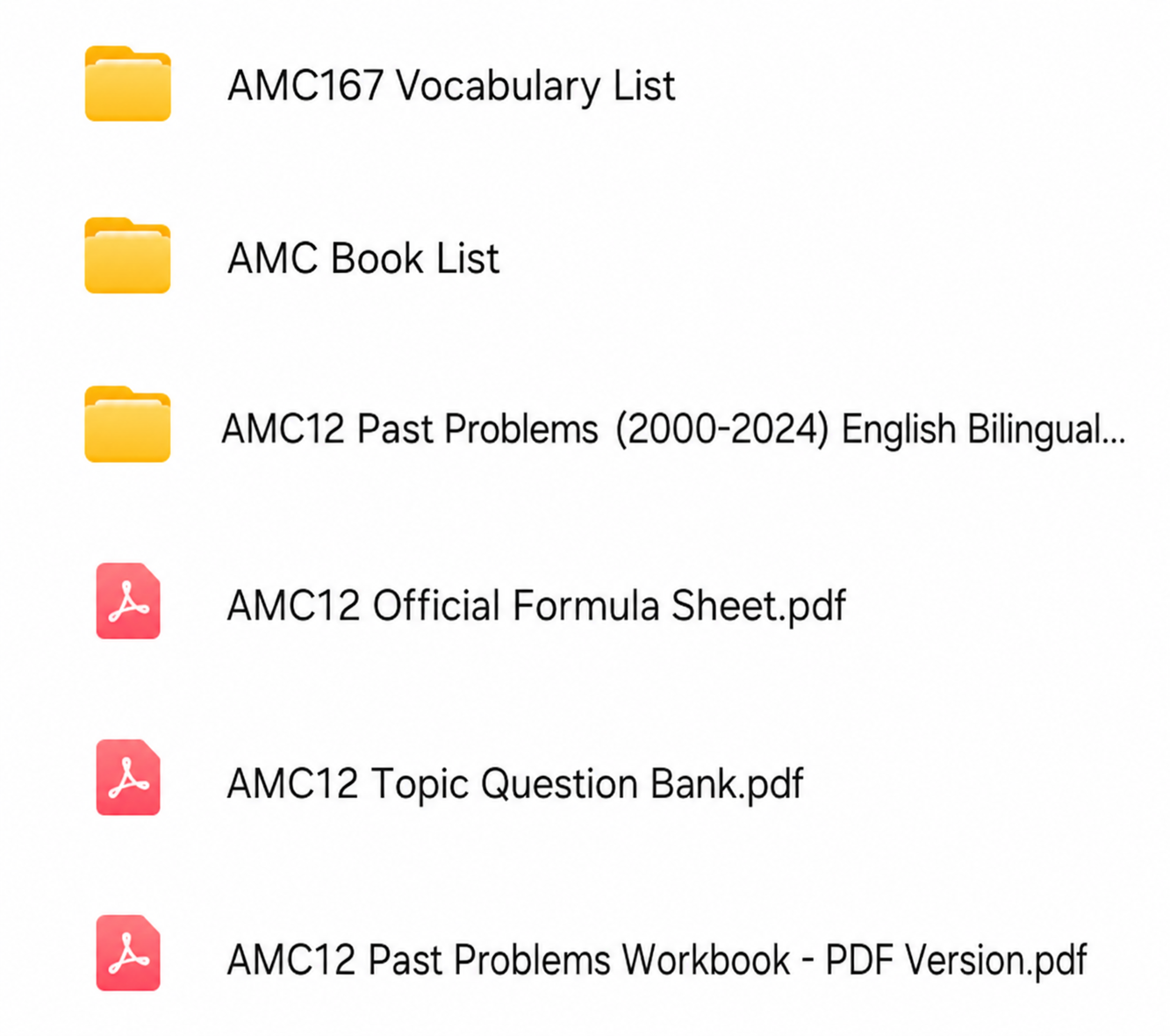
Free AMC12 Preparation Materials: Scan the QR code to get a free AMC12 preparation materials pack (including past exam papers + answer keys + book list + formula sheet, etc.)

2025 AMC10/12 New Awards Cutoff Scores Released! What is the Practical Value of These New Awards?

The 2025 AMC10/12 award cutoff scores have been officially released. This year, two new honors have been innovatively introduced: "Global Top 10%" and "Global Top 25%", aimed at recognizing more outstanding students. This means the overall probability of students winning awards will significantly increase.

推荐

I. 2025 AMC10/12 Award Cutoff Scores Update!

II. Comprehensive Analysis of AMC10/12 Competition Awards

Award Name Qualification Criteria 2025 Cutoff Scores
Perfect Score Award Score = 150 Perfect score required for both AMC10/12 A/B
Distinguished Honor Roll (DHR) Global Top 1% AMC10A: 136.5, AMC12A: 150 (must be perfect!)
Honor Roll (HR) Global Top 5% AMC10A: 112.5, AMC12A: 127.5
AIME Qualification AMC10: Top 2.5%, AMC12: Top 5% AMC10A: 105, AMC12A: 96
Achievement Roll Grade 8 or below + AMC10 ≥ 90 AMC10 only, dual age + score threshold
Top 10% Award Global Top 10% AMC10A: 94.5, AMC12B: 109.5
Top 25% Award Global Top 25% AMC10A: 69, AMC12A: 66
Key Changes: Starting from 2025, MAA has officially added the Top 10% and Top 25% awards, significantly expanding award coverage!

III. Three Core Values of the New Awards

1. Enabling More Students to "Win Awards"

In the past, only about 6% of test-takers could win awards (1% + 5%).

Now, Top 25% means approximately 75,000+ winners (based on 300,000 test-takers).

Average students can also receive official certification, breaking the misconception that "competitions are only for top students."

2. "Effective Endorsement" for College Admissions

Award Application Value
Top 25% Demonstrates mathematical ability above the global average, suitable for: - US high school / UK undergraduate initial screening - Domestic international school transfers / placements
Top 10% Showcases strong logical and problem-solving skills, can be included in: - Common App activities list - UCAS Personal Statement
HR / DHR / AIME "Hard currency" for top STEM program applications, highly regarded by Ivy Leagues / Oxbridge / G5 universities

3. Inspiring Learning Confidence and Long-term Motivation

Getting the first competition certificate → building the belief that "I can do it."

Laying a psychological foundation for subsequent challenges like AIME, Euclid, Physics Bowl.

Avoid giving up interest in mathematics due to the frustration of "zero awards."

III. Award Difficulty and Goal Suggestions by Student Type

Student Type Recommended Goal Preparation Focus
G6–G8 (AMC10) Achievement Roll (≥90) or Top 25% Strengthen algebra and geometry foundations; master word problem techniques
G9–G10 (AMC10) AIME qualification (≥105) or HR (≥112.5) Strengthen combinatorics and number theory; train problem-solving thinking for challenging questions
G11–G12 (AMC12) AIME qualification (≥96) or Top 10% (≥87+) Supplement complex numbers, vectors, advanced probability models
STEM Program Applicants At least AIME qualification; aim for HR/DHR Systematic training + real exam mock tests + error correction loop
Humanities/Social Science Applicants Top 10% or AIME qualification is sufficient Ensure accuracy on the first 15 questions; strategically choose which of the last 10 questions to attempt

推荐

IV. Efficient Preparation Strategy: Three-Phase Sprint Method

Phase 1: Foundation Building (3 months)

Core Tasks: Master the four major modules (Algebra 35%, Geometry 30%, Combinatorics 25%, Number Theory 10%).

Key Breakthroughs: AMC10: permutations and combinations, power of a point theorem, average speed traps; AMC12: complex number operations, trigonometric identities, solid geometry volume.

Phase 2: Real Exam Intensive Practice (3 months)

Work through past papers from 2015–2025, categorized by question number for training.

Q1–15: 20 minutes time limit, target accuracy ≥95%.

Q16–20: 25 minutes time limit, target accuracy ≥70%.

Q21–25: Specialized breakthrough, learn techniques such as "construction method" and "symmetry."

Phase 3: Mock Exam Sprint (1–2 months)

2 full mock exams per week (strictly 75 minutes).

Build an error log categorized by "knowledge point + error cause" (e.g., number theory – misunderstanding of congruence).

Adjust time allocation strategy: don't get stuck on difficult problems; prioritize securing points on foundational questions.

V. Common Misconception Reminders

Misconception Correct Understanding
"Only DHR is useful" Top 10%/25% are also effective in the initial screening stage, especially for non-top applicants
"Chinese version is easier" The English version is closer to the original problem context and exercises academic English; it is recommended to prioritize English
"More practice is better" Blind practice is not as effective as in-depth study of 10 sets of real exams + thorough review
Free Resources: Scan the QR code to get free AMC 10/12 past papers, answer keys, book lists, formulas, and more!

Online Customer Service
Contact Customer Service