

Why Were the 2025 AMC Cutoff Scores "Ridiculously High"? Has the Value of AMC10/12 Changed? Is AMC Still Worth It for Average Students?

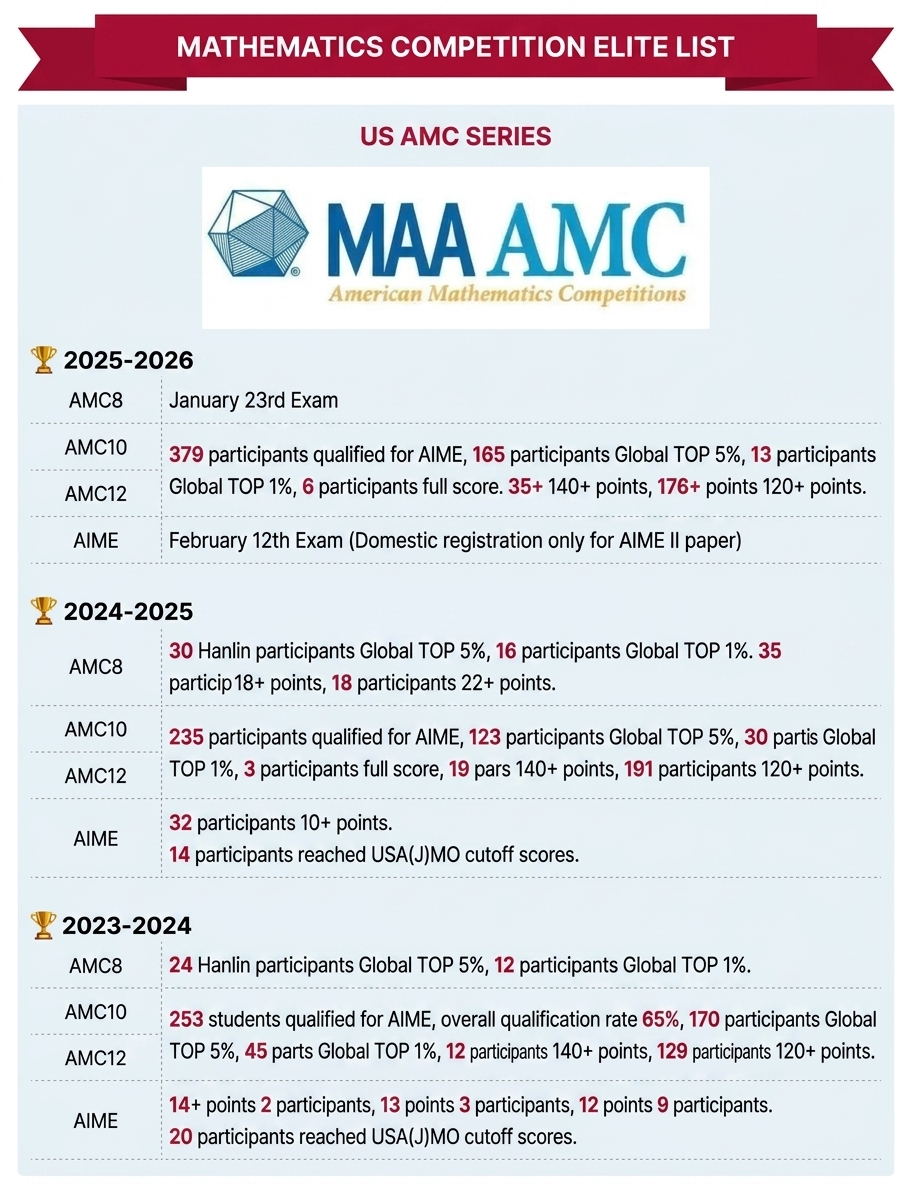
As soon as the official 2025 AMC cutoff scores were released, they immediately sparked heated discussions among parents and in the competition community: The AMC10 AIME cutoff soared from 94.5 to 105 points (+10.5). The AMC12 AIME cutoff skyrocketed from 76.5 to 96 points (+19.5!). Even more shocking: The DHR (Top 1%) cutoff for AMC12 A was 150 points – a perfect score was required!

Many parents exclaimed: "How are we supposed to compete now?" "Is this only for geniuses?" But is that really the case? This article will peel back the layers to reveal the logic behind the soaring cutoff scores, the real changes in the value of AMC, and how average students can benefit from this and achieve a comeback.

推荐

I. Why Were the 2025 AMC Cutoff Scores "Ridiculously High"?

1. Surge in Number of Participants Leads to Severe "Inflation" in the High-Score Range

The global number of AMC10/12 registrants has nearly doubled in the past two years. Especially in first-tier Chinese cities, students begin preparing for AMC8 as early as the fourth grade to lay the groundwork for AMC10. The result: a massive influx of well-trained students, a high concentration of top scores, and cutoff scores naturally rising.

2. AMC12 A, Question 25 Disqualified – Everyone Receives +6 Points

Officials voided Question 25 due to a dispute, automatically giving all test-takers full credit (6 points) for that question. Even so, the Top 1% still required a perfect 150 – meaning the remaining 24 questions had to be answered correctly! This shows that the gap among top-tier competitors has narrowed to a "zero tolerance for errors" level.

3. AMC Gains Recognition from More Prestigious Educational Institutions, Becoming "Hard Currency"

International schools, advanced placement programs, and top overseas universities (especially in STEM fields) heavily rely on AMC scores to identify talent. The more authoritative the exam, the more people value it → the stronger the competitors become → the higher the cutoff scores → the more valuable the credential becomes.

II. Has the Value of AMC10/12 Changed?

It has not weakened, but the "barrier to entry" has risen.

Award Past Role Current Requirement
Top 1% (DHR) Basis for top international schools to "recruit" students Still a "gold label" for STEM applications; Oxford, Cambridge, MIT, Stanford, and other universities highly value it
Top 5% (Honor Roll) Entry ticket to advanced classes/international divisions Now a "basic threshold"; may not be sufficient to stand out by itself
AIME Qualification Proof of mathematical potential Has become the "standard requirement" for applying to STEM programs at G5/Ivy League schools

Real Trend: Previously, achieving a Top 5% score could catch the attention of top universities. Now, you must aim for the Top 1% or a high AIME score to truly stand out. However, even without winning an award, the process of systematically preparing for the AMC holds immense value:

Significant improvement in in-school math performance (AMC training far exceeds the difficulty of the standard curriculum);

Comprehensive enhancement of logical thinking, problem decomposition skills, and stress resilience;

Building a solid foundation for subjects such as high school physics, computer science, and economics.

推荐

III. Is AMC Still Worth It for "Average Students"?

The answer is: Absolutely! And the sooner you start, the better!

Average students derive three core values from preparing for the AMC:

1. Develop advanced problem-solving thinking: In-school math emphasizes calculation and following routines; AMC math emphasizes logical chains, modeling skills, and flexible application.

2. Broaden your options for academic advancement: International school entrance exams heavily borrow from AMC problems. Shanghai Guanghua Cambridge's 2024 entrance exam question 9 was an AMC original question. WLSA Shanghai explicitly requires mastery of AMC core topics such as polynomial factorization and quadratic extrema. The math sections of schools like Beijing National Day School's International Department and Shenzhen College of International Education are roughly equivalent to mid-level AMC10 difficulty.

3. Build long-term academic competitiveness: AMC is just the starting point, serving as a bridge to AIME, USA(J)MO, and interdisciplinary competitions such as HiMCM, BPhO, and Physics Bowl. This path represents the "academic depth" most valued by top overseas universities.
推荐

AMC12 Difficulty Level Compared to Chinese Math + Comprehensive Analysis of Required Abilities! What Skills Are Needed to Learn AMC12?

AMC12 is an advanced math competition for students in 12th grade or below. Its depth and breadth go far beyond the regular high school curriculum, and it is often compared to the Chinese High School Mathematics League (CMO). So, what grade level in China does AMC12 correspond to? What are its similarities and differences with the Chinese High School Mathematics League? And what core abilities are needed to learn AMC12? This article provides a comprehensive analysis.

推荐

I. What Grade Level in China Does AMC12 Correspond To?

Overall AMC12 Difficulty ≈ Level 1 of the Chinese High School Mathematics League (CMO system). Some final problems are comparable to Level 2 introductory level.

Although AMC12 is designed for high school students, the content it tests far exceeds the Chinese college entrance exam syllabus and even covers some advanced pre-college topics (e.g., complex numbers, generating functions, number base conversions, etc.).

Detailed Breakdown of AMC12's Core Exam Modules

AMC12 fully covers AMC10 content and adds the following advanced topics:

Module Topics Added/Enhanced in AMC12
Algebra • Complex number operations and geometric interpretation
• Higher-degree polynomials (Rational Root Theorem, symmetric polynomials)
• Recurrence sequences (linear non-homogeneous)
Functions • Comprehensive applications of logarithmic and exponential functions
• Piecewise discussion of floor and absolute value functions
Trigonometry • Advanced transformations of trigonometric identities
• Trigonometric equations and inequalities
• Applications of trigonometry in geometry (e.g., using the Law of Sines to find areas)
Number Theory • Modular arithmetic (congruences)
• Simplified version of Fermat's Little Theorem
• Number base conversions and digit sums
• Diophantine equations (integer solutions)
Geometry • Power of a Point Theorem, Ptolemy's Theorem
• Solid geometry (Euler's formula, Platonic solids)
• Basic properties of conic sections (ellipse/hyperbola foci)
Combinatorics & Probability • Complex applications of the Inclusion-Exclusion Principle
• Recurrence relation modeling
• Conditional probability and Bayesian thinking
• Introduction to expected value

Most Difficult Areas:
• Problems 21–25 often involve triple fusion of number theory + combinatorics + algebra.
• Extreme time pressure: average of only 3 minutes per question; the last 5 questions often require 5–8 minutes.

Note: AMC12 does not test calculus, but does involve limits, recurrence relations, discrete math, and other advanced topics.

II. Detailed Comparison: AMC12 vs. Chinese High School Mathematics League (CMO)

Aspect AMC12 Chinese High School Math League (CMO Level 1 + Level 2)
Exam Format 25 multiple-choice questions, 75 minutes Level 1: 8填空题 + 3大题; Level 2: 4 proof/complex problems
Core Modules Algebra, Geometry, Number Theory, Combinatorics (four pillars) Level 1: Algebra, Geometry, Trigonometry
Level 2: Plane geometry, Algebra, Number Theory, Combinatorics
Number Theory Emphasis ✓ Heavy! Modular arithmetic, prime factorization, Diophantine equations are frequent Level 1: ✗ Not tested
Level 2: ✓ Core component
Combinatorics Emphasis ✓ Very heavy! Inclusion-Exclusion, recurrence, generating functions common Level 2: ✓ Important, but focuses more on construction and proofs
Analytic Geometry ⚠️ Moderate: Conic sections, symmetry, shoelace formula ✓ Key area in Level 1! Ellipse/hyperbola problems are frequent
Problem Design Breadth-first + cross-module fusion (e.g., solving number theory with trigonometric identities) Depth-first + single-module deep dive (e.g., pure geometry proofs, complex inequalities)
Scoring Rules Correct: 6 points; Unanswered: 1.5 points; Incorrect: 0 points Step-by-step scoring, with emphasis on rigorous process

推荐

III. What Skills Are Needed to Learn AMC12?

1. Solid Foundation in High School Mathematics

Must master: quadratic functions, trigonometric identities, vectors, solid geometry volume formulas, etc.
Suggested prerequisite knowledge: Complete high school compulsory + elective courses (especially complex numbers, logarithms, sequences).

2. Competition-Level Number Theory and Combinatorial Thinking

Ability to understand the meaning of "modular congruence";
Ability to solve path-counting, coloring, and distribution problems using "counting by cases";
Ability to recognize "recurrence structures" and set up equations.

3. Fast Manual Calculation and Stamina Under Pressure

All calculations must be done by hand; calculators are not allowed.
Stay calm under 75 minutes of high pressure, making wise decisions (e.g., skipping questions that are too difficult).

4. Ability to Integrate Knowledge Across Modules

Example: A single problem might require:
"Given an integer satisfying ... with a digit sum of 10, find the minimum ..." – combining number theory, Diophantine equations, and possibly constraints from digit sums.

推荐

Online Customer Service
Contact Customer Service