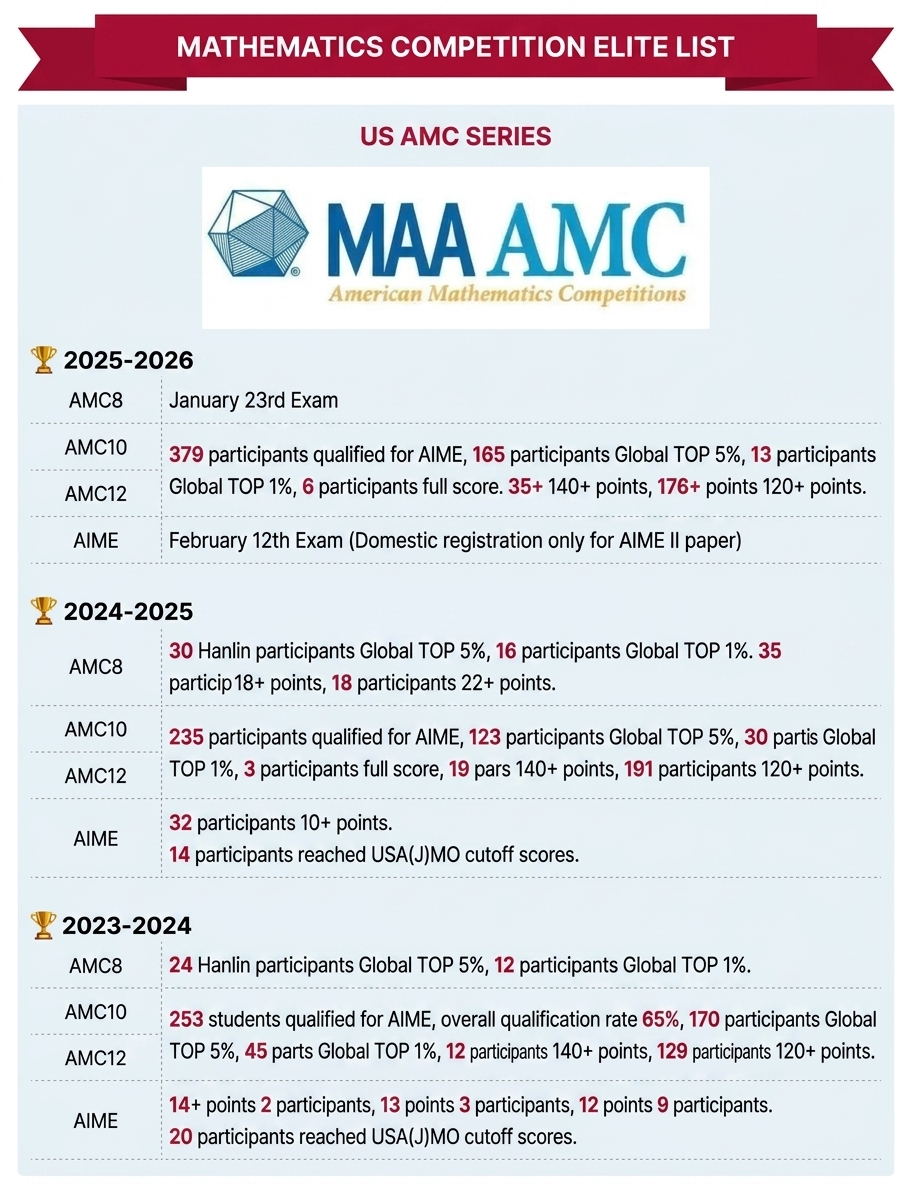

AMC12 is a mathematics competition designed for students in grade 12 and below. It is more difficult than AMC10 and covers a wider range of topics. The AMC12 competition not only tests the breadth of a student's mathematical knowledge but also challenges their problem-solving speed and depth of thinking. Through scientific planning and systematic preparation, even average students can achieve excellent results in this high-level competition.

I. Detailed Analysis of the Four Core Modules of AMC12 and Preparation Strategies
1. Algebra Module (Accounts for 35%-40%)
Foundation Connection: Review of core algebra concepts from AMC10 (polynomial operations, functions and equations, basics of sequences and inequalities).
Advanced Topics:
Advanced Inequalities: Cauchy-Schwarz inequality, mean inequalities (multi-variable extensions), comprehensive methods for solving absolute value inequalities.
Advanced Polynomials: Deepening of the rational root theorem, extension of Vieta's formulas (higher-degree polynomials), advanced techniques for polynomial factorization, properties of polynomial roots.
Advanced Functions: Comprehensive application of logarithmic and exponential functions, transformation of trigonometric identities (sum-to-product, product-to-sum formulas), deep dive into trigonometric function graph transformations and properties.
Complex Numbers: Rules of operation, geometric interpretation (complex plane, modulus and argument), application of De Moivre's theorem.
Module Problem Patterns: A high proportion of comprehensive application problems, often interwoven with geometry and combinatorics modules.
2. Geometry Module (Accounts for 25%-30%)
Foundation Connection: Review of core geometry concepts from AMC10: plane geometry theorems (Pythagorean theorem, similar triangles, etc.), basics of analytic geometry (standard equations and properties of lines and circles), basics of solid geometry (surface area and volume calculations of common 3D shapes).
Advanced Topics:
Advanced Coordinate Geometry: Polar coordinates and parametric equations (conversion, application), the positional relationship between lines and curves.
Advanced Solid Geometry: Application of space vectors (angle and distance calculations), comprehensive problems involving circumscribed and inscribed spheres, folding and unfolding of spatial geometric solids.
Advanced Circle Properties: Comprehensive properties of cyclic polygons, advanced application of the power of a point theorem, deepening of the positional relationships between circles.
Foundations of Conic Sections: Definitions, standard equations, and core properties of ellipses, hyperbolas, and parabolas.
Module Problem Patterns: Increased graphical complexity, requiring the use of algebraic tools for problem-solving, and a high demand for spatial visualization skills.
3. Number Theory Module (Accounts for 15%-20%)
Foundation Connection: Review of core number theory concepts from AMC10: modular arithmetic (understanding basic concepts and applications), divisibility (mastering methods to determine divisibility), prime factorization (proficiency in decomposing numbers into prime factors), basics of congruence equations (understanding concepts and solution methods).
Advanced Topics:
Advanced Number Theory Theorems: Euler's theorem, advanced application of the Chinese remainder theorem.
Advanced Indeterminate Equations: Higher-level solution methods (method of infinite descent, modular analysis), special indeterminate equations (basics of Pell equations).
Number Theoretic Functions: Properties and applications of the Euler's totient function, divisor function, and Gauss's function.
Advanced Congruences: Solving higher-degree congruence equations, comprehensive application of systems of congruences.
Module Problem Patterns: Problems are often subtle, requiring proficiency in the flexible application of number theory tools.
4. Combinatorics Module (Accounts for 15%-20%)
Foundation Connection: Review of core combinatorics concepts from AMC10: permutations and combinations (mastering basic concepts and applications), basics of probability and statistics (understanding basic probability concepts and calculation methods), recurrence relations (mastering basic concepts and applications), basics of the inclusion-exclusion principle (understanding basic concepts and applications).
Advanced Topics:
Advanced Counting: Generating functions (ordinary generating functions, exponential generating functions), advanced applications of the inclusion-exclusion principle.
Advanced Recurrence Relations: Solving linear recurrence relations, introduction to nonlinear recurrence relations.
Advanced Probability: Comprehensive application of conditional probability, calculation of expectation and variance (for discrete random variables), expansion of probabilistic models.
Fundamentals of Combinatorial Geometry: Counting of figures, region division problems.
Module Problem Patterns: High demand for logical reasoning, often presented in practical contexts, with a wide variety of methods.
II. Complete Long-Term Preparation Guide for AMC10/12
Phase 1 (Now - June): Build Knowledge System, Strengthen Foundation
Clarify the approximate weight of each module in the test:
Algebra: 30% (functions, equations, sequences, etc.)
Geometry: 25% (triangles, circles, solid geometry, etc.)
Number Theory and Combinatorics: 20%-25% each
Allocate time based on your own strengths and weaknesses: develop a personalized study plan, focusing on breaking through weak areas.
Phase 2 (July - September): Intensive Practice with Real Exams, Train Answering Rhythm
Select real AMC10/12 questions from recent years and train using the "three-pass method":
First pass - Timed Mock Exam: Strictly complete within 75 minutes to simulate the real exam environment.
Second pass - Categorize and Redo Mistakes: Summarize solution techniques for different question types.
Third pass - Focus on Challenging Problems (Q21-25): Break through mental blocks.
Train Answering Strategy:
Ensure 100% accuracy on the first 10 basic questions.
Control errors on the intermediate questions (Q11-20).
Allocate time reasonably for questions 21-25, avoiding losing easy points due to getting stuck on hard problems.
Phase 3 (October - Before the Exam): Review Mistakes, Sprint for Higher Scores
Create a dedicated error notebook:
Record the error type for each mistake (calculation error / conceptual confusion / strategic error).
Note the topic it belongs to (e.g., "Number Theory - Chinese Remainder Theorem").
Write down the correct solution and link to similar problem types. Review once a week to generalize and extrapolate.
Conduct full mock exams with real questions: adjust your answering rhythm and mindset, and conduct targeted breakthroughs on high-frequency and error-prone points. If aiming for the top 1%, you can additionally practice AIME questions to improve comprehensive problem-solving skills.