
After the release of the 2025 AMC12 results, a shocking phenomenon attracted widespread attention—the cutoff for the global top 1% (Distinguished Honor Roll, DHR) on Version A soared to a perfect score of 150. What exactly happened behind this? What is the true difficulty of AMC12? And how should students prepare for the 2026 exam? This article will provide an in-depth review.
I. The Truth Behind the 2025 AMC12 "Perfect Score Incident"
1. A Question-Writing Error Led to Universal Score Adjustment
A question on the 2025 AMC12 US region Version A contained a writing error—none of the five answer choices was correct. After verifying the issue, the MAA committee applied a universal score adjustment according to competition rules: every test-taker received 6 points (full credit) for that question, regardless of what they had answered.
2. The Chain Reaction of "Distorted" Cutoffs
AMC cutoffs are determined based on the performance of US students. Because everyone received full credit on that question, it was equivalent to all test-takers "getting" an extra 6 points, causing a surge in the number of high-scoring students. As a result, the top 1% cutoff for AMC12 Version A rose to a perfect 150—not because the questions became easier, but due to a rare "technical perfect score."
Important Reminder: This incident was an isolated error and does not reflect the true difficulty level of AMC12. When preparing for the 2026 exam, do not use this as a difficulty reference. Instead, aim for the cutoffs of normal years (around 120–130 for the top 1%).
II. Why Is AMC12 a "Golden Ticket" for US College Applications?
AMC12 is an advanced mathematics competition for high school students, with tens of thousands of participants worldwide. Its scores are recognized by top universities across the US and around the globe.
The Key Difference from In-School Mathematics: In-school exams focus on knowledge memorization and formula application, while AMC12 emphasizes logical thinking, comprehensive problem-solving, and innovative adaptability.
In the eyes of admissions officers, AMC12 scores are one of the strongest academic proofs of a student's mathematical potential.
The Value of Achieving a Global Top 1% Honor in AMC12:
✅ Directly adds a bonus point to applications for top universities
✅ Grants direct entry to the AIME Invitational, building a complete mathematics competition portfolio
✅ Makes your US college application profile stand out immediately
III. Understanding the True Difficulty of AMC12
Many students mistakenly believe that AMC12 is a "basic high school competition," but in reality, its difficulty far exceeds that of regular domestic high school courses and is close to the level of the High School Mathematics League. The challenges are concentrated and highly specific:
Challenge 1: Broad Coverage with Extensive Out-of-Syllabus Content
The exam covers four core modules: advanced algebra, solid analytic geometry, number theory, and combinatorics. These include complex numbers and trigonometric identities, modular arithmetic and Diophantine equations—topics that are either only briefly touched upon or not taught at all in domestic high schools. Knowledge gaps can easily lead to significant point loss. Systematic learning is the only way to avoid these pitfalls.
Challenge 2: Highly Flexible and Integrated Question Types
In-school problems are mostly direct applications of formulas, whereas AMC12 questions are often cross-module integrated problems—a single question may combine geometry, algebra, and number theory. Rote memorization is useless; the exam tests your ability to quickly deconstruct problems and apply knowledge flexibly.
Challenge 3: Tight Pacing and High-Difficulty Final Problems
25 questions in 75 minutes means very little time to think and solve each problem. The first 20 questions focus on foundational and intermediate-level problems and are the core of your score. The last 5 final problems are significantly more difficult, approaching the level of the AIME competition, and are the key differentiator for those aiming for the top 1%.
IV. Practical Tips for Boosting Your AMC12 Score
Tip 1: Categorized Error Management
Label your mistakes with three types of tags, and prioritize the first two types—which are "easier to score" on:
| Tag Type | Characteristics | Priority |
|---|---|---|
| Calculation Error | Right approach, wrong calculation | ⭐⭐⭐ Highest |
| Vague Knowledge | Have an impression but can't apply it | ⭐⭐⭐ Highest |
| Completely Clueless | No idea at all | ⭐⭐ Tackle later |
Tip 2: Master Multiple-Choice Shortcuts
AMC12 is entirely multiple-choice. Make good use of the following techniques to significantly boost efficiency:
Special Value Substitution: Replace abstract variables with concrete numbers
Option Elimination: First eliminate clearly wrong options
Estimation: Quickly narrow down the answer range to reduce precise calculations
Tip 3: Strict Timed Training
Learn to decisively skip any problem that leaves you without a clue for more than 1 minute, and focus your energy on the parts you are confident about. AMC12 is not about "finishing all the questions," but about "getting the most points possible within the time limit."
Tip 4: Scientific Time Allocation During the Exam
It is recommended to follow this pacing, adhering to the principle of "secure the basics → compete on intermediate → challenge the difficult":
| Question Range | Recommended Time | Strategy |
|---|---|---|
| Questions 1–15 | 40 minutes | Steady and solid, aim for all correct |
| Questions 16–20 | 20 minutes | Aim to solve, create separation |
| Questions 21–25 | 15 minutes | Take what you can, don't get stuck |
Tip 5: Avoid Common Mistakes
Pay special attention to these three types of "invisible point-loss traps":
⚠️ Domain of a function: Ignoring domain restrictions can lead to incorrect answers
⚠️ Ordered vs. unordered in probability problems: Confusing permutations and combinations
⚠️ Boundary initial conditions in recurrence sequences: Failing to verify initial values can lead to incorrect general term formulas
We are an authorized AMC test center and offer free registration assistance!
Scan the code to inquire about AMC 12 registration for the 2026 season ⇓

Scan the QR code to get free AMC 12 prep resource pack
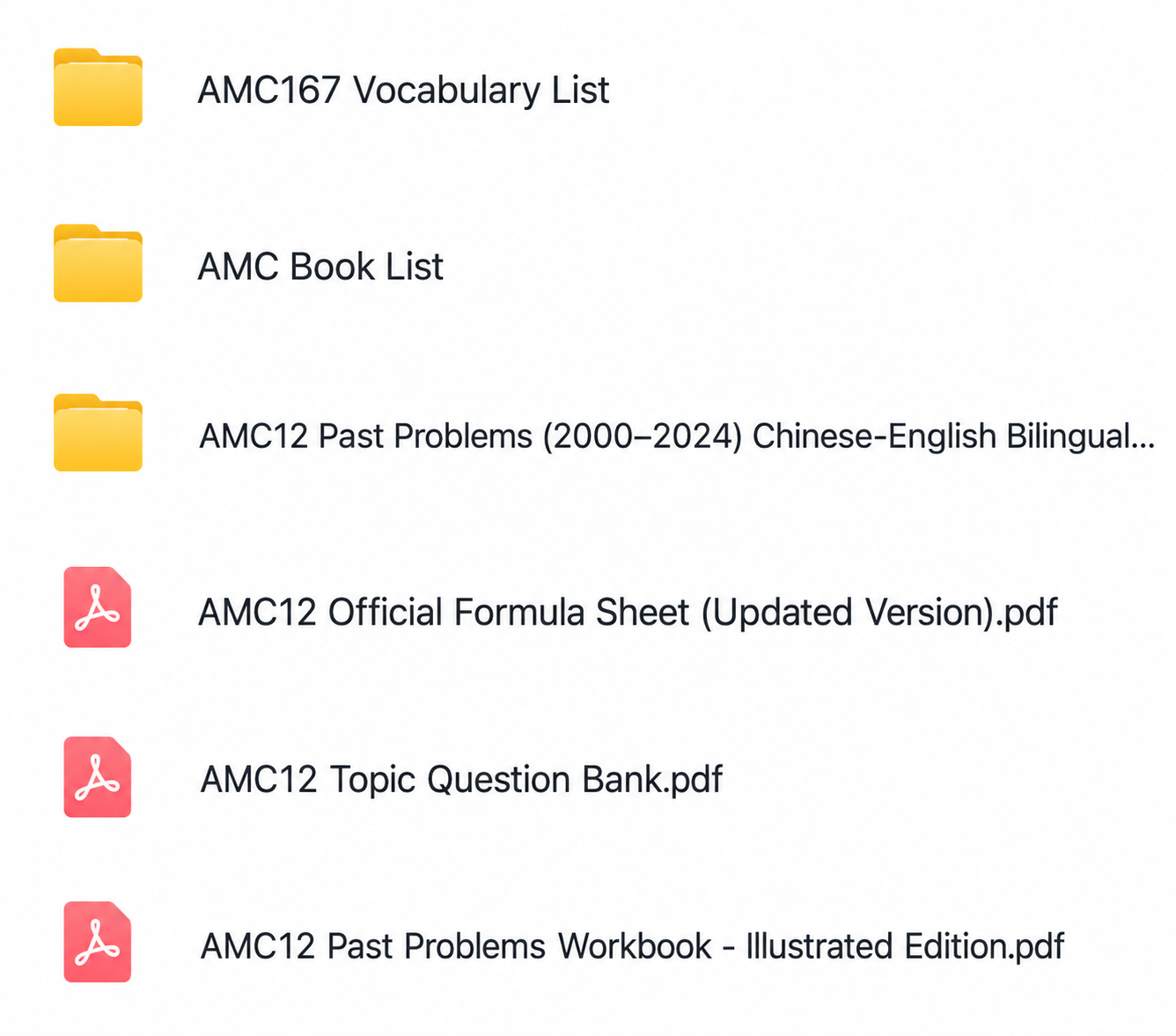
(Includes past AMC 12 exam papers with solutions, reading lists, formula sheets, and more)