
For the vast majority of participants, the primary strategic goal of taking AMC12 is not to achieve a globally top-tier honor, but to secure an invitation to the AIME (American Invitational Mathematics Examination). Many students and parents often feel confused during preparation: "What exact score on AMC12 is needed to securely qualify for AIME? What is the difference in cutoff scores between Version A and Version B? How can students with zero or weak foundations lock in qualification through a reasonable 'score-control strategy'?"
This article provides you with the most hardcore review of official historical data, helping you thoroughly understand the AIME qualification cutoff scores for AMC12 and the golden logic of preparation.
I. What Are the Official Rules for AMC12 Advancement to AIME?
First, we need to clarify the underlying logic behind how the official committee sets the AIME cutoff. Unlike some domestic exams that award based on a fixed score (such as 60 points for passing), AMC12 is a global norm-referenced assessment (relative score evaluation).
Basic Format: The paper consists of 25 multiple-choice questions (5 options each), with a total exam time of 75 minutes and a maximum score of 150.
Scoring Formula: Final Score = (Number of Correct Answers × 6) + (Number of Blank Answers × 1.5) + (Number of Wrong Answers × 0)
Qualification Hard Requirement: Officially, participants who rank in the global top 5% in the current AMC12 exam (Versions A and B are calculated independently) will automatically qualify for AIME.
Key Advantage: Many new competitors are unaware that the AIME qualification rate for AMC12 (top 5%) is exactly twice that of AMC10 (top 2.5%)! Although AMC12 introduces advanced topics such as logarithms, trigonometric functions, and complex numbers, the qualification cutoff is often lower than that of AMC10 due to the relaxed qualification ratio. This provides students with a solid high school mathematics foundation with significant strategic room for error.
II. Complete Summary: Historical AMC12 AIME Qualification Cutoff Trends
Since the difficulty of the questions, the computational load, and the overall performance of global participants fluctuate each year, the AIME cutoff is not a fixed number. Below is a trend review and core range summary based on recent official data:
1. Three Core Ranges of Historical Qualification Cutoffs
Based on recent changes in question design styles, the AIME cutoff for AMC12 (Versions A and B) can be divided into three typical scenarios:
High-difficulty years / years with frequent innovative questions (e.g., extremely heavy computation, difficult number theory final problems): The cutoff typically drops to the 81–85.5 range.
Standard years / moderate difficulty (the most common scenario): The cutoff typically remains stable in the 88.5–93 range.
Easier years / more traditional question types (intense competition, many high scores): The cutoff is pushed up to around 96–100.5.
2. Cutoff Differences Between Version A and Version B
AMC12 offers two exam sessions each year—Version A and Version B (held a few days apart). The knowledge coverage of the two versions is identical, but the cutoffs are determined independently.
Typically, if Version A in a given year is more difficult and has a lower cutoff, Version B in the same year tends to be relatively stable, with the cutoff fluctuating slightly.
Strategic Advice: It is strongly recommended that students with the means register for both Version A and Version B. Taking both not only provides an extra opportunity for "stress rehearsal" but also allows you to securely qualify through the other version if one exam turns out to be exceptionally difficult.
III. The "Golden Score-Control Model" for Securing AIME Qualification
Now that we know the approximate cutoff ranges, we must absolutely avoid blind guessing during the exam. AMC12's unique "1.5 points for blank answers" mechanism provides an excellent mathematical tool for developing a score-control strategy.
Assuming a relatively conservative AIME cutoff of 91.5 points for the year, here are two "secure and win" golden score-control models best suited for Chinese students:
Model A: Maximum Stability Type (Suitable for students with average foundations who aim for zero mistakes)
Strategy: Only attempt the first 12 questions, ensuring 100% accuracy. For the remaining 13 questions, firmly resist the urge to guess and leave all of them blank.
Final Score Calculation: 12 correct × 6 points = 72 points; 13 blank × 1.5 points = 19.5 points; Total = 91.5 points.
Assessment: This score puts you right on the cutoff line or securely qualifies. This strategy minimizes exam pressure—you don't need to look at any difficult final problems; you only need to thoroughly and carefully solve the first 12 questions (which are typically foundational questions at or below Grade 10 level).
Model B: Aggressive with Error Tolerance Type (The most recommended standard preparation model)
Strategy: Complete the first 15 questions (aim for 14 correct, allowing 1 mistake). Among the remaining 10 difficult questions, pick 2 that you are best at—such as algebra or complex numbers—and attempt them (aim for 1 correct, 1 wrong). Leave the other 8 questions blank.
Final Score Calculation: (14 correct × 6 points) + (1 wrong × 0 points) + (1 correct among the difficult ones × 6 points) + (8 blank × 1.5 points) = 84 + 0 + 6 + 12 = 102 points.
Assessment: This score comfortably surpasses the vast majority of historical AIME cutoffs! It may even reach the threshold for the Global Top 5% (Honor Roll) award. This model allows for up to 2 mistakes under exam pressure, offering a very high tolerance for errors.
We are an authorized AMC test center and offer free registration assistance!
Scan the code to inquire about AMC 12 registration for the 2026 season ⇓

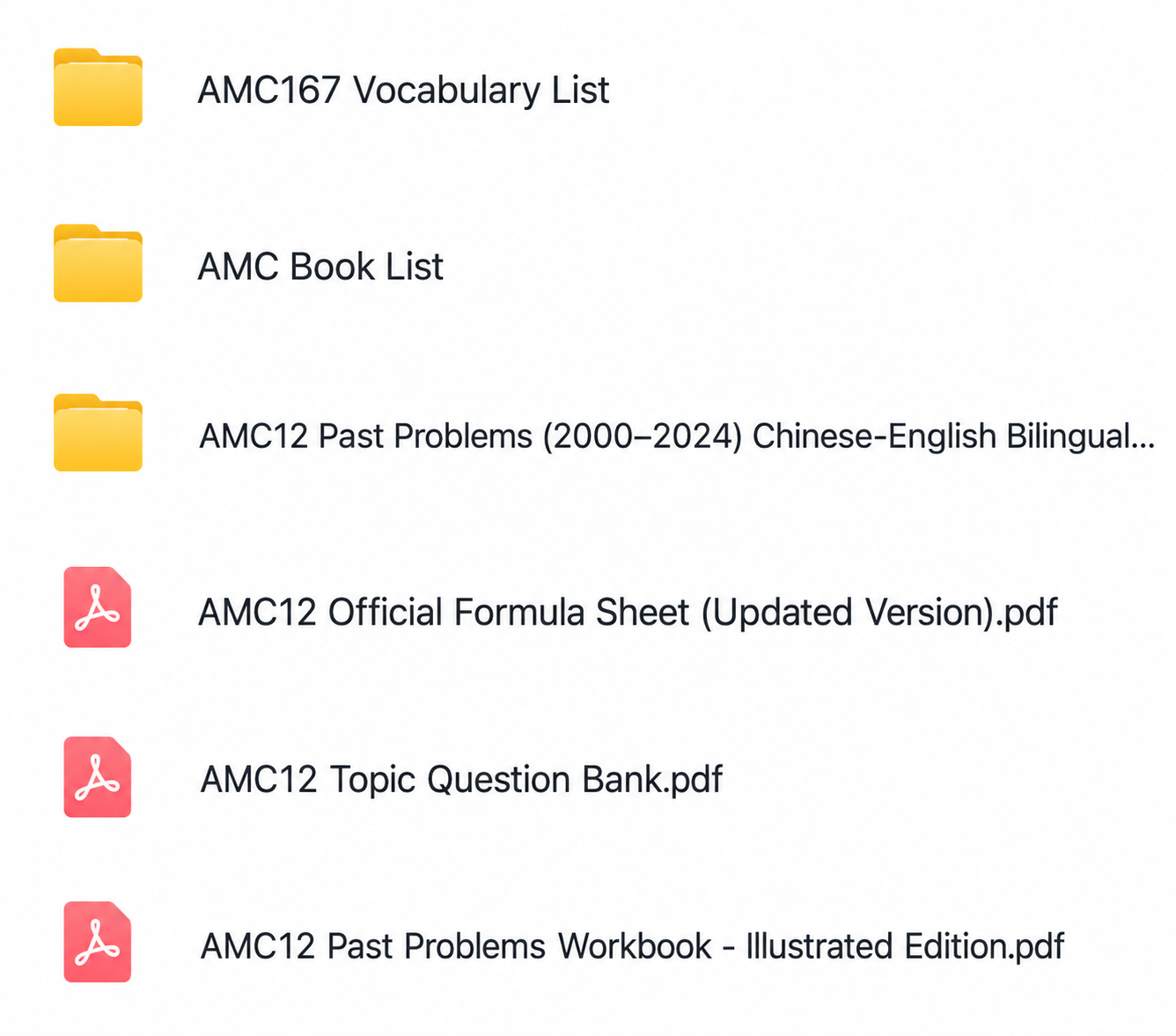
Scan the QR code to get free AMC 12 prep resource pack
(Includes past AMC 12 exam papers with solutions, reading lists, formula sheets, and more)