
When faced with the two core competitions, AMC10 and AMC12, many students and parents often find themselves in a dilemma: "How big is the gap between these two? Is it merely a difference of two grade levels? If a student currently has a solid foundation, which one should they choose?" In fact, AMC12 is by no means a simple "upgraded version" of AMC10. They differ fundamentally in knowledge dimensions, problem-solving thinking, and strategic advancement lines. This article provides a comprehensive, data-driven comparison of the two competitions, helping you thoroughly understand their core differences.
I. Core Basic Information: The Surface Differences Between the Two Competitions
Let's first look at the basic official rules of AMC10 and AMC12 through an intuitive comparison table:
| Comparison Dimension | AMC10 Competition | AMC12 Competition |
|---|---|---|
| Grade Eligibility | Grade 10 and below (and under 17.5 years old on the day of the exam) | Grade 12 and below (and under 19.5 years old on the day of the exam) |
| Exam Format | 25 multiple-choice questions, 75 minutes, total score 150 | 25 multiple-choice questions, 75 minutes, total score 150 |
| Scoring Rules | Correct answer: +6 points; Wrong answer: 0 points; Blank answer: +1.5 points | Correct answer: +6 points; Wrong answer: 0 points; Blank answer: +1.5 points |
| AIME Qualification Quota | Approximately top 2.5% globally | Approximately top 5% globally |
| Core Assessment Focus | Breadth and speed of basic mathematical thinking | Deep application and deduction of advanced mathematical tools |
From the basic competition structure, the two exams have identical question counts, time limits, and scoring methods. However, the most critical differences lie in the "disconnect in knowledge points" and the "dividend in advancement cutoffs."
II. Knowledge Gap: The Disconnect from "Middle School Algebra" to "Advanced Complex Numbers"
This is the largest and deepest chasm between AMC10 and AMC12. Although neither competition tests college-level calculus, their depth of engagement with high school mathematical tools is on completely different levels.
1. AMC10's Knowledge Scope: Algebra and Geometry as the Core
AMC10's testing scope mainly includes the deepening of middle school mathematics and a portion of foundational Grade 10 mathematics.
Core Exam Points: Proficiency in quadratic functions, simple arithmetic/geometric sequences, relationships between roots and coefficients of quadratic equations (Vieta's theorem), plane geometry (similar triangles, analytic properties of circles).
Student Experience: The questions are highly flexible but not difficult to understand. The main assessment is the student's ability to use elementary algebraic and geometric tools to solve problems with "speed and precision."
2. AMC12's New Arsenal: Three Major Advanced Modules
AMC12 fully encompasses all AMC10 content while comprehensively introducing the most abstract and powerful mathematical tools from the senior high school curriculum:
Advanced Functions: Introduces extreme simplifications of logarithmic functions and highly complex sum-to-product and double-angle identities nested within trigonometric functions.
Complex Numbers and Vectors: Introduces the geometric meaning of complex numbers on the complex plane, basic Euler's formula, De Moivre's theorem, and the use of spatial vectors to solve solid geometry problems.
Advanced Number Theory: Introduces hardcore theorems at the level of the High School Mathematics League, such as the Chinese Remainder Theorem and Fermat's Little Theorem.
Concrete Gap: Faced with the same geometry rotation problem, an AMC10 competitor must painstakingly search for clever auxiliary lines; meanwhile, a student who has mastered complex numbers and vectors for AMC12 can directly establish a coordinate system on the complex plane and use advanced tools to deliver a "brute-force cross-dimensional strike."
III. Cutoff Score Gap: AMC12's Counterintuitive "Strategic Dividend"
Many students, upon hearing that AMC12 questions are more difficult, naturally assume that AMC12 is even more unattainable. However, from the strategic perspective of advancing to AIME, AMC12 offers a huge counterintuitive dividend.
1. Qualification Ratio Doubled
AMC10: Only the top 2.5% of global competitors can secure an invitation to AIME.
AMC12: The official qualification channel is generously widened to the top 5% globally.
2. Historical Qualification Cutoff Differences
Due to the relaxed qualification ratio, the AMC12 advancement cutoff is typically significantly lower than that of AMC10:
AMC10's Norm: In years with easier questions, the AMC10 cutoff often approaches 100 or even 105 points. This means you can only afford to get 4 questions wrong or left blank within the 75-minute time limit—an extremely demanding requirement for both speed and accuracy.
AMC12's Dividend: In previous years, the AMC12 cutoff has often remained in the range of 85–91.5 points.
3. Score-Control Strategy: A Dimensional Comparison
Let's do the math to see how much the margin for error differs between the two competitions when aiming for an AIME invitation:
To score 102 points in AMC10 for qualification: Strategy: Must get 15 questions correct and leave 8 blank. (At most, you can afford to not solve 10 questions.)
To score 91.5 points in AMC12 for qualification: Strategy: Only need to get 12 questions correct and leave 13 blank. (You can afford to ignore more than half of the difficult questions on the entire paper!)
This shows that AMC12's perfect "high tolerance for errors" provides an excellent strategic pathway for students who are not good at sprinting for speed but excel at tackling difficult, advanced knowledge points.
We are an authorized AMC test center and offer free registration assistance!
Scan the code to inquire about AMC 12 registration for the 2026 season ⇓

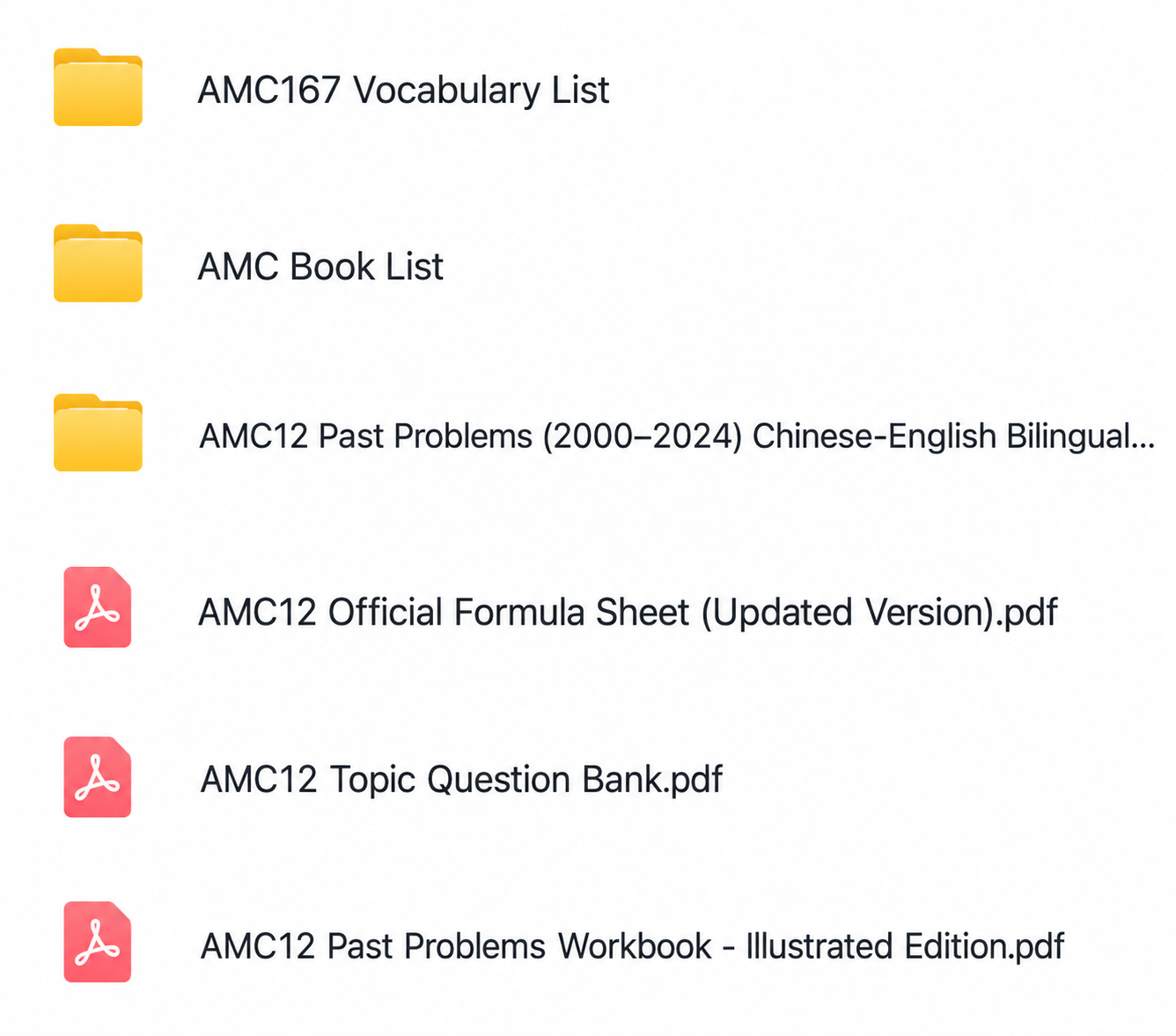
Scan the QR code to get free AMC 12 prep resource pack
(Includes past AMC 12 exam papers with solutions, reading lists, formula sheets, and more)