
The 2025 AMC12 competition has come to a close. What new characteristics did this year's questions present? How do they differ from previous years? And how should candidates prepare for the 2026 exam? This article provides a comprehensive analysis of the exam, from question breakdown and trend prediction to preparation strategies, for students and parents planning to participate.
I. Core Characteristics of the 2025 AMC12 Questions
1. Number Theory Module "Pervades the Entire Paper," Becoming a Must-Know Key Area
In the 2025 AMC12 B, there were as many as 7 number theory questions, distributed throughout the early, middle, and later sections. This means number theory is no longer an "optional" module but a core component running through the entire paper. From basic divisibility problems to advanced congruence operations, the depth and breadth of number theory assessment have significantly increased.
2. Surge in Cross-Module Integrated Questions
The most prominent change this year was the significant enhancement of cross-domain integration. A typical example is the "deep comprehensive application of complex logarithms and function transformations"—such questions weave together knowledge points from multiple modules such as complex numbers, logarithms, and function transformations, requiring students not only to "know each module" but also to "connect the modules."
This deep integration of number theory + combinatorics, algebra + geometry appeared with significantly higher frequency in 2025 than in previous years. The preparation model of relying solely on "module-based practice" is no longer sufficient to handle such comprehensive questions.
3. Overall Difficulty Steadily Increased, with Heavier Computation in Mid-Range Questions
Compared to previous years, the overall difficulty of the 2025 AMC12 showed a trend of "steady increase." A notable change was the significant rise in computation load for mid-range questions (Questions 11–18), leading to dispersed pressure—students were no longer only stumped by the final few questions but began to feel time pressure in the middle section. Although each individual question was manageable in difficulty, the extended time required for solving posed higher demands on overall time allocation.
II. 2026 AMC12 Exam Trend Forecast
Based on the changes in the 2025 exam, we make the following three predictions for the 2026 AMC12 question trends:
Trend ①: Higher-Order Thinking
AMC12 will increasingly focus on assessing higher-order mathematical thinking, rather than simple knowledge recall or formula application. Questions will place greater emphasis on the rigor of logical reasoning, the flexibility of problem transformation, and the ability to extract key information from complex conditions.
Trend ②: Intensive Algebraic Computation
Advanced algebraic computation will become key to winning awards. Algebraic techniques such as complex number operations, polynomial transformations, exponential-logarithmic combinations, and sequence recursion will occupy a more important position in the 2026 paper. The gap in computation speed and accuracy will be directly reflected in scores.
Trend ③: AIME-Style Normalization
In the future, the difficulty and question style of AMC12 will lean more toward the AIME Invitational, with deeper and more comprehensive assessments. This means the "gap" between AMC12 and AIME is narrowing, and top AMC12 performers will need to possess problem-solving abilities close to the AIME level.
III. Why Is Summer the Best Time for AMC12 Preparation?
1. Ample Learning Time
AMC12 covers a wide range of modules—algebra, geometry, number theory, combinatorics, functions, probability and statistics—with broad knowledge and strong comprehensiveness. After the school term begins, it is difficult to find large blocks of time for systematic learning due to the demands of coursework, exams, and other activities. Summer, however, allows for concentrated completion of the first round of knowledge review, laying a foundation for subsequent intensive training.
2. Facilitates Targeted Sprint After School Starts
After completing intensive knowledge lectures and core考点 learning during the summer, students from September to November can devote more time to past paper practice, mock exams, and gap-filling, rather than learning new knowledge and practicing simultaneously, thereby improving overall preparation efficiency.
IV. Analysis of the Three Major Challenges in AMC12 Preparation
Challenge 1: Close Interconnection of Knowledge Modules
AMC12 involves multiple mathematical fields, requiring students not only to master fundamental knowledge but also to flexibly apply content from different modules to solve comprehensive problems. Key modules include:
| Module | Core Content |
|---|---|
| Algebra | Functions and equations, inequalities, polynomials, exponents and logarithms, complex numbers, sequences, etc. |
| Geometry | Plane geometry, analytic geometry, circles, triangles, solid geometry, vectors, etc. |
| Number Theory | Divisibility, congruences, prime numbers, greatest common divisor, least common multiple, modular arithmetic, etc. |
| Combinatorics and Probability | Permutations and combinations, counting methods, recursion, probability models, etc. |
Among these, combinatorics and number theory are often the sections where many students lose the most points during preparation. These two areas are less covered in domestic school curricula but account for a very high proportion in AMC12, making them essential for targeted breakthrough.
Challenge 2: High Discrimination in the Last 10 Questions
AMC12 consists of 25 multiple-choice questions in total. The first 10 questions mainly test fundamental knowledge, the middle questions emphasize comprehensive application, while the last 10 questions are typically significantly more difficult and are key to among high-scoring students. These questions often require the integrated application of multiple knowledge areas, placing high demands on problem-solving approaches, mathematical intuition, and computational ability. Therefore, relying solely on practice is insufficient; one must also summarize methods and build models.
Challenge 3: Both Speed and Accuracy Are Equally Important
The AMC12 exam lasts 75 minutes, requiring completion of 25 questions, averaging only about 3 minutes per question. Many students fail not because they cannot solve the problems, but because of poor time allocation, calculation errors, or getting stuck on difficult questions during the exam, which affects their overall performance.
Strategic Advice: Learn to "strategically"—if you have no idea how to approach a question after more than 5 minutes, skip it decisively, ensure you score on all questions you can solve, and return to the difficult ones if time permits.
We are an authorized AMC test center and offer free registration assistance!
Scan the code to inquire about AMC 12 registration for the 2026 season ⇓

Scan the QR code to get free AMC 12 prep resource pack
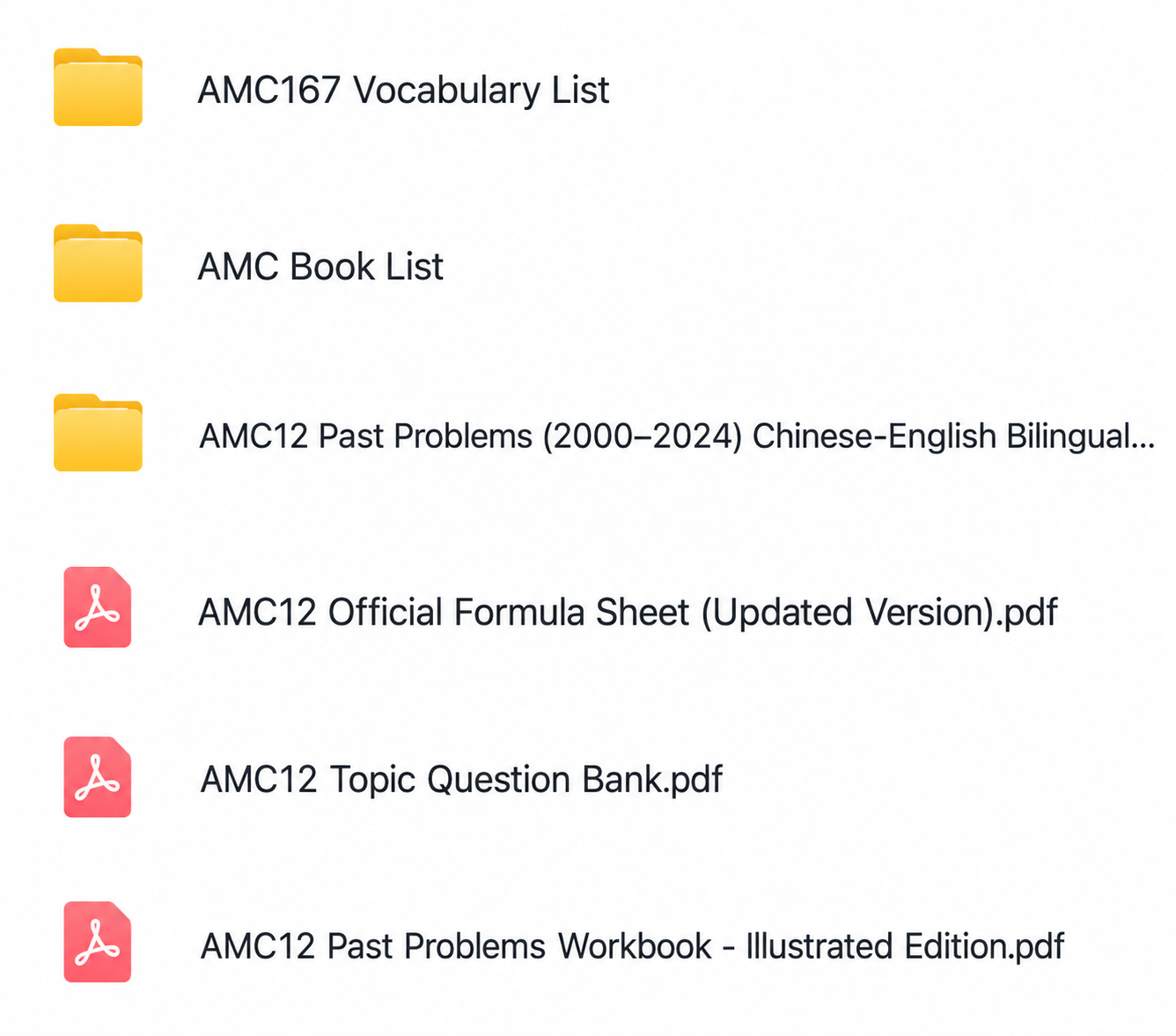
(Includes past AMC 12 exam papers with solutions, reading lists, formula sheets, and more)