
Hearing the name "AMC12 covers high school mathematics up to grade 12," many students who have never received systematic Olympiad training and have only average in-school math grades often become intimidated before even starting: "Can a true zero-base beginner really tackle AMC12? How can they achieve a strong comeback without becoming cannon fodder?"
The answer is: absolutely yes.
Compared to AMC10, which has an extremely low tolerance for errors, AMC12 offers a more generous advancement ratio (global top 5% qualify for AIME) and a lower cutoff score advantage. As long as you extend your preparation timeline and execute a scientific, precise "annual study plan," even a zero-base beginner can securely secure an AIME invitation in the new season!
I. Two Core Knowledge Gaps That Zero-Base AMC12 Preparers Must Bridge
Before drawing up a plan, zero-base candidates must stay clear-headed and the real gap between themselves and AMC12. Your core areas to fill are not in calculus, but in advanced algebra that is rarely covered in school and competition-specific modules:
Advanced Algebra and Advanced Functions (Core New Content): This is the watershed between AMC12 and AMC10. It includes the geometric meaning of complex numbers and rotations, extreme simplification of logarithmic functions, and trigonometric identity transformations (sum-to-product/product-to-sum). School only tests formula substitution, while AMC12 tests the cross-integration of tools.
Elementary Number Theory and Advanced Counting (School Blind Spot): Congruence equations, advanced transformations of prime factorization, recursion models in permutations and combinations, and the stars and bars method—topics barely touched in school. These are frequent visitors in the last 10 difficult questions and require building a logical foundation from scratch.
II. Zero-Base Comeback: AMC12 Annual Efficient Study Plan Guide
The AMC12 exam is usually held in November each year. Targeting the learning curve of zero-base beginners, we scientifically divide the year-long preparation cycle into four phases. Be sure to follow the sequence step by step, and absolutely avoid blindly practicing with past papers in the first phase.
Phase 1: Early Start and Foundation Building (January – May)
Core Task: Rapidly build the knowledge foundation and fill your competition toolkit.
Action 1 (In-School Advancement): Use this time, through self-study or systematic courses, to complete in advance all the algebra, functions, and solid geometry content from AP Pre-Calculus, IB DP Math HL (early to mid-stage), or the domestic grade 11–12 curriculum.
Action 2 (Competition Foundation): Focus on the classic American Olympiad textbook The Art of Problem Solving (AoPS) Volume 1: The Basics. Systematically conquer the three major new core modules—complex numbers, logarithms, and trigonometric functions—ensuring you no longer feel unfamiliar when seeing related symbols.
Phase 2: Modular Intensive Training and Deep Internalization (June – August Summer Break)
Core Task: Break down past papers, conquer topics one by one, and build competition muscle memory.
Action 1 (Topic Focus): Do not complete full papers by year. Instead, completely拆解 the past 15 years of AMC12 past papers into five major modules: Algebra, Functions, Geometry, Number Theory, and Combinatorics. Use the summer's large blocks of golden time for high-density轰炸. For example: spend one week doing only all the trigonometry and complex numbers questions from past papers, thoroughly understanding the examiners' trap-setting patterns for this topic.
Action 2 (Create a Bilingual Error Log): Zero-base candidates are extremely prone to stumbling on the qualifiers in long English problem statements. When you encounter errors due to contextual misunderstanding or logical gaps, copy them into your error log and use the AoPS Wiki to view 3–5 different solution approaches from global experts, completing a mental reconstruction.
Phase 3: Timed Mock Exams and "Strategic Abandonment" Practice (September – October)
Core Task: Strictly simulate the real exam environment, refine score-control strategies, and enhance peak performance.
Action 1 (Full-Length Mock Exams): Every weekend, strictly set a 75-minute timer and, in a completely quiet environment, carefully work through full past papers from the last 5 years (both A and B versions).
Action 2 (Practice "Strategic Abandonment"): The iron rule for zero-base beginners on exam day is: absolutely do not get stuck on questions 18 and beyond. Practice判断 within 30 seconds whether a question is "worth sticking with" or "better left blank with dignity". Continuously adjust your mindset during mock exams, and do not be thrown off by the high difficulty of later questions.
Phase 4: Final Score Locking and Error Review (Pre-Exam in November)
Core Task: Awaken muscle memory, revisit the error log, and adjust to peak competitive condition.
Action: Stop doing any new high-difficulty questions. Repeatedly review the error log accumulated in earlier phases, and re-derive core high-frequency shortcut formulas (such as Fermat's Little Theorem, De Moivre's Theorem) on blank paper. Maintain a "blitzkrieg" practice of questions 1–15 every two days to ensure zero loss of foundational points.
III. Zero-Base Must-Know: The "Defensive Score-Control" Ledger for Securing AIME
For zero-base candidates sprinting for AMC12, the biggest taboo is trying to finish all 25 questions. AMC12's unique "1.5 points for blank answers" mechanism is the most perfect mathematical weapon gifted to zero-base candidates.
Let's do the math: In previous years, the AIME cutoff for AMC12 has typically remained in the 88.5 – 93 point range.
Your ultimate formula = 12 correct (out of the first 15 questions) × 6 + 13 (firmly left blank) × 1.5 = 91.5 points.
Logic: There are 25 questions in total on the entire paper. You only need to thunderously sweep through 12 of the first 15 questions (typically foundational to intermediate questions at grade 10 level). For the remaining 13 hellishly difficult questions, you don't even need to look at them—leave them all firmly blank, and you will securely cross the global top 5% threshold and secure an AIME invitation!
We are an authorized AMC test center and offer free registration assistance!
Scan the code to inquire about AMC 12 registration for the 2026 season ⇓

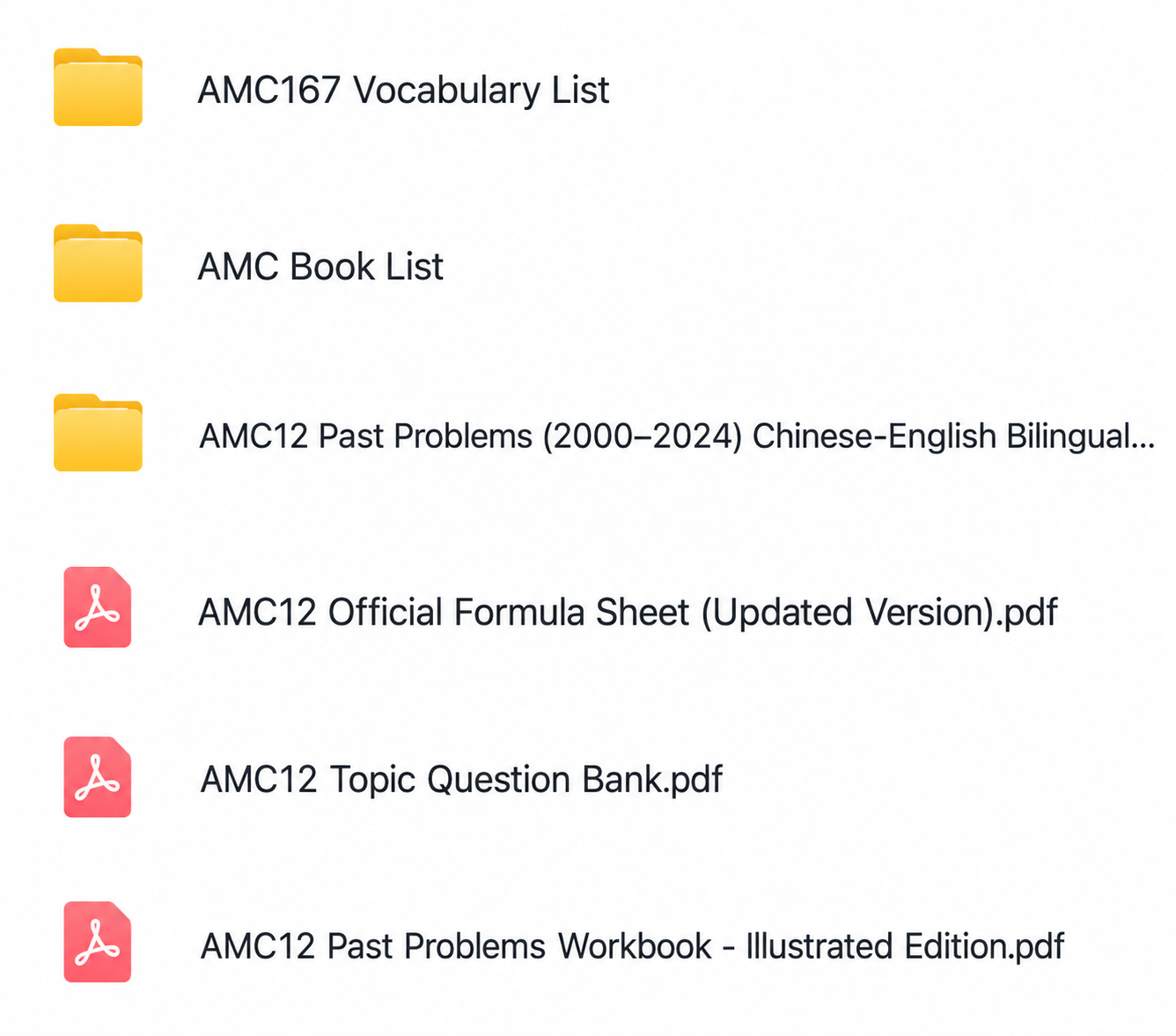
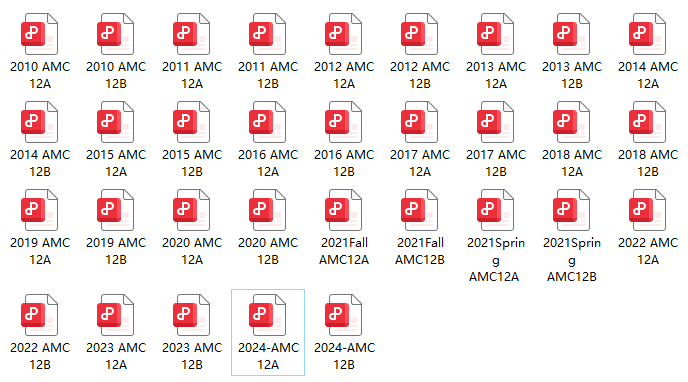
Scan the QR code to get free AMC 12 prep resource pack
(Includes past AMC 12 exam papers with solutions, reading lists, formula sheets, and more)