
On the math and science track for international education and applications to Ivy League and Oxbridge, AMC12 (American Mathematics Competition), with its deep application of advanced mathematical tools and extremely high fault tolerance, has become a for countless math prodigies to advance to AIME (American Invitational Mathematics Examination). Many students often feel devastated when checking their scores: "I clearly calculated the answer, why did I get zero points?" "Why did I think I could score 100 in practice tests, but only ended up with 70-something?" The answer is simple: you fell into the "high-frequency point-loss traps" carefully laid out by the examiners. Although the first 15 questions of AMC12 are moderately difficult, they are riddled with numerous logical pitfalls, boundary traps, and linguistic mazes. This article brings you the most hardcore guide to avoiding error-prone question types in AMC12, helping you perfectly steer clear of those frustrating point-loss pitfalls in the new season!
I. Algebra and Functions Section: The Most Overlooked "Hidden Boundaries"
Algebra and advanced functions are the fundamental scoring base of AMC12, but they are also a hard-hit area where examiners set "thinking traps." Here, the vast majority of competitors lose points not because they cannot solve equations, but because they overlook implicit mathematical premises.
Trap 1: "Multiple Solutions and Rotation Directions" in the Geometric Properties of Complex Numbers
High-Frequency Point-Loss Area: Problems require solving for the figure formed by complex numbers on the complex plane that satisfy certain absolute value conditions (e.g., |z-a| = |z-b|), or using De Moivre's theorem to solve for the roots of z^n = 1. Students often only calculate the principal root, or when performing rotations on the complex plane, they neglect the two possibilities of clockwise and counterclockwise rotation, resulting in calculating only half of the final polygon area or point coordinates.
Guide to Avoiding the Trap: For any problem involving geometric transformations of complex numbers, you must sketch the complex plane on scratch paper. Whenever you see keywords such as "rotation" or "polygon vertices," immediately sound the alarm in your mind: have you considered both forward and reverse rotations?
Trap 2: The "Argument Greater Than 0" and "Base Restrictions" of Logarithmic Functions
High-Frequency Point-Loss Area: In logarithmic inequalities or equations, students often confidently simplify expressions using the change-of-base formula and logarithmic properties, ultimately solving a perfect quadratic inequality interval. However, nine times out of ten, they completely forget the original restrictions that "the argument must be greater than 0, and the base must be greater than 0 and not equal to 1," and end up selecting a distractor that includes an invalid domain.
Guide to Avoiding the Trap: The first step before solving any logarithmic problem is to write down the domain restrictions next to the problem in bold. After obtaining the final answer, you must substitute it back into the original expression to perform a "legality check of the argument/base."
II. Geometry Section: The "Pictureless Hell" Bound by Fixed Thinking Patterns
AMC12 geometry problems (especially those between questions 8 and 15) have a very tricky characteristic: many problems are not accompanied by diagrams; they only provide a paragraph of pure English text. If you misread a single word, or introduce subjective assumptions when drawing the diagram, even the most precise calculations will be in vain.
Trap 3: "Multiple Structural Possibilities" in Solid Geometry
High-Frequency Point-Loss Area: Problems describe "a cube cut by a plane" or "several circumscribed spheres tangent to inscribed spheres." Many students, when drawing, habitually draw the most symmetrical, extreme, and easily imaginable special position (e.g., the cross-section passing exactly through a vertex). As a result, they overlook the possibility that the cross-section could also form a pentagon or hexagon in general cases, directly missing an entire branch of answers.
Guide to Avoiding the Trap: When facing "pictureless" geometry problems, you must deliberately avoid "specialization" when drawing. If the problem says "there is a triangle," never draw it as an equilateral or right triangle; if it involves cross-sections or projections, try to dynamically "rotate" the plane in your mind and look for critical points.
III. Number Theory and Combinatorics Section: The Most Frustrating "Overcounting and Undercounting"
Permutations, combinations, and number theory often appear in the middle-to-late sections of AMC12 and are key to. The point-loss characteristic of these two sections is: the distractors are extremely vicious. The examiners know exactly how you might miscalculate, and the options often precisely include incorrect answers such as N+1, N-1, and failure to deduplicate (overcounting by a factor), making you feel confidently wrong during the exam.
Trap 4: "Indistinguishable Objects and Order Dependence" in Permutations and Combinations
High-Frequency Point-Loss Area: Problems involve "placing n identical balls into m different boxes" or "several people sitting around a circle (circular permutations)." Students confuse whether objects are distinguishable. When using the stars and bars method or recurrence models, they often end up multiplying or dividing by n! because they fail to clarify "whether order matters."
Guide to Avoiding the Trap: Before solving a combinatorics problem, close your eyes for 3 seconds and silently recite three core questions in your mind: Are the elements identical or different? Are the containers identical or different? Does the order of selection matter? Once you have clarified these three points, pull out the corresponding formula from your arsenal (such as permutations P, combinations C, or the stars and bars method).
Trap 5: Discrimination Against "0" and "Negative Numbers" in Number Theory Problems
High-Frequency Point-Loss Area: When discussing divisibility properties, greatest common divisor (GCD), or congruence equations, the problem asks "how many integers x satisfy the condition." Chinese students, deeply influenced by the "positive integer" mindset in school, often automatically filter out cases where x = 0 or x is negative.
Guide to Avoiding the Trap: Read the problem carefully. Clearly distinguish whether the problem defines Positive Integers, Non-negative Integers, or Integers (including negative numbers and zero).
IV. Exam Strategic Traps: Long English Problem Statements and Blind Perseverance
Beyond loopholes in knowledge itself, AMC12 has two fatal point-loss areas related to "exam mindset and strategy."
Step 1: Beware of Modifiers and Deconstruct Long English Problem Statements
In the first 20 minutes of the exam, AMC12 likes to wrap mathematical models in long application-problem backgrounds. Special attention should be paid to the final question: does it ask for the value of x, or the value of x+y? Does it ask for the perimeter or the area? Before picking up your pen, use a pencil to circle the core words and qualifiers of the question to prevent directional deviation.
Step 2: Implement the "3-Minute Sunk Cost" Rule
Between the 20th and 50th minutes of the exam, when working on questions 13–18, if you have been stuck on a problem for more than 3 minutes without any substantial progress, stop immediately! The biggest point loss in AMC12 is not getting a problem wrong, but spending 15 minutes stubbornly grinding on a single difficult problem, leaving no time to even look at the 3 foundational questions you could have securely answered later.
Step 3: Keep Your Hands in Check and Refuse Pointless "Blind Guessing"
In the final 10 minutes of the exam, during the last review phase, you look at your paper and see you have only completed 11 questions. You panic and decide to randomly guess all the remaining difficult problems? Resolutely stop this self-destructive behavior! In AMC12, a wrong answer earns 0 points, while a blank answer earns 1.5 points. Leaving 13 questions blank securely gives you 19.5 points, whereas blindly guessing on 13 questions yields an expected score close to zero. In the final moments before the exam, overcoming impatience and firmly choosing to leave questions blank is also a core scoring ability.
We are an authorized AMC test center and offer free registration assistance!
Scan the code to inquire about AMC 12 registration for the 2026 season ⇓

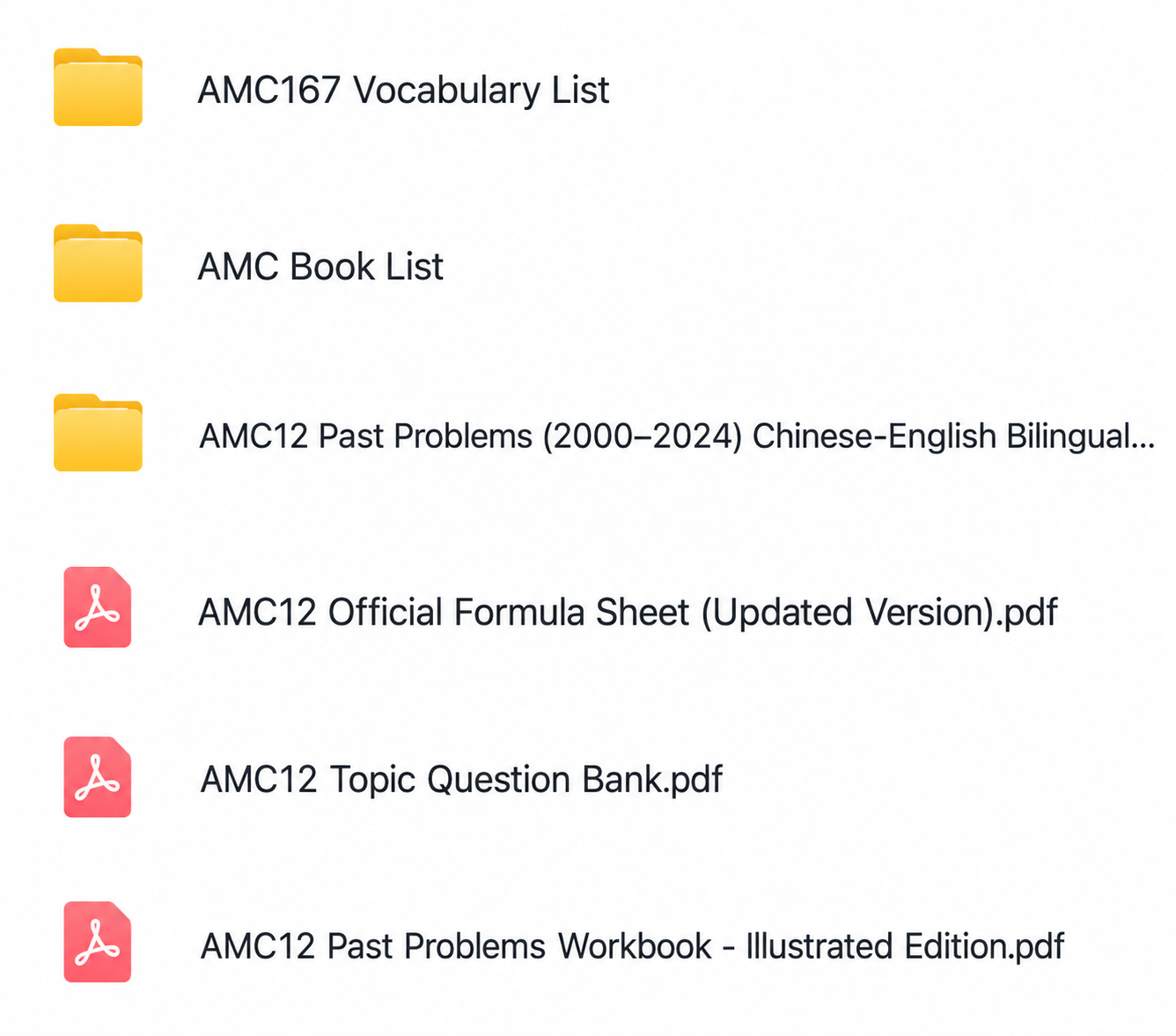
Scan the QR code to get free AMC 12 prep resource pack
(Includes past AMC 12 exam papers with solutions, reading lists, formula sheets, and more)