
Why Did AMC12 Cutoff Scores Rise Collectively? Is AMC12 Still Worth Taking? 2026 Long-term Preparation Guide!

AMC12 is an important competition aimed at improving high school mathematical literacy and cultivating students' logical thinking skills. Its academic authority and wide recognition mean that students who achieve excellent results in this competition can gain a competitive advantage in their academic applications, especially when applying to top universities such as Ivy League schools and G5 institutions. AMC12 scores are often regarded as one of the important evaluation criteria.

推荐

I. Analysis of the Reasons for the Collective Rise in AMC12 Cutoff Scores

"Gift Points" Controversy

In the 2023 AMC12 Paper A, the final problem sparked controversy. The MAA committee ultimately decided to award the 6 points for that problem to all test-takers, regardless of whether they answered it correctly.

Direct Impact: This decision led to nearly 200 perfect score students in the China region, whereas in previous years, there were usually fewer than 50 perfect scores. This means a large number of test-takers gained an extra score advantage, pushing the overall cutoff scores higher.

II. Why Is AMC12 Still Worth Taking?

Qualifying for AIME: The primary goal for most students taking AMC12 is to qualify for AIME, thereby adding a competitive advantage to their college applications.

Demonstrating True Ability: Even if perfect scores occur in certain cases, admissions officers will still consider other academic performances (such as A-Level Math grades). If AIME scores are unsatisfactory or standardized test scores do not align with competition results, it may raise doubts.

Academic Enrichment: During the preparation process, students can systematically learn and master a large amount of mathematics knowledge, which not only aids in the competition but also enhances everyday academic performance.

How to Cope with Rising Scores? Improve overall strength: As cutoff scores rise, relying solely on luck or isolated factors can no longer guarantee qualification. Only through systematic training and solid preparation can you stand out in the competition.

推荐

III. 2026 AMC12 Long-term Preparation Guide

Phase 1: Foundation Consolidation (6–12 months before the exam)

Algebra
Review content: Core knowledge points such as functions, equations, inequalities, sequences, polynomials, etc.
Key skills: Factorization techniques, analysis of function properties (monotonicity, parity, etc.).

Geometry
Review content: Triangles, circles, similarity and congruence theorems and their applications.
Key skills: Area formulas, volume calculations, proof methods in geometry.

Number Theory
Review content: Divisibility, prime numbers, congruences, and other foundational concepts.
Key skills: Common theorems (such as Fermat's Little Theorem, Euler's Theorem) and their proof ideas.

Combinatorics
Review content: Permutations and combinations, probability basics, counting principles.
Key skills: Modeling thinking, learning to classify and discuss, and recurrence modeling.

Phase 2: Topic Reinforcement (3–6 months before the exam)

Specialized training by module
Summary of high-frequency problem types: Combine with past exam questions to extract high-frequency test points and problem-solving routines for each module.
Develop reasoning ability: Gradually work on medium-to-high difficulty problems to practice multi-step reasoning and comprehensive application skills.

Real simulation
Timed practice: Conduct at least one timed mock test per week to adapt to the exam rhythm and time pressure.
Organize mistakes: Keep an error notebook, mark causes of errors and improvement measures, and avoid repeating the same mistakes.

Phase 3: Sprint & Mock Exams (1–3 months before the exam)

Real simulation
Adapt to exam intensity: Conduct multiple full-length mock exams according to the official exam schedule to ensure both physical and mental readiness for the high-intensity exam environment.
Time allocation strategy: Practice sound time management skills to secure points on easy and medium-difficulty questions, and make wise strategic choices for challenging problems.

Mindset adjustment
Build stress resilience: Gain on-the-spot experience through mock exams to enhance confidence and adaptability.
Detail control: Emphasize details such as accurate problem reading and standard notation to reduce unnecessary point loss.

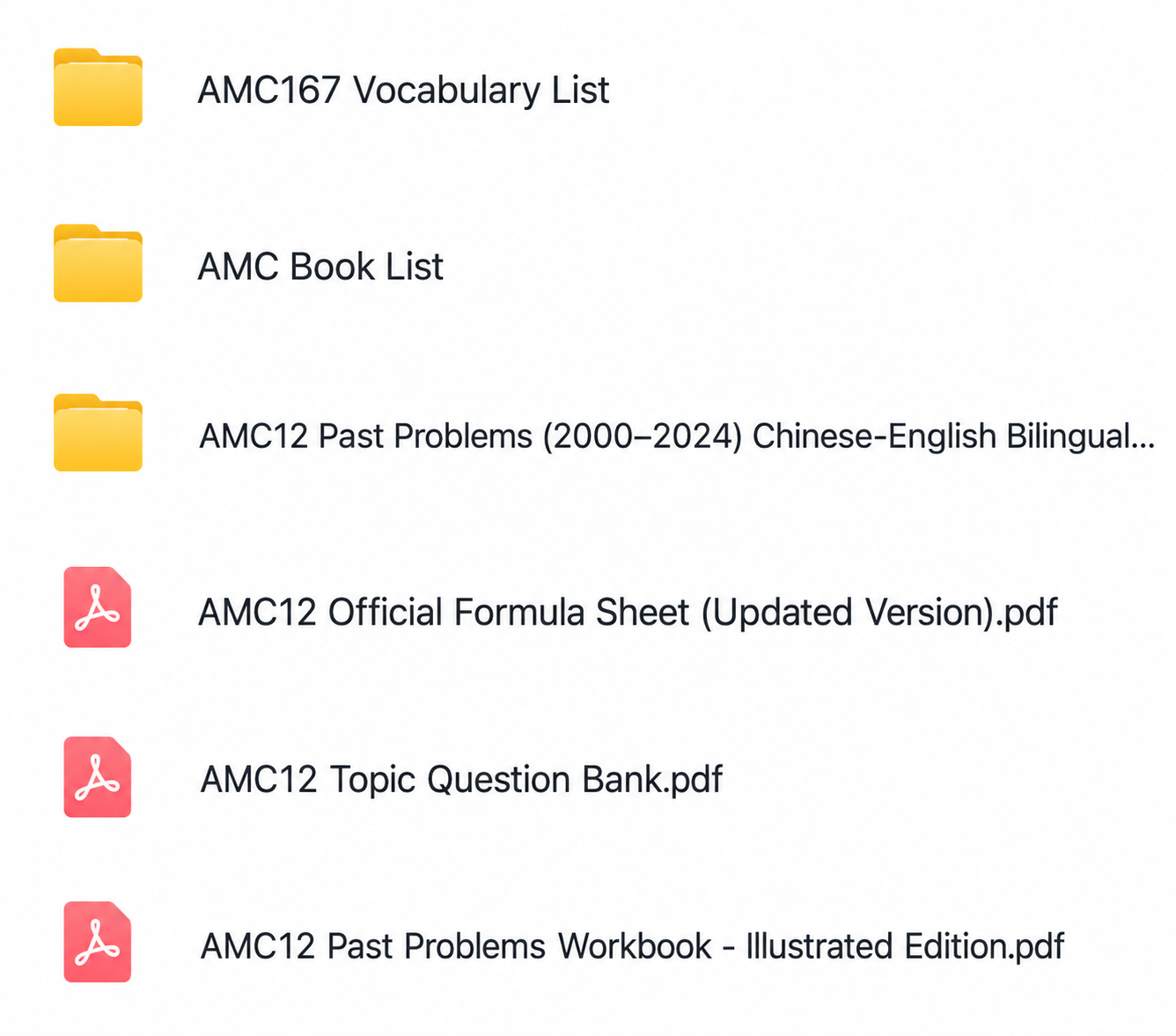
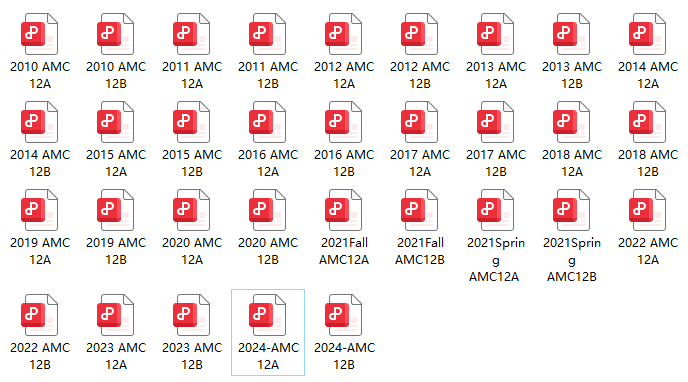
Free AMC12 Preparation Materials: Scan the QR code to get a free AMC12 preparation materials pack (including past exam papers + answer keys + book list + formula sheet, etc.)

2025 AMC10/12 New Awards Cutoff Scores Released! What is the Practical Value of These New Awards?

The 2025 AMC10/12 award cutoff scores have been officially released. This year, two new honors have been innovatively introduced: "Global Top 10%" and "Global Top 25%", aimed at recognizing more outstanding students. This means the overall probability of students winning awards will significantly increase.

推荐

I. 2025 AMC10/12 Award Cutoff Scores Update!

II. Comprehensive Analysis of AMC10/12 Competition Awards

Award Name Qualification Criteria 2025 Cutoff Scores
Perfect Score Award Score = 150 Perfect score required for both AMC10/12 A/B
Distinguished Honor Roll (DHR) Global Top 1% AMC10A: 136.5, AMC12A: 150 (must be perfect!)
Honor Roll (HR) Global Top 5% AMC10A: 112.5, AMC12A: 127.5
AIME Qualification AMC10: Top 2.5%, AMC12: Top 5% AMC10A: 105, AMC12A: 96
Achievement Roll Grade 8 or below + AMC10 ≥ 90 AMC10 only, dual age + score threshold
Top 10% Award Global Top 10% AMC10A: 94.5, AMC12B: 109.5
Top 25% Award Global Top 25% AMC10A: 69, AMC12A: 66
Key Changes: Starting from 2025, MAA has officially added the Top 10% and Top 25% awards, significantly expanding award coverage!

III. Three Core Values of the New Awards

1. Enabling More Students to "Win Awards"

In the past, only about 6% of test-takers could win awards (1% + 5%).

Now, Top 25% means approximately 75,000+ winners (based on 300,000 test-takers).

Average students can also receive official certification, breaking the misconception that "competitions are only for top students."

2. "Effective Endorsement" for College Admissions

Award Application Value
Top 25% Demonstrates mathematical ability above the global average, suitable for: - US high school / UK undergraduate initial screening - Domestic international school transfers / placements
Top 10% Showcases strong logical and problem-solving skills, can be included in: - Common App activities list - UCAS Personal Statement
HR / DHR / AIME "Hard currency" for top STEM program applications, highly regarded by Ivy Leagues / Oxbridge / G5 universities

3. Inspiring Learning Confidence and Long-term Motivation

Getting the first competition certificate → building the belief that "I can do it."

Laying a psychological foundation for subsequent challenges like AIME, Euclid, Physics Bowl.

Avoid giving up interest in mathematics due to the frustration of "zero awards."

III. Award Difficulty and Goal Suggestions by Student Type

Student Type Recommended Goal Preparation Focus
G6–G8 (AMC10) Achievement Roll (≥90) or Top 25% Strengthen algebra and geometry foundations; master word problem techniques
G9–G10 (AMC10) AIME qualification (≥105) or HR (≥112.5) Strengthen combinatorics and number theory; train problem-solving thinking for challenging questions
G11–G12 (AMC12) AIME qualification (≥96) or Top 10% (≥87+) Supplement complex numbers, vectors, advanced probability models
STEM Program Applicants At least AIME qualification; aim for HR/DHR Systematic training + real exam mock tests + error correction loop
Humanities/Social Science Applicants Top 10% or AIME qualification is sufficient Ensure accuracy on the first 15 questions; strategically choose which of the last 10 questions to attempt

推荐

IV. Efficient Preparation Strategy: Three-Phase Sprint Method

Phase 1: Foundation Building (3 months)

Core Tasks: Master the four major modules (Algebra 35%, Geometry 30%, Combinatorics 25%, Number Theory 10%).

Key Breakthroughs: AMC10: permutations and combinations, power of a point theorem, average speed traps; AMC12: complex number operations, trigonometric identities, solid geometry volume.

Phase 2: Real Exam Intensive Practice (3 months)

Work through past papers from 2015–2025, categorized by question number for training.

Q1–15: 20 minutes time limit, target accuracy ≥95%.

Q16–20: 25 minutes time limit, target accuracy ≥70%.

Q21–25: Specialized breakthrough, learn techniques such as "construction method" and "symmetry."

Phase 3: Mock Exam Sprint (1–2 months)

2 full mock exams per week (strictly 75 minutes).

Build an error log categorized by "knowledge point + error cause" (e.g., number theory – misunderstanding of congruence).

Adjust time allocation strategy: don't get stuck on difficult problems; prioritize securing points on foundational questions.

V. Common Misconception Reminders

Misconception Correct Understanding
"Only DHR is useful" Top 10%/25% are also effective in the initial screening stage, especially for non-top applicants
"Chinese version is easier" The English version is closer to the original problem context and exercises academic English; it is recommended to prioritize English
"More practice is better" Blind practice is not as effective as in-depth study of 10 sets of real exams + thorough review
Free Resources: Scan the QR code to get free AMC 10/12 past papers, answer keys, book lists, formulas, and more!

2026 AIME Competition Event Notice

The American Invitational Mathematics Examination (AIME), as an important part of the American mathematics competition system, serves as a key platform for mathematically gifted students worldwide to showcase their talents. For test-takers in China, understanding the schedule, exam characteristics, and preparation strategies for the AIME is crucial. This article will comprehensively analyze all the detailed information for the 2026 AIME competition.

推荐

I. 2025 AMC10/12 Award Cutoff Scores and 2026 AIME Qualification Scores

To qualify for AIME, students must rank approximately in the top 2.5% of AMC10 or the top 5% of AMC12.

II. 2026 AIME Event Arrangements for China Region

According to the latest arrangements, the 2026 AIME event in China has the following important information for test-takers:

Test-takers in China will participate in AIME II.

The test paper language is tentatively set as Chinese-English bilingual (subject to the final notice from MAA).

No registration fee or exam fee will be charged for this event.

Format: In-person exam. Exam center coordinators should email their test room arrangements by January 15, 2026.

AIME participation is limited to students who have reached the qualifying score. After 12:00 PM on December 26, 2025, candidates should click the link (https://amc.jinshuju.com/f/rwyqJW) to confirm registration. Failure to confirm means forfeiting the qualification.

Event Schedule:

AIME registration confirmation period: December 26, 2025, 12:00 PM – January 15, 2026, 12:00 PM

AIME admission ticket inquiry: February 7, 2026, 12:00 PM – February 12, 2026, 12:00 PM

AIME exam time: February 12, 2026, 1:00 PM – 4:00 PM (Thursday) (tentative, subject to the admission ticket information)

AIME score inquiry: 2-4 weeks after the exam (specific time to be notified)

AIME certificate download: 2-4 weeks after the exam (specific time to be notified)

推荐

III. Certificate Distribution Arrangements

AMC10&12 e-certificates can be downloaded after 12:00 PM on December 26, 2025, from the official website (http://score.math-table.world/login.html) using the registered mobile phone number and verification code.

AMC10&12 score reports and paper certificates are expected to be distributed to exam centers at the beginning of March.

IV. Efficient Preparation Strategies

Preparation strategies should vary based on the student's situation:

Strategy for those barely qualifying: If your AMC10/12 score is just above the qualifying line, focus on ensuring the accuracy of the first 10 questions. Systematically review basic knowledge points, especially algebra and geometry, aiming to get at least 9 points out of these 10 questions. Such a result is already a strong plus for applying to TOP30 schools.

Strategy for those with high AMC10 scores: Students who achieved high scores in AMC10 need to further broaden their knowledge and supplement AMC12-level topics such as trigonometry, complex numbers, vectors, etc. At the same time, conduct targeted training for AIME question types, adapting in advance to the difficulty and problem-solving style of AIME.

Strategy for those with high AMC12 scores: Students who achieved high scores in AMC12 should, while ensuring the accuracy of the first 10 questions, focus on tackling the last 5 difficult problems. This requires a deeper understanding of knowledge points and stronger comprehensive application abilities, especially skills in handling complex geometry problems and mastering advanced number theory methods.

推荐

2026 AIME Competition Event Notice

The American Invitational Mathematics Examination (AIME), as an important part of the American mathematics competition system, serves as a key platform for mathematically gifted students worldwide to showcase their talents. For test-takers in China, understanding the schedule, exam characteristics, and preparation strategies for the AIME is crucial. This article will comprehensively analyze all the detailed information for the 2026 AIME competition.

I. 2025 AMC10/12 Award Cutoff Scores and 2026 AIME Qualification Scores

To qualify for AIME, students must rank approximately in the top 2.5% of AMC10 or the top 5% of AMC12.

推荐

II. 2026 AIME Event Arrangements for China Region

According to the latest arrangements, the 2026 AIME event in China has the following important information for test-takers:

  1. Test-takers in China will participate in AIME II.
  2. The test paper language is tentatively set as Chinese-English bilingual (subject to the final notice from MAA).
  3. No registration fee or exam fee will be charged for this event.
  4. Format: In-person exam. Exam center coordinators should email their test room arrangements by January 15, 2026.
  5. AIME participation is limited to students who have reached the qualifying score. After 12:00 PM on December 26, 2025, candidates should click the link (https://amc.jinshuju.com/f/rwyqJW) to confirm registration. Failure to confirm means forfeiting the qualification.
  6. Event Schedule:

AIME registration confirmation period: December 26, 2025, 12:00 PM – January 15, 2026, 12:00 PM

AIME admission ticket inquiry: February 7, 2026, 12:00 PM – February 12, 2026, 12:00 PM

AIME exam time: February 12, 2026, 1:00 PM – 4:00 PM (Thursday) (tentative, subject to the admission ticket information)

AIME score inquiry: 2-4 weeks after the exam (specific time to be notified)

AIME certificate download: 2-4 weeks after the exam (specific time to be notified)

III. Certificate Distribution Arrangements

AMC10&12 e-certificates can be downloaded after 12:00 PM on December 26, 2025, from the official website (http://score.math-table.world/login.html) using the registered mobile phone number and verification code.

AMC10&12 score reports and paper certificates are expected to be distributed to exam centers at the beginning of March.

IV. Efficient Preparation Strategies

Preparation strategies should vary based on the student's situation:

Strategy for those barely qualifying: If your AMC10/12 score is just above the qualifying line, focus on ensuring the accuracy of the first 10 questions. Systematically review basic knowledge points, especially algebra and geometry, aiming to get at least 9 points out of these 10 questions. Such a result is already a strong plus for applying to TOP30 schools.

Strategy for those with high AMC10 scores: Students who achieved high scores in AMC10 need to further broaden their knowledge and supplement AMC12-level topics such as trigonometry, complex numbers, vectors, etc. At the same time, conduct targeted training for AIME question types, adapting in advance to the difficulty and problem-solving style of AIME.

Strategy for those with high AMC12 scores: Students who achieved high scores in AMC12 should, while ensuring the accuracy of the first 10 questions, focus on tackling the last 5 difficult problems. This requires a deeper understanding of knowledge points and stronger comprehensive application abilities, especially skills in handling complex geometry problems and mastering advanced number theory methods.

推荐

Why Were the 2025 AMC Cutoff Scores "Ridiculously High"? Has the Value of AMC10/12 Changed? Is AMC Still Worth It for Average Students?

As soon as the official 2025 AMC cutoff scores were released, they immediately sparked heated discussions among parents and in the competition community: The AMC10 AIME cutoff soared from 94.5 to 105 points (+10.5). The AMC12 AIME cutoff skyrocketed from 76.5 to 96 points (+19.5!). Even more shocking: The DHR (Top 1%) cutoff for AMC12 A was 150 points – a perfect score was required!

Many parents exclaimed: "How are we supposed to compete now?" "Is this only for geniuses?" But is that really the case? This article will peel back the layers to reveal the logic behind the soaring cutoff scores, the real changes in the value of AMC, and how average students can benefit from this and achieve a comeback.

推荐

I. Why Were the 2025 AMC Cutoff Scores "Ridiculously High"?

1. Surge in Number of Participants Leads to Severe "Inflation" in the High-Score Range

The global number of AMC10/12 registrants has nearly doubled in the past two years. Especially in first-tier Chinese cities, students begin preparing for AMC8 as early as the fourth grade to lay the groundwork for AMC10. The result: a massive influx of well-trained students, a high concentration of top scores, and cutoff scores naturally rising.

2. AMC12 A, Question 25 Disqualified – Everyone Receives +6 Points

Officials voided Question 25 due to a dispute, automatically giving all test-takers full credit (6 points) for that question. Even so, the Top 1% still required a perfect 150 – meaning the remaining 24 questions had to be answered correctly! This shows that the gap among top-tier competitors has narrowed to a "zero tolerance for errors" level.

3. AMC Gains Recognition from More Prestigious Educational Institutions, Becoming "Hard Currency"

International schools, advanced placement programs, and top overseas universities (especially in STEM fields) heavily rely on AMC scores to identify talent. The more authoritative the exam, the more people value it → the stronger the competitors become → the higher the cutoff scores → the more valuable the credential becomes.

II. Has the Value of AMC10/12 Changed?

It has not weakened, but the "barrier to entry" has risen.

Award Past Role Current Requirement
Top 1% (DHR) Basis for top international schools to "recruit" students Still a "gold label" for STEM applications; Oxford, Cambridge, MIT, Stanford, and other universities highly value it
Top 5% (Honor Roll) Entry ticket to advanced classes/international divisions Now a "basic threshold"; may not be sufficient to stand out by itself
AIME Qualification Proof of mathematical potential Has become the "standard requirement" for applying to STEM programs at G5/Ivy League schools

Real Trend: Previously, achieving a Top 5% score could catch the attention of top universities. Now, you must aim for the Top 1% or a high AIME score to truly stand out. However, even without winning an award, the process of systematically preparing for the AMC holds immense value:

Significant improvement in in-school math performance (AMC training far exceeds the difficulty of the standard curriculum);

Comprehensive enhancement of logical thinking, problem decomposition skills, and stress resilience;

Building a solid foundation for subjects such as high school physics, computer science, and economics.

推荐

III. Is AMC Still Worth It for "Average Students"?

The answer is: Absolutely! And the sooner you start, the better!

Average students derive three core values from preparing for the AMC:

1. Develop advanced problem-solving thinking: In-school math emphasizes calculation and following routines; AMC math emphasizes logical chains, modeling skills, and flexible application.

2. Broaden your options for academic advancement: International school entrance exams heavily borrow from AMC problems. Shanghai Guanghua Cambridge's 2024 entrance exam question 9 was an AMC original question. WLSA Shanghai explicitly requires mastery of AMC core topics such as polynomial factorization and quadratic extrema. The math sections of schools like Beijing National Day School's International Department and Shenzhen College of International Education are roughly equivalent to mid-level AMC10 difficulty.

3. Build long-term academic competitiveness: AMC is just the starting point, serving as a bridge to AIME, USA(J)MO, and interdisciplinary competitions such as HiMCM, BPhO, and Physics Bowl. This path represents the "academic depth" most valued by top overseas universities.

推荐

AMC12 Difficulty Level Compared to Chinese Math + Comprehensive Analysis of Required Abilities! What Skills Are Needed to Learn AMC12?

AMC12 is an advanced math competition for students in 12th grade or below. Its depth and breadth go far beyond the regular high school curriculum, and it is often compared to the Chinese High School Mathematics League (CMO). So, what grade level in China does AMC12 correspond to? What are its similarities and differences with the Chinese High School Mathematics League? And what core abilities are needed to learn AMC12? This article provides a comprehensive analysis.

推荐

I. What Grade Level in China Does AMC12 Correspond To?

Overall AMC12 Difficulty ≈ Level 1 of the Chinese High School Mathematics League (CMO system). Some final problems are comparable to Level 2 introductory level.

Although AMC12 is designed for high school students, the content it tests far exceeds the Chinese college entrance exam syllabus and even covers some advanced pre-college topics (e.g., complex numbers, generating functions, number base conversions, etc.).

Detailed Breakdown of AMC12's Core Exam Modules

AMC12 fully covers AMC10 content and adds the following advanced topics:

Module Topics Added/Enhanced in AMC12
Algebra • Complex number operations and geometric interpretation
• Higher-degree polynomials (Rational Root Theorem, symmetric polynomials)
• Recurrence sequences (linear non-homogeneous)
Functions • Comprehensive applications of logarithmic and exponential functions
• Piecewise discussion of floor and absolute value functions
Trigonometry • Advanced transformations of trigonometric identities
• Trigonometric equations and inequalities
• Applications of trigonometry in geometry (e.g., using the Law of Sines to find areas)
Number Theory • Modular arithmetic (congruences)
• Simplified version of Fermat's Little Theorem
• Number base conversions and digit sums
• Diophantine equations (integer solutions)
Geometry • Power of a Point Theorem, Ptolemy's Theorem
• Solid geometry (Euler's formula, Platonic solids)
• Basic properties of conic sections (ellipse/hyperbola foci)
Combinatorics & Probability • Complex applications of the Inclusion-Exclusion Principle
• Recurrence relation modeling
• Conditional probability and Bayesian thinking
• Introduction to expected value

Most Difficult Areas:
• Problems 21–25 often involve triple fusion of number theory + combinatorics + algebra.
• Extreme time pressure: average of only 3 minutes per question; the last 5 questions often require 5–8 minutes.

Note: AMC12 does not test calculus, but does involve limits, recurrence relations, discrete math, and other advanced topics.

II. Detailed Comparison: AMC12 vs. Chinese High School Mathematics League (CMO)

Aspect AMC12 Chinese High School Math League (CMO Level 1 + Level 2)
Exam Format 25 multiple-choice questions, 75 minutes Level 1: 8填空题 + 3大题; Level 2: 4 proof/complex problems
Core Modules Algebra, Geometry, Number Theory, Combinatorics (four pillars) Level 1: Algebra, Geometry, Trigonometry
Level 2: Plane geometry, Algebra, Number Theory, Combinatorics
Number Theory Emphasis ✓ Heavy! Modular arithmetic, prime factorization, Diophantine equations are frequent Level 1: ✗ Not tested
Level 2: ✓ Core component
Combinatorics Emphasis ✓ Very heavy! Inclusion-Exclusion, recurrence, generating functions common Level 2: ✓ Important, but focuses more on construction and proofs
Analytic Geometry ⚠️ Moderate: Conic sections, symmetry, shoelace formula ✓ Key area in Level 1! Ellipse/hyperbola problems are frequent
Problem Design Breadth-first + cross-module fusion (e.g., solving number theory with trigonometric identities) Depth-first + single-module deep dive (e.g., pure geometry proofs, complex inequalities)
Scoring Rules Correct: 6 points; Unanswered: 1.5 points; Incorrect: 0 points Step-by-step scoring, with emphasis on rigorous process

推荐

III. What Skills Are Needed to Learn AMC12?

1. Solid Foundation in High School Mathematics

Must master: quadratic functions, trigonometric identities, vectors, solid geometry volume formulas, etc.
Suggested prerequisite knowledge: Complete high school compulsory + elective courses (especially complex numbers, logarithms, sequences).

2. Competition-Level Number Theory and Combinatorial Thinking

Ability to understand the meaning of "modular congruence";
Ability to solve path-counting, coloring, and distribution problems using "counting by cases";
Ability to recognize "recurrence structures" and set up equations.

3. Fast Manual Calculation and Stamina Under Pressure

All calculations must be done by hand; calculators are not allowed.
Stay calm under 75 minutes of high pressure, making wise decisions (e.g., skipping questions that are too difficult).

4. Ability to Integrate Knowledge Across Modules

Example: A single problem might require:
"Given an integer satisfying ... with a digit sum of 10, find the minimum ..." – combining number theory, Diophantine equations, and possibly constraints from digit sums.

推荐

Detailed Analysis of the Four Core Modules of AMC12! A Complete Long-Term Preparation Guide for AMC10/12!

AMC12 is a mathematics competition designed for students in grade 12 and below. It is more difficult than AMC10 and covers a wider range of topics. The AMC12 competition not only tests the breadth of a student's mathematical knowledge but also challenges their problem-solving speed and depth of thinking. Through scientific planning and systematic preparation, even average students can achieve excellent results in this high-level competition.

推荐

I. Detailed Analysis of the Four Core Modules of AMC12 and Preparation Strategies

1. Algebra Module (Accounts for 35%-40%)

Foundation Connection: Review of core algebra concepts from AMC10 (polynomial operations, functions and equations, basics of sequences and inequalities).

Advanced Topics:

Advanced Inequalities: Cauchy-Schwarz inequality, mean inequalities (multi-variable extensions), comprehensive methods for solving absolute value inequalities.

Advanced Polynomials: Deepening of the rational root theorem, extension of Vieta's formulas (higher-degree polynomials), advanced techniques for polynomial factorization, properties of polynomial roots.

Advanced Functions: Comprehensive application of logarithmic and exponential functions, transformation of trigonometric identities (sum-to-product, product-to-sum formulas), deep dive into trigonometric function graph transformations and properties.

Complex Numbers: Rules of operation, geometric interpretation (complex plane, modulus and argument), application of De Moivre's theorem.

Module Problem Patterns: A high proportion of comprehensive application problems, often interwoven with geometry and combinatorics modules.

2. Geometry Module (Accounts for 25%-30%)

Foundation Connection: Review of core geometry concepts from AMC10: plane geometry theorems (Pythagorean theorem, similar triangles, etc.), basics of analytic geometry (standard equations and properties of lines and circles), basics of solid geometry (surface area and volume calculations of common 3D shapes).

Advanced Topics:

Advanced Coordinate Geometry: Polar coordinates and parametric equations (conversion, application), the positional relationship between lines and curves.

Advanced Solid Geometry: Application of space vectors (angle and distance calculations), comprehensive problems involving circumscribed and inscribed spheres, folding and unfolding of spatial geometric solids.

Advanced Circle Properties: Comprehensive properties of cyclic polygons, advanced application of the power of a point theorem, deepening of the positional relationships between circles.

Foundations of Conic Sections: Definitions, standard equations, and core properties of ellipses, hyperbolas, and parabolas.

Module Problem Patterns: Increased graphical complexity, requiring the use of algebraic tools for problem-solving, and a high demand for spatial visualization skills.

3. Number Theory Module (Accounts for 15%-20%)

Foundation Connection: Review of core number theory concepts from AMC10: modular arithmetic (understanding basic concepts and applications), divisibility (mastering methods to determine divisibility), prime factorization (proficiency in decomposing numbers into prime factors), basics of congruence equations (understanding concepts and solution methods).

Advanced Topics:

Advanced Number Theory Theorems: Euler's theorem, advanced application of the Chinese remainder theorem.

Advanced Indeterminate Equations: Higher-level solution methods (method of infinite descent, modular analysis), special indeterminate equations (basics of Pell equations).

Number Theoretic Functions: Properties and applications of the Euler's totient function, divisor function, and Gauss's function.

Advanced Congruences: Solving higher-degree congruence equations, comprehensive application of systems of congruences.

Module Problem Patterns: Problems are often subtle, requiring proficiency in the flexible application of number theory tools.

4. Combinatorics Module (Accounts for 15%-20%)

Foundation Connection: Review of core combinatorics concepts from AMC10: permutations and combinations (mastering basic concepts and applications), basics of probability and statistics (understanding basic probability concepts and calculation methods), recurrence relations (mastering basic concepts and applications), basics of the inclusion-exclusion principle (understanding basic concepts and applications).

Advanced Topics:

Advanced Counting: Generating functions (ordinary generating functions, exponential generating functions), advanced applications of the inclusion-exclusion principle.

Advanced Recurrence Relations: Solving linear recurrence relations, introduction to nonlinear recurrence relations.

Advanced Probability: Comprehensive application of conditional probability, calculation of expectation and variance (for discrete random variables), expansion of probabilistic models.

Fundamentals of Combinatorial Geometry: Counting of figures, region division problems.

Module Problem Patterns: High demand for logical reasoning, often presented in practical contexts, with a wide variety of methods.

推荐

II. Complete Long-Term Preparation Guide for AMC10/12

Phase 1 (Now - June): Build Knowledge System, Strengthen Foundation

Clarify the approximate weight of each module in the test:

Algebra: 30% (functions, equations, sequences, etc.)

Geometry: 25% (triangles, circles, solid geometry, etc.)

Number Theory and Combinatorics: 20%-25% each

Allocate time based on your own strengths and weaknesses: develop a personalized study plan, focusing on breaking through weak areas.

Phase 2 (July - September): Intensive Practice with Real Exams, Train Answering Rhythm

Select real AMC10/12 questions from recent years and train using the "three-pass method":

First pass - Timed Mock Exam: Strictly complete within 75 minutes to simulate the real exam environment.

Second pass - Categorize and Redo Mistakes: Summarize solution techniques for different question types.

Third pass - Focus on Challenging Problems (Q21-25): Break through mental blocks.

Train Answering Strategy:

Ensure 100% accuracy on the first 10 basic questions.

Control errors on the intermediate questions (Q11-20).

Allocate time reasonably for questions 21-25, avoiding losing easy points due to getting stuck on hard problems.

Phase 3 (October - Before the Exam): Review Mistakes, Sprint for Higher Scores

Create a dedicated error notebook:

Record the error type for each mistake (calculation error / conceptual confusion / strategic error).

Note the topic it belongs to (e.g., "Number Theory - Chinese Remainder Theorem").

Write down the correct solution and link to similar problem types. Review once a week to generalize and extrapolate.

Conduct full mock exams with real questions: adjust your answering rhythm and mindset, and conduct targeted breakthroughs on high-frequency and error-prone points. If aiming for the top 1%, you can additionally practice AIME questions to improve comprehensive problem-solving skills.

推荐

Who Should Take AMC12? Which Grade to Start Preparing? Specialized Strategies for Each Section!

The AMC12 is a prestigious international math competition for high school students, organized by the Mathematical Association of America (MAA). Many parents mistakenly believe that only 11th and 12th graders are suitable. In reality, as long as age and grade requirements are met, anyone from math-proficient 9th graders to 12th graders can participate.

推荐

I. Student Profile for AMC12

1. Students meeting official eligibility requirements

Age Requirement: Under 19.5 on competition day.
Grade Requirement: 12th grade or below.

Talented 9th graders can test the waters and gain contest experience.

10th and 11th graders are the core participant group with ample time and flexibility.

12th graders (if still age-eligible) can still aim for AIME qualification or boost their application materials.

2. Students with clear academic goals

Planning to apply to top-tier undergraduate institutions (e.g., Harvard, MIT, Oxford, Cambridge). Strong AMC12 scores demonstrate math ability; advancing to the AIME is a "hard currency."

Wanting to improve competitiveness for international school admissions. Prestigious schools like Shanghai Pinghe, WLSA, and Shenzhen College of International Education often incorporate AMC-style problems in their entrance tests.

Aiming for Canadian universities (Waterloo, U of T, UBC). AMC series scores are widely recognized, and some majors may accept them for academic credit.

3. Students seeking to expand mathematical thinking and perspective

Not satisfied with exam-oriented training and eager to explore higher-level algebra, combinatorics, number theory, complex numbers, trigonometric identities, etc.

Wanting to build core math skills like logical reasoning, case-based discussions, counterexample construction, and number–geometry integration.

Laying a solid foundation for subsequent competitions such as the AIME, USA(J)MO, Euclid Contest, and Physics Bowl.

II. AMC12 Difficulty Structure: A Graduated Challenge

The AMC12 consists of 25 multiple-choice questions, a maximum score of 150, and a time limit of 75 minutes. Difficulty is clearly tiered:

Question Range Difficulty Level Focus Areas Target Accuracy
1–10 Basic Direct application of core concepts (e.g., quadratic functions, trigonometric identities, plane geometry) ≥90% (aim for 100%)
11–20 Intermediate Integrated modules (e.g., number theory + combinatorics, geometry + algebra), requires flexible modeling ≥60% (key to awards)
21–25 Advanced Hidden approaches, multi‑step reasoning, creative methods (e.g., generating functions, complex number rotation, recurrence construction) Top 5%: ≥20%; Top 1%: ≥40%
Scoring rule reminder: Correct answer: +6 points; Unanswered: +1.5 points; Incorrect: 0 points → For questions with no clear idea, leave them blank without guessing!

III. Full‑Cycle Preparation Strategy for AMC12 Awards

Phase 1: Foundation Building (start as early as first semester of 10th grade or earlier)

Systematically study the four AMC12 modules: algebra, geometry, number theory, combinatorics.

Catch up on high‑frequency contest topics not covered in high school: complex numbers, logarithmic inequalities, recurrence sequences, inclusion‑exclusion principle.

Practice 800+ basic problems and maintain a mistake notebook organized by "knowledge point + error type."

Phase 2: Strengthening & Breakthrough (second semester of 10th grade – first semester of 11th grade)

Intensively work on past 10 years of real exams (2015–2025), focusing on questions 11–20.

Summarize general solution models, e.g., "coordinate method vs. pure geometry in geometry" or "modular arithmetic routines in number theory."

Do two timed practice tests per week (75 minutes each) to build rhythm.

Phase 3: Sprint & Optimization (2–3 months before the exam)

Take 1–2 full‑length mock exams per week under strict timing to simulate test‑day pressure.

Focus on techniques for challenging problems: substituting special values, verifying answer choices, symmetry analysis.

Review your mistake notebook and core formula sheet; avoid blindly working on new problems.

Adjust your mindset to maintain consistent performance.

IV. Specialized Advice for Each Question Type

Module Key Skills Preparation Priorities
Algebra Polynomial factorization, Vieta‘s formulas, inequalities and bounds Become proficient with high‑degree equations and symmetric transformations.
Geometry Power of a point theorem, similarity/congruence, triangle centers, solids and sections Practice constructing auxiliary lines and master vector/coordinate methods.
Number Theory Prime factorization, modular arithmetic, digit problems in different bases Use remainders and congruence for classification; master Euclidean algorithm.
Combinatorics Counting principles (permutations/combinations), probability in structures, recurrence relations Learn classification counting, inclusion‑exclusion, and constructive induction.

推荐

Unveiling the Truth Behind the 2026 AMC12 Score Surge: Is AMC12 Still Worth It? Tailored Prep Plans for Students with Different Backgrounds

The "sharp surge" in AMC12 cutoffs has puzzled many parents and students. This article provides an in-depth analysis of the reasons behind the cutoff surge and offers tailored preparation plans for students with different backgrounds to help you achieve ideal results in the 2026 competition.

I. Two Key Reasons for the AMC12 Cutoff Surge

Reason 1: Full Scoring Due to Question Error

Event Background: During the 2025 AMC12 US Region Exam A, a question contained a design flaw—none of the five options provided was correct.
Resolution: After verifying the issue, the MAA committee decided to award all test-takers full 6 points for that question. Since the AMC12 cutoff is determined based on the performance of US students, this full-point concession caused the top 1% cutoff to soar to a perfect 150!

Although such a scenario is rare, it serves as a reminder: official scoring policies can be adjusted due to special circumstances. Therefore, preparation should focus on comprehensive readiness rather than pinning hopes on individual questions.

Reason 2: Persistent Leakage Issues

Current Situation Analysis: While question leakage has not been completely eradicated, official authorities in the China region have implemented multiple preventive measures: promoting in-person exams, using multiple exam paper sets, and planning to introduce new regulations in February 2026 to crack down on cheating.
Credibility Restoration: With the gradual implementation of these measures, the credibility of the AMC competition is steadily recovering, and its status as a highly internationally recognized math competition remains solid.

推荐

II. Three Reasons Why AMC12 Is Still Worth Taking

1. Powerful Academic Endorsement

For students applying to top-tier schools such as MIT, Stanford, Oxford, and Cambridge, a high AMC12 score plus AIME qualification serves as a compelling academic endorsement, significantly boosting competitiveness.

2. Scores Must Align Authentically with Other Achievements

High AMC12 scores need to be consistent with other academic performance (such as AIME scores, A-Level/IB math grades). If a significant discrepancy appears—for example, a perfect AMC12 score but an underwhelming AIME score—it may raise admissions officers' doubts about the authenticity of the application materials.

3. Significant Academic Reinforcement

The mathematical thinking and knowledge accumulated during competition preparation not only help you excel in the contest but also tangibly enhance your subject proficiency in regular school studies.

III. 2026 AMC12 Basic Format Overview

Exam Dates: Expected in November 2026 (specific dates to be announced officially).
Eligibility: Students in 12th grade (senior high school) or below, and under 19.5 years of age.
Exam Format: 25 multiple-choice questions. Each correct answer earns 6 points, no points deducted for wrong answers, 1.5 points for unanswered questions. Maximum score: 150 points. Exam duration: 75 minutes.
Version A/B Explanation: Version A and Version B are different exam papers, but they are similar in difficulty and coverage. Students may choose to take either Version A or Version B, or both; the highest score will be used for award ranking and AIME qualification.
Topic Summary:

Algebra: 9–10 questions, covering complex inequalities, Cauchy inequalities, advanced function problems, etc.

Geometry: 6–8 questions, involving solid geometry, plane geometry, etc.

Number Theory: 4–6 questions, including Euler's formula, Fermat's little theorem, etc.

Combinatorics & Probability: 3–5 questions, covering permutations, combinations, recurrence relations, etc.

推荐

IV. Tailored AMC12 Preparation Plans for Students with Different Backgrounds

1. Starting from Scratch for AMC12

Focus: Organize the foundational knowledge of the AMC12 competition to form a complete framework; master the basic concepts across the four modules (Algebra, Geometry, Number Theory, Combinatorics).
Recommended Timeline: 8–12 months
Recommended Course: AMC12 Direct Track Course

2. Transitioning from AMC10 to AMC12

Focus: Expand into AMC12-specific topics, particularly newly added content such as complex inequalities, Cauchy inequalities, advanced function problems, Euler's formula, Fermat's little theorem, etc.; strengthen Number Theory and Combinatorics.
Recommended Timeline: 6–8 months
Recommended Course: AMC12 Premium Prep Class

3. Non-First-Time AMC12 Takers

Focus: Reinforce weak areas strategically, summarize frequently-missed points and unfamiliar topics from previous AMC12 attempts; conduct intensive strengthening training to improve speed and accuracy.
Recommended Timeline: 4–6 months
Recommended Course: AMC12 Intensive Sprint Class

AMC12 Preparation Courses

Our instructors are all graduates of top global universities. With precise curriculum planning and full‑course learning tracking, we support you all the way to improving scores and winning awards! Scan the QR code to learn about AMC10/12 competition courses. You can also receive a free, carefully prepared lecture handout. Online customer service. WeChat consultation.

推荐

Why Take AMC10/12? Which Students Should Start Preparing Early?

AMC10/12 (American Mathematics Competitions) has long transcended the realm of "just another exam" to become one of the world's most influential mathematics assessment systems for secondary school students. It serves not only as a litmus test of mathematical proficiency but also as a strategic tool for applying to top global universities and planning a STEM academic path. The following provides a comprehensive analysis from four dimensions: skill enhancement, college admissions value, target audience, and efficient preparation strategies.

推荐

I. Three Core Values of Taking AMC10/12

1. Systematically Enhance Mathematical Literacy

AMC does not test obscure or overly tricky questions; rather, it deeply assesses the ability to comprehensively apply knowledge learned in the classroom:

Algebra: Functions, equations, inequalities, sequences

Geometry: Triangles, circles, coordinate systems, spatial visualization

Number Theory: Congruences, divisibility, modular arithmetic

Combinatorics: Counting principles, probability, logical reasoning

Through preparation, students connect isolated knowledge points into a cohesive network, truly understanding "why" rather than just "how."

2. Cultivate Advanced Thinking and Innovation Skills

Problem design emphasizes the integration of multiple knowledge points, open-ended solutions, and unconventional approaches. For example: solving algebra problems using geometric methods, or optimizing computational paths through combinatorial thinking. This training directly enhances:

Logical rigor

Problem decomposition skills

Creative modeling thinking

These skills are applicable not only to mathematics but also transfer to all quantitative fields such as physics, computer science, and economics.

3. Highly Recognized by Top Global Universities

Prominent institutions including MIT, Stanford, Caltech, Oxford, and Cambridge explicitly consider AMC scores in their admissions processes:

MIT's official website lists AMC as the top "recommended competition."

Admissions officers view AIME qualification as a key signal of "readiness for college-level STEM coursework."

In an era where standardized test scores are increasingly high, AMC top 5% or top 1% awards have become the "hard currency" distinguishing "excellent" from "outstanding."

II. Which Students Should Start Preparing Early? (Recommended 6–12 Months Minimum)

Student Profile Preparation Timeline Reason
Strong in-school math but no competition experience 6–12 months in advance Need to shift from "problem solving" to "problem deconstruction" and develop competition mindset
Knowledge gaps (e.g., combinatorics/number theory not yet studied) 9–12 months in advance Closing gaps and training take time; avoid last‑minute cramming
Aiming for AIME qualification 8–10 months in advance Need ≈17 correct for AMC10, ≈18 for AMC12; requires targeted breakthrough on challenging final questions
Fragmented preparation time Extend timeline, steady progress Consistent daily accumulation (30–60 min/day) is better than intensive cramming
Planning to apply to Ivy League / Top 30 STEM programs Start as early as 8th or 9th grade Build a progressive track: AMC10 → AMC12 → AIME → Research

推荐

III. Three-Phase Efficient Preparation Strategy (Adaptable to Different Foundations)

Phase 1: Build Knowledge System + Basic Problem‑Type Training (3–6 months)

Goal: Cover the four modules (Algebra, Geometry, Number Theory, Combinatorics) and master the logical approach to problems 1–20.
Action:

Systematically study using the Art of Problem Solving textbook series.

Daily practice: 10–15 basic real exam questions (problems 1–15).

Maintain an error log, flagging specific knowledge gaps.

Phase 2: Real Exam Simulation + Mindset Upgrade (2–3 months)

Goal: Adapt to the exam rhythm, tackle problems 16–20, and recognize traps.
Action:

One full‑length mock exam per week (75 minutes, no electronic devices).

Deeply review mistakes: Categorize as calculation errors, conceptual misunderstandings, or flawed reasoning.

Summarize high‑frequency techniques (e.g., substituting special values, leveraging symmetry, elimination for speed).

Phase 3: Sprint Mocks + Strategy Reinforcement (1 month)

Goal: Achieve stable performance, strategically secure points, and make wise decisions on which problems to attempt.
Action:

2–3 sets of real exams from the past 3 years each week, strictly timed.

Reinforce pacing strategy:

Problems 1–10: ≤15 minutes (aim for all correct).

Problems 11–20: ≤35 minutes (minimize errors).

Problems 21–25: ≤20 minutes (aim for solving 2).

Use the "skip strategy" wisely: For uncertain questions, leaving them blank (1.5 points) is better than answering incorrectly (0 points).

推荐

Online Customer Service
Contact Customer Service