
How Are AMC12 Question Difficulty and Question Types Distributed? How to Break Through the Top 5% Qualification Threshold?

As a higher-level competition in the American Mathematics Competitions (AMC) system, the AMC12 not only covers all standard high school mathematics content but also deeply integrates competition extension topics. For students aiming for top-tier universities, the AMC12 is not only a touchstone of academic ability but also a crucial stepping stone to the AIME (American Invitational Mathematics Examination).

推荐

I. AMC12 Question Difficulty and Question Type Distribution

The AMC12 has a total score of 150 points, consisting of 25 multiple-choice questions, with an exam duration of 75 minutes. The difficulty of the questions is distributed in a stair-step pattern, covering all high school mathematics content, including algebra, functions, trigonometry, logarithms, complex numbers, analytic geometry, solid geometry, probability and statistics. In addition, number theory and combinatorics, which are largely not covered in the standard domestic Chinese high school curriculum, are also tested — these are the main "new difficulties" for Chinese students preparing for the exam.

The specific difficulty distribution of the exam paper is as follows:

Questions 1-10 (Basic Questions): Equivalent to intermediate-level questions in the Gaokao (Chinese college entrance exam), mainly testing basic concepts and operations. This section is the foundation for scoring; candidates should strive to answer all correctly, aiming for zero mistakes.

Questions 11-15 (Intermediate Questions): Difficulty is close to that of Gaokao final problems or the preliminary level of provincial/city-level competitions, requiring students to comprehensively apply multiple knowledge points to solve them.

Questions 16-20 (Relatively Difficult Questions): Close to the basic questions of Round 1 of the Chinese High School Mathematics League. This is the key differentiator for reaching the AIME qualification line and the core area that separates ordinary participants from award winners.

Questions 21-25 (Difficult Questions): Reach the level of the final problems of Round 1 of the High School Mathematics League or intermediate difficulty in the AIME. They involve the cross-cutting application of multiple knowledge points and clever constructions. It is generally recommended that candidates attempt according to their ability and not stubbornly dwell on them.

II. What Level is Needed to Reach the Top 5% in AMC12?

To obtain the AMC12 Distinguished Honor Roll (i.e., to be ranked in the top 5% globally), a score of approximately 115-125 points is usually required, meaning correctly solving about 19 out of the 25 questions. To consistently reach this level, it is not only necessary to control your score, but also to possess the following three core abilities:

1. Comprehensive Mastery of Knowledge Points and Building a Complete System
Candidates must master the core modules of AMC12: algebra, plane geometry, solid geometry, permutations and combinations, number theory, and probability and statistics, ensuring no knowledge blind spots. Especially for high-frequency topics such as number theory and combinatorics, it is not enough to be familiar with basic concepts; in-depth expansion and training are also required.

2. Improving Problem-Solving Speed and Reasonably Arranging Time
Completing 25 multiple-choice questions in 75 minutes means the average time per question cannot exceed 3 minutes. During the preparation process, emphasis must be placed on timed training to develop a scientific problem-solving rhythm:

Basic Questions (1-15): Must all be answered correctly. This is the foundation for winning an award; the difficulty level corresponds to advanced in-class high school question types in China.

Intermediate Questions (16-20): At least 4 out of 5 questions must be correct. These questions focus on the integrated application of knowledge points and are key to winning an award.

Final Problems (21-25): Cover number theory, combinatorics, and advanced functions, with difficulty close to that of the AIME. There is no need to stubbornly solve all of them; getting 1-2 correct is enough. For the remaining questions, it is recommended to leave them blank to avoid point deductions for incorrect answers. Remember not to spend too much time on any single question — mark it and decisively move on if you are unsure.

3. Timely Review and Avoiding Question Traps
While practicing past papers, candidates need to accurately distinguish between error-prone question types and high-frequency difficult questions to avoid traps set by question designers. It is recommended to promptly review and annotate mistakes, and review them repeatedly before the exam to prevent making the same type of errors on the actual test day.

推荐

Complete Guide to AMC12 Score Inquiry! Is it necessary to prepare for AIME in advance? Golden strategy for advancing from AMC12 to AIME!

After the AMC12 exam, when will scores be released? How to check them? Should you wait for the results before preparing for the AIME? These questions are directly related to your competition schedule and academic planning.

I. AMC12 Score Announcement Schedule

Item Time Notes
Official Score Release 6–8 weeks after exam (Estimated: late December 2025 – mid-January 2026) Released globally simultaneously by MAA
AIME Cutoff Score Release 2–3 weeks after exam (Estimated: late November – early December 2025) Earlier than individual scores, allows early judgment of qualification
Official Notification Method SMS / Email (if reserved during registration) Suggest checking SMS, email, and spam folder regularly

推荐

II. AMC12 Score Inquiry Process (China Region)

Score inquiry channels are strictly tied to registration methods. Please follow the corresponding path below:

Via AMC China Organizing Committee Registration
Applicable: Registered through school or institution under "China AMC Organizing Committee"
Steps:

Click the top menu bar: PERSONAL CENTER

Select Scores (Score Inquiry)

Enter registered mobile number + verification code

View: Raw score, global percentile, whether qualified for AIME

Via ASEEDER Registration
Applicable: Registered through ASEEDER partner schools or the "ASEEDER International Science Assessment" mini-program
Methods (choose one):

Official website inquiry: Go to the AMC12 Score Inquiry Zone → Enter mobile number for verification → View results.

Mini-program inquiry (Recommended): Search WeChat for ASEEDER International Science Assessment → Click My Registrations → Select AMC12Score Inquiry or Certificate Download. No additional login, automatically linked to registration info.

Important Reminder: If registered through another agency, please contact the agency teacher directly for score inquiry guidance.

III. Is it necessary to prepare for AIME before AMC12 scores are released?

Answer: It is absolutely necessary to prepare in advance! Here‘s why:

Issue Reality
AIME Exam Date Around February 5, 2026 (Wednesday)
AMC12 Score Release Early January 2026 (at the earliest)
Actual Prep Window ≤ 60 days (if waiting for scores)
AIME Difficulty 15 fill-in-the-blank questions, requiring complete logic + precise calculation, far exceeding AMC12 difficulty
High Score Goal AIME 8–10 points required for Ivy League competitiveness, needs systematic training

How to predict whether you will qualify?
Refer to the 2024 cutoffs: AMC12 A: 94.5 points / AMC12 B: 99 points
Combine with self-estimation (post-exam recall answers). If your estimated score is ≥ 90 points, it is recommended to start AIME preparation immediately.

推荐

IV. Golden strategy for advancing from AMC12 to AIME: From goal to practice

1. Set a Target Score

Qualification Line: Approximately 90–100 points (top 2.5% globally) in recent years.

Strategy to meet the target: Solving 15 questions correctly (90 points) + leaving 5 questions blank (7.5 points) = 97.5 points → Secure qualification for AIME.

Avoid random guessing: Incorrect answer: 0 points; leave blank: 1.5 points!

2. Core Preparation Focus (AMC12-specific scoring modules)

Module High-Frequency Topics Prep Suggestions
Algebra • Polynomial root & coefficient relations • Trigonometric identities • Complex roots of unity Focus on practicing trigonometric transformations and geometric applications of complex numbers
Geometry • Power of a Point Theorem • Triangle centers (incenter, circumcenter, centroid, orthocenter) • Analytic geometry + vectors Master the technique of "converting geometry to algebra"
Number Theory • Congruence equations • Fermat's Little Theorem • Diophantine equations (integer solutions) Strengthen modular arithmetic and construction methods
Combinatorics • Expected value calculation • Recursive modeling • Inclusion-Exclusion Principle Start with simple models (e.g., Fibonacci sequence)

3. Speed and Strategy Training

Timed practice: Use past 5 years of exams, strictly 75 minutes per set.

Solidify order of answering questions: Q1–10 (Basic) → Q11–15 (Intermediate) → Q16–20 (Difficult) → Q21–25 (Selective abandonment).

Guessing techniques (only when no idea):
Geometry: Estimate with a ruler/protractor (allowed in exam)
Algebra: Substitute symmetric values (e.g., x=0,1,-1)

推荐


Major Changes + Core Difficulty Analysis for the 2026 AIME! Must-Know High-Score Tips for AMC10/12 Qualifiers!

The 2025 AMC10/12 exams have concluded. Students confident of qualifying must immediately begin AIME preparation! Even more critically—the USA(J)MO qualification rules have undergone a significant adjustment in 2026, with AIME weight doubling, making it one of the most valuable math competition results for Ivy League applications.

I. 2026 AIME Key Information Overview

Item Details
Eligibility Must achieve the current year's AIME qualifying score on the 2025 AMC10/12 (estimated: AMC10 ≈ 93, AMC12 ≈ 95)
Exam Format Online computer-based exam (China region)|Bilingual Chinese/English test paper
Question Type & Scoring 15 fill-in-the-blank questions|Answers are integers from 000–999|1 point per question, full score 15|No penalty for wrong answers
Exam Dates • AIME I: February 6, 2026 (Thursday) 13:00–16:00
• AIME II: February 12, 2026 (Wednesday) 13:00–16:00
Registration Deadline January 27, 2026, 23:59:59 (late registration not accepted!)

II. Major Change: USA(J)MO Qualification Formula Adjusted, AIME Weight Doubled!

Qualification Formula Comparison

Year USAJMO (AMC10 Path) USAMO (AMC12 Path)
Old Rule (pre-2025) AMC10 Score + 10 × AIME Score AMC12 Score + 10 × AIME Score
New Rule (starting 2026) AMC10 Score + 20 × AIME Score AMC12 Score + 20 × AIME Score

Strategic Impact Analysis

Each additional AIME point = 20 extra points on the total score! Example: Improving from 6 to 8 points on AIME → Increases the USAJMO Index by 40 points, which can directly determine qualification for USAMO.

AMC high-score advantage is diluted: Even if a student scores 135 on AMC10, but only 5 on AIME, total = 135 + 100 = 235; whereas AMC10 120 + AIME 8 = 120 + 160 = 280 → a comeback!

推荐

III. Four Core Difficulty Points of the AIME

1. Deeper Knowledge

Covers all AMC12 content, with deeper exploration:

Number Theory: Higher-degree congruences, Pell equations, Chinese Remainder Theorem

Algebra: Complex roots of unity, trigonometric identities, polynomial roots and coefficients

Combinatorics: Recurrence modeling, expectation calculation, generating function concepts

Geometry: Vector methods, coordinate geometry + conic sections integration

2. High Level of Comprehensiveness

Individual questions often integrate 2–3 modules, for example:

"Using complex numbers to represent geometric rotations, combined with trigonometric identities to find extremes."

"Constructing recurrence relations to solve combinatorial counts, then using modular arithmetic to verify integrality."

3. Heavy Computation and High Precision Requirements

No multiple-choice options to rely on; must calculate accurately down to the unit digit.

Common mistakes: errors in converting decimals to fractions, omitted signs, incorrect modular remainders.

4. Intense Time Pressure

15 questions in 3 hours → average 12 minutes per question.

The challenging problems (questions 11–15) often require more than 20 minutes each, making strategic abandonment necessary.

IV. AIME Problem Difficulty Distribution and Score-Boosting Strategies

Question Range Difficulty Characteristics Target Group
1–6 ⭐⭐☆ Basic applications, similar to AMC12 questions 1–20 All qualifiers should aim to get all correct
7–10 ⭐⭐⭐ Multi-step reasoning, requires 1–2 key techniques Key to scoring 7–9 points
11–15 ⭐⭐⭐⭐⭐ Highly innovative, close to USAMO level Essential for scoring 10+ points and qualifying for USA(J)MO

V. Four Techniques for a High Score on the AIME

1. Look for Numerical Patterns

Simplify the problem into a small case, list the result sequence; observe: Is it arithmetic? Periodic? Fibonacci-like?

2. Try Substituting Simple Values

Let variables be 0, 1, -1, 2, etc., and observe the output; especially useful for functional equations and symmetry problems.

3. Use Diagrams to Aid Understanding

For geometry problems: draw a precise diagram and label known conditions; for combinatorics problems: use tree diagrams or tables to organize states; visualization reduces abstraction.

4. Make Good Use of Symmetry and Extremal Principles

If the problem involves "maximum/minimum," consider boundary cases; if the structure is symmetrical, the answer is often an integer or a special value (e.g., 0, 1, √3).

推荐

VI. AIME Past Exam Training Strategy

Recommended Training Process:

Phase 1 (December): Work intensively on past exams from 2015–2020, focusing on questions 1–10.

Phase 2 (January): Tackle past exams from 2021–2025, analyzing the logic of questions 11–15.

Phase 3 (2 weeks before the exam): Full-length mock exams (3 hours/set), training time allocation and calculation stability.

Key points for using past exams:

Don't just look at the answers! Focus on studying "official solutions" and "ingenious solutions."

Create an "error notebook," categorizing mistakes by type (knowledge gaps / calculation errors / flawed reasoning).

For challenging questions, try multiple solution methods to expand your thinking boundaries.

Scan the QR code to get free AIME past exam papers + answer keys + mind maps + categorized question bank (2011–2024) ⇓

Online Customer Service | WeChat Consultation

推荐

2025 AMC10/12 Cutoff Scores Released! AIME Threshold Soars – How to Respond Rationally?

The AMC, as the world's most influential secondary school mathematics competition, has long served both as a platform to promote mathematical thinking and as a channel to identify top talent. However, the 2025 competition has sparked widespread discussion: the AIME cutoff has risen significantly, scores have been revised multiple times, and the number of participants has dropped markedly—this is not just a change in scores, but a deep reflection on "contest fairness and engagement."

推荐

I. 2025 AMC10/12 Official Cutoff Scores (Key Data)

Exam Paper AIME Cutoff Top 5% (Honor Roll) Top 1% (DHR)
AMC10A 105 112.5 136.5
AMC10B 99 105 133.5
AMC12A 96 127.5 150 (perfect score)
AMC12B 100.5 127.5 145.5

Historical Comparison: In the past, the AMC12 AIME cutoff was long in the 80–90 range; in 2025, AMC12B exceeded 100 for the first time, and AMC12A also approached 100, indicating a clear shift in the screening logic.

II. Why Did the Cutoff Scores "Jump Abnormally"? Three Core Reasons

1. Structural Decline in Number of Participants

2025 Data:
AMC10: approx. 57,000 (down 15–25% from 65,000–75,000 in previous years)
AMC12: approx. 37,000 (down 20–30% from 45,000–55,000 in previous years)

Impact: Fewer total participants → the absolute score corresponding to the same percentage rises → cutoff is pushed up passively.

2. Increased Concentration of High-Level Participants

As international competition training systems mature, the abilities of top-tier students continue to strengthen; the MAA may be intentionally raising the cutoff to screen for more promising AIME/USAMO candidates in advance.

3. Lack of Rule Transparency, Causing a Trust Crisis

For AMC12A, invalidating Question 25 and awarding points was a routine procedure; but multiple score revisions + lack of clear explanation have left students puzzled: "I didn't lose to mathematics, I lost to uncertain rules." Long-term impact: weakens the credibility of the competition and discourages moderately strong students from participating.

推荐

III. Qualified for AIME? Next Steps for Efficient Preparation!

Congratulations on surpassing the newly raised AIME threshold! But please note: AIME and AMC are completely different competitions.

AIME Basic Information

Exam Dates: AIME I: February 6, 2025; AIME II: February 12, 2025

Format: 15 fill-in-the-blank questions, answers are integers from 0–999

Duration: 3 hours

Scoring: 1 point per question, max 15 points, no penalty for wrong answers

Core Preparation Strategies

1. Understand the Gap: AMC ≠ AIME

AMC: Multiple-choice, techniques can be used, emphasis on speed

AIME: Pure ability test, full derivation required, emphasis on rigor and depth

2. Set Layered Goals

Goal Required Score Strategy
Secure a certificate ≥6 Focus on questions 1–10, secure basic points
Excellent level ≥8–10 Get all of questions 6–10 correct + break through 1 question from 11–12
Qualify for USAMO ≥11+ Master advanced combinatorics, number theory, and geometry techniques

3. Targeted Gap-Filling

For AMC10 qualifiers: Must supplement trigonometry, complex numbers, logarithms, conic sections, Power of a Point Theorem, Stewart's Theorem, Chinese Remainder Theorem

For AMC12 qualifiers: Deepen comprehensive inequalities, generating functions, LTE lemma, homothety transformations

4. Real Exam Training Methods

Timed mock exams: Strictly complete one set in 3 hours to build pacing

In-depth error analysis: Create a categorized notebook for "calculation errors / knowledge gaps / mental blocks"

Verify multiple solutions: Try at least 2 approaches for key problems to improve robustness

Time is tight: Only 6–8 weeks remain until the exam in February. It is recommended to devote 1.5–2 hours per day to efficient training.

Free AIME preparation materials! Scan the QR code to get free AIME past papers + answer keys + mind maps (1983–2024)
AIME Holiday Intensive Camp – Helps you prepare efficiently and aim for a score of 10+
Scan the code for one-on-one consultation and registration to sprint for AIME!
Online customer service | WeChat consultation


What is AMC12? Why is it so important? What are the differences compared to Chinese high school math? Who is suitable to take AMC12?

AMC12 is one of the most influential secondary school mathematics competitions in the world, organized by the Mathematical Association of America (MAA). Each year, it attracts participation from over 300,000 students from more than 6,000 schools. It is not only a benchmark for assessing mathematical ability but also a critical stepping stone to AIME, USA(J)MO, prestigious summer programs, and top universities like the Ivy League and G5 institutions.

I. What is AMC12? Why is it so important?

1. Basic Positioning

Target Audience: Students in 12th grade or below (age ≤19.5 on the day of the exam).

Core Objective: To select students with solid mathematical foundations and flexible thinking skills.

Pathway: AMC12 → AIME (top 5%) → USA(J)MO (top 270) → IMO (national team).

2. Value for College Admissions

Top U.S. universities such as MIT, Caltech, CMU, and Brown have a separate section for AMC12 scores on their application systems.

Oxford and Cambridge consider AMC12/AIME as a strong supplement to MAT/STEP for STEM programs.

Top math summer programs (e.g., Ross, PROMYS, SUMaC) explicitly require AIME scores ≥8–9.

The University of Waterloo and other top Canadian universities include AMC12 scores in their scholarship evaluation system.

推荐

II. Detailed AMC12 Rules and Format

Item Details
Exam Language Bilingual (Chinese/English) – students can choose either language for the questions
Exam Dates - Version A: November 6, 2025 (Thursday) 17:00–18:15
- Version B: November 14, 2025 (Friday) 17:00–18:15
Exam Format Online computer-based exam / paper-based exam (determined by the test center)
Question Format & Quantity 25 multiple-choice questions (5 options each)
Scoring Rules - Correct answer: +6 points
- Unanswered: +1.5 points
- Incorrect answer: 0 points → Total possible: 150 points
Version A/B Information Similar difficulty, different content. Students may take one or both versions; the higher score will be used for awards and advancement.

III. Six Core Modules of AMC12 Content

AMC12 covers all core high school mathematics and extends to pre‑university levels, emphasizing knowledge integration and rapid application.

Module Core Topics
1. Algebra Factoring techniques, Vieta‘s formulas (roots and coefficients), inequalities (AM-GM, Cauchy), Binomial Theorem, functional equations, exponential and logarithmic operations
2. Plane Geometry Triangle centers (incenter, circumcenter, centroid, orthocenter), Power of a Point Theorem, similarity and congruence, trigonometry (Law of Sines/Cosines), coordinate geometry, area methods
3. Number Theory Divisibility, prime factorization, modular arithmetic, Fermat‘s Little Theorem, Euler’s theorem, linear Diophantine equations, modular inverses
4. Combinatorics Addition/Multiplication principles, Inclusion-Exclusion Principle, Pigehole Principle, combinatorial identities, probability and expectation, recurrence counting
5. Sequences & Series Arithmetic/geometric sequences, recursive sequences, summation techniques (telescoping, shifting subtraction), integrated problems combining with algebra and combinatorics
6. Complex Numbers & Basic Graph Theory Algebraic and geometric representation of complex numbers, roots of unity, basic graph theory models (paths, connectivity) and combinatorial applications

IV. AMC12 vs. Chinese High School Math: Three Fundamental Differences

Aspect AMC12 Chinese High School Math (including CMO system)
1. Thinking Style Breadth-first: a single problem integrates 2–3 knowledge points (e.g., "Number Theory + Combinatorics") Depth-first: deep exploration of a single knowledge point (e.g., complex inequality proofs)
2. Exam Pressure 25 multiple-choice questions, 75 minutes, about 3 minutes per question, emphasizing "quick decision-making" Includes open-ended problems requiring complete solution processes, heavy computation, and rigorous steps
3. Content Focus High proportion of number theory and combinatorics, emphasizing modeling and application Focus on algebra and geometry, valuing logical proofs and systematic reasoning

推荐

V. AMC12 Difficulty Benchmark & Advancement Path

Benchmark System Difficulty Reference
Chinese Curriculum Level Second semester of 11th grade – first semester of 12th grade mathematics level
Competition Difficulty ≈ Difficulty of the first round of the CMO (Chinese Mathematical Olympiad)
AIME Cutoff Score (recent years) Typically 90–100 points (top 5%). Unusually high in 2025: 96–100.5 points
DHR (Top 1%) Typically 120–135 points. In 2025, AMC12A required a perfect score of 150 to reach the top 1%

VI. Who is suitable for taking AMC12?

International school students: The curriculum content strongly aligns with AMC12, offering a golden opportunity to demonstrate academic ability.

Students from top tier domestic schools: Bridges the gap to CMO, building solid awards for strong foundation programs / comprehensive evaluation systems.

Students planning to apply for overseas STEM programs: AMC12 + AIME is the "standard credential" for Ivy League / G5 universities.

Math enthusiasts: Even without aiming for college admissions, preparing for AMC12 greatly enhances logical thinking and problem-solving skills.

推荐

What Level is AMC12 Compared to Chinese Math? How Long Does It Take to Prepare? Plus, Grade-Specific Preparation Strategies for AMC12

The AMC12 is one of the most influential high school mathematics competitions in the United States, designed to identify top mathematical talent. It not only provides a pathway to the AIME and USAMO, but also serves as an important academic credential for applying to top STEM universities. This article will provide a detailed analysis of the similarities and differences between AMC12 and Chinese math competitions from three dimensions: knowledge coverage, difficulty comparison, and problem-solving thinking, along with grade-specific preparation strategies.

推荐

I. What Level is AMC12 Compared to Chinese Math?

1. Comparison of Knowledge Coverage

AMC12 Knowledge Points: AMC12 covers all high school mathematics knowledge, mainly testing modules such as Algebra, Geometry, Number Theory, and Combinatorics.

Focus of Chinese High School Math:

Functions and Derivatives (35%)

Solid Geometry (25%)

Probability and Statistics (20%)

Sequences and Inequalities (20%)

Differences:
AMC12 emphasizes comprehensive ability, covering a wider range of knowledge, especially in Number Theory and Combinatorics. Chinese high school math focuses more on in-depth study of Functions and Derivatives, particularly in the final challenging problems of the Gaokao.

2. Difficulty Comparison

Basic Questions (1–15): AMC12 is close to medium-level Gaokao problems, but emphasizes model-based thinking (such as recursion and symmetry applications), requiring strong logical reasoning and problem-solving skills. The Chinese Gaokao focuses mainly on standard question types, emphasizing calculation accuracy and formula proficiency.

Medium Difficulty Questions (16–20): AMC12 is comparable to the first round of the Chinese High School Math League (Jilin Province level), requiring mastery of reverse thinking and extreme analysis, with questions often combining multiple knowledge points. The Chinese league's first round is similar in difficulty to AMC12's medium questions, but focuses more on traditional mathematical methods and techniques, especially in geometric proofs and algebraic transformations.

Difficult Questions (21–25): AMC12 is close to the second round level of strong provincial competitions (e.g., Zhejiang), requiring cross-module integration (such as number theory + geometry combination), featuring novel problem formats and emphasizing practical problem-solving skills. The Chinese league's second round is significantly more difficult, placing extremely high demands on students' mathematical literacy, innovative thinking, and problem-solving abilities.

3. Problem-Solving Thinking and Techniques

Characteristics of AMC12 Problem-Solving:
Logical thinking and innovation ability: AMC12 problems often appear in novel formats, emphasizing practical problem-solving skills, requiring students to flexibly apply what they have learned. Cross-knowledge point integration: a single problem may combine multiple knowledge points, testing students' knowledge transfer ability and cross-disciplinary thinking.

Characteristics of Chinese High School Math League Problem-Solving:
Formula proficiency and calculation accuracy: Chinese math competitions focus more on mastering traditional mathematical methods and techniques, especially in geometric proofs and algebraic transformations. Accumulation of problem-solving experience: requires students to have a solid mathematical foundation and extensive problem-solving experience, improving speed and accuracy through large amounts of practice.

Differences: AMC12 emphasizes understanding and application, making it suitable for students at different levels. Chinese competitions rely more on talent and intensive training, suitable for students who already have a strong mathematical foundation.

II. Grade-Specific Preparation Strategies for AMC12

1. Grades 9–10

Goal: Build a solid foundation, familiarize yourself with the content and question types of AMC12. Pre-learn topics not covered in school and gradually improve problem-solving skills.

Preparation Advice:

Review middle school math concepts: ensure all middle school knowledge points are mastered.

Get to know AMC12: use past papers to understand the exam format and difficulty.

Pre-learn advanced content: such as logarithms, trigonometry, complex numbers, etc.

2. Grade 11

Goal: Take the AMC12 and strive to reach the top 1% or top 5%. Improve problem-solving speed and answer strategy.

Preparation Advice:

Set a specific target score based on your own situation.

Regularly practice with past papers to improve speed and accuracy.

Strengthen weak areas: conduct targeted training for knowledge points that are not solid.

3. Grade 12

Suggestion: If time and energy permit, you may attempt to take the exam; otherwise, it is not recommended as a main task. At this point, more attention should be paid to college application preparation, such as standardized test scores (SAT/ACT) and application essays.

推荐

III. AMC12 Preparation Time Planning

1. Foundation Building (3–5 months)

For students in Grades 10–12: Starting from AMC12 knowledge points, systematically review the four major sections: advanced geometry, algebra, number theory, and combinatorics according to the syllabus. Integrate with school courses: use IB/AP/IG/A-Level math content for in-depth learning.

2. Reinforcement (2–3 months)

Fill in knowledge gaps: conduct supplementary training on weak points. Practice with past papers: familiarize yourself with the difficulty of real exams and practice according to difficulty levels.

3. Sprint Preparation (1–3 months)

Organize mistakes: compile and review incorrect answers, learn the correct approaches and techniques. Conduct mock exams: take AMC12 mock tests to train time management skills.

推荐

How Hard Is It to Qualify for AIME from AMC12? What Are the Unique Challenges of the AIME Contest? Pathways After Successfully Qualifying for AIME!

Every year, tens of thousands of students worldwide take the AMC12 contest, but only about the top 5% qualify for the AIME. This selection process alone indicates that the difficulty of qualifying for AIME from AMC12 is not to be underestimated. This article provides a comprehensive guide for math contest students by deeply analyzing the difficulty of qualification, the unique challenges of the AIME, and preparation strategies after successful qualification.

推荐

I. Difficulty Comparison: AMC12 vs. AIME

The AMC12 contest itself is already quite challenging, roughly equivalent in difficulty to the Chinese High School Mathematics League (CMO). The contest covers four major areas: Algebra, Geometry, Number Theory, and Combinatorics, with problems designed to test students' logical thinking and creative problem-solving abilities.

The AIME contest, however, raises the difficulty to a new level beyond AMC12, with some problems approaching first-year university mathematics. Specifically, AIME significantly expands the depth of knowledge:

Algebra: Adds content such as generating functions, recursive sequences, and advanced inequalities.

Geometry: Covers advanced concepts such as triangle centers (incenter, circumcenter, orthocenter, centroid, excenters), inversion transformations, and the geometric interpretation of complex numbers.

Number Theory: Expands to advanced topics like Euler's theorem, the Chinese Remainder Theorem, and higher-degree congruences.

Combinatorics: Involves challenging content such as proving combinatorial identities and constructing complex probability models.

II. Unique Challenges of the AIME Contest

The AIME contest consists of 15 fill-in-the-blank questions, with answers being integers between 000 and 999. Compared to AMC12, the main challenges of the AIME are:

No answer choices: Rely entirely on your own problem-solving abilities; you cannot guess by eliminating answer choices.

No partial credit: Only the final answer must be correct to earn points; solution steps do not receive credit.

Extremely high precision required: Any minor miscalculation could render your efforts futile.

Intense time pressure: On average, only about 10 minutes is available for thinking and calculation per question.

This assessment format places very high demands on students' logical rigor, computational accuracy, and psychological resilience.

推荐

III. Pathways After Successfully Qualifying for AIME

Pathway 1: Fully Prepare for the AIME Contest

For students who have successfully qualified for the AIME, the contest is not only a stage to showcase mathematical ability but also a crucial opportunity to enhance their academic background.

1. Value for Study Abroad Applications

A high AIME score is a strong plus factor when applying to top US institutions such as Ivy League schools.

A high score is an important qualification for applying to top math summer programs like SUMaC, Ross, and PROMYS, which typically require an AIME score of 9 or higher.

AIME scores are also valuable for students planning to apply to top UK universities. The difficulty of the mathematics entrance exams (MAT/STEP) for STEM programs at Oxford and Cambridge is approximately equivalent to an AIME score of 8.

2. Key 2026 AIME Dates

Registration Deadline: January 27, 2026, 23:59:59

Exam Dates:

AIME I: February 6, 2026 (Friday) 13:00-16:00

AIME II: February 12, 2026 (Thursday) 13:00-16:00

3. Efficient Preparation Strategies

Systematically learn the advanced mathematical content unique to AIME.

Focus on training problem-solving thinking without multiple-choice options.

Improve computational precision and speed through extensive practice with mock problems.

Conduct targeted breakthrough training for your own weak areas.

Pathway 2: Continue Preparing for the AMC12 Contest

If your AMC12 score does not meet the qualification standard, do not be discouraged. The AMC12 is difficult, especially for students with insufficient preparation time or a weaker foundation; it is often hard to perform at your best in your first attempt. At this point, you should:

Deeply analyze your mistakes and weak points from the exam.

Develop a targeted improvement plan to strengthen your weaknesses.

Adjust your preparation strategy and prepare thoroughly for the 2026 AMC12 contest.

Turn your contest experience into a valuable learning resource.

Pathway 3: Expand to Participate in the Euclid Mathematics Contest

The Euclid Mathematics Contest is organized by the Faculty of Mathematics at the University of Waterloo, Canada, and is a highly recognized mathematics competition in North America.

Academic Value: Outstanding performance significantly helps when applying to STEM programs at prestigious North American universities.

Scholarship Opportunities: A qualifying condition for scholarships from the University of Waterloo's Faculty of Mathematics, and also one of the evaluation criteria for STEM scholarships at many North American universities.

Skill Alignment: Students who perform well on the AMC12 generally have a solid foundation to participate in the Euclid contest.

Schedule: The Euclid contest is typically held in April each year, does not conflict with AIME preparation time, and can serve as a supplementary contest.

推荐

How Hard Are AMC12 Problems? What Level Is Needed to Reach the Top 1% in AMC12?

AMC12 is a world-class mathematics competition for students in grade 12 and below, with a maximum score of 150 points and 25 multiple-choice questions to be completed in 75 minutes. It is not only a key stepping stone to AIME and USAMO, but also an important academic credential for applying to top STEM institutions such as MIT, Stanford, and Princeton. However, many students mistakenly believe that "AMC12 is just an extension of school mathematics"—in reality, the competition for the top 1% (Distinguished Honor Roll) has already entered the arena of "mathematical thinking competition." This article will reveal the true path to high scores from three perspectives: question difficulty gradient, depth of knowledge, and dimensions of ability.

推荐

I. The "Four-Stage" Difficulty Ladder of AMC12

Question Range Difficulty Level Target Strategy
Questions 1–10 Foundation Consolidation Zone Must get all correct! Tests algebraic operations, basic geometry, fundamental probability; mistakes = self-sabotage
Questions 11–15 Ability Watershed Key to distinguishing "average" from "good"; requires proficiency in intermediate techniques (e.g., Vieta's formulas, trigonometric transformations)
Questions 16–20 Main Battlefield for Awards Multi-knowledge point integration (e.g., "Number Theory + Combinatorics," "Geometry + Algebra"), requires cross-module associative ability
Questions 21–25 Top-Tier Showdown Zone Close to Olympiad style, often includes constructive proofs, extremal principle, symmetry insights; top 1% contenders are decided here
Core Strategy:
• Target Top 5% (≈127.5 points): Ensure ≤1 mistake in questions 1–15, solve 2–3 of questions 16–20.
• Target Top 1% (≈135+ points): At most 2 mistakes in questions 1–20, and fully solve at least 1 of questions 21–25.

II. What Level Is Needed to Reach the Top 1% in AMC12?

AMC12 does not test obscure or tricky problems, but requires the flexible application of knowledge to real problems. The following are the core content areas that high-scoring students must thoroughly master:

1. Algebra

Polynomials: Vieta's formulas, Remainder Theorem, factorization techniques

Complex Numbers: Modulus and argument, Euler's formula

Trigonometry: Sum-to-product/difference formulas, double-angle formulas, graph properties

Inequalities: AM-GM, Cauchy-Schwarz, comprehensive application of rearrangement inequalities

2. Geometry

Plane Geometry: Ptolemy's theorem, Heron's formula, Power of a Point theorem, advanced similarity and congruence

Solid Geometry: Properties of regular polyhedra, distance and volume in coordinate space

Analytic Geometry: Standard equations of ellipses/hyperbolas, intersection analysis of lines and conic sections

3. Number Theory

Modular Arithmetic: Chinese Remainder Theorem, Fermat's Little Theorem, Euler's theorem

Diophantine Equations: Linear (e.g., ax + by = c) and nonlinear (e.g., sum of squares problems)

Primes and Factors: Fundamental theorem of arithmetic, properties of GCD, perfect square determination

4. Combinatorics & Probability

Counting Techniques: Stars and bars method, inclusion–exclusion principle (advanced level), recurrence relations

Probability Models: Conditional probability, expected value calculation, geometric probability

Combinatorial Identities: Applications of binomial theorem, Pascal's triangle properties

推荐

III. High Scores ≠ Volume of Practice, But "Quality of Thinking"

Students in the top 1% are not those who solve the most problems, but those who think most deeply.

1. Problem-Solving Speed: Build "Rhythm"

Time Allocation Recommendations:

Questions 1–10: ≤25 minutes

Questions 11–15: ≤20 minutes

Questions 16–20: ≤20 minutes

Questions 21–25: ≥10 minutes (selective)

Training Method: Weekly timed mock exams, use a timer to enforce strict time segmentation, avoid "spending 5 minutes stuck on one question."

2. Thinking Flexibility: Learn "Unconventional Problem-Solving"

Common advanced thinking tools:

Symmetry: Simplify complex structures (e.g., regular polygon problems)

Extremal Principle: Consider maximum/minimum cases (e.g., "at least how many...")

Construct Counterexamples: Quickly eliminate incorrect answer choices

Reverse Thinking: Deduce conditions from conclusions

3. Mistake Review: From "Understanding" to "Internalization"

Establish a mistake notebook, categorize errors into three types:

Calculation errors → Strengthen scratchwork habits

Knowledge gaps → Return to textbook to clarify concepts

Blocked thinking → Accumulate "breakthrough keywords" (e.g., when you see "divisible" → think modular arithmetic)

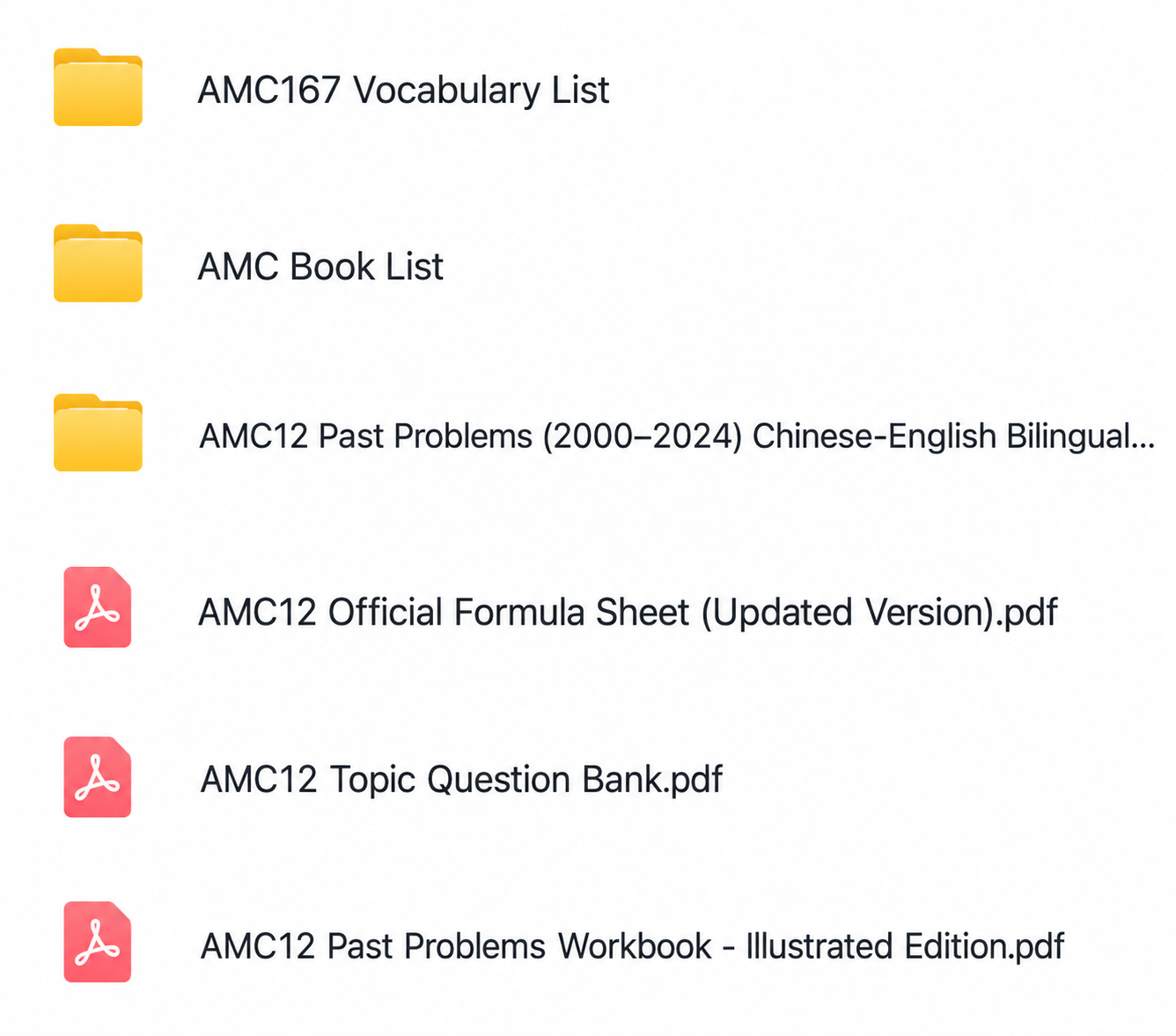
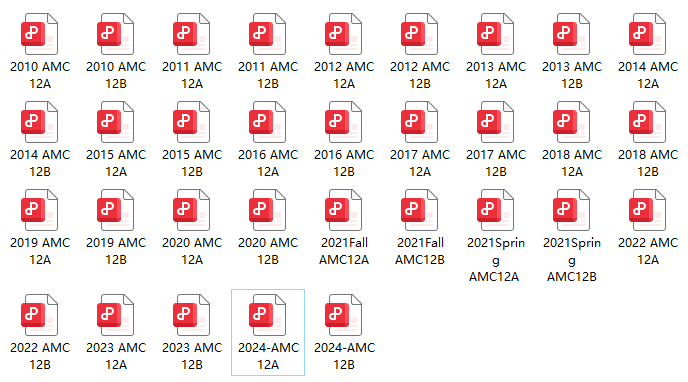
Free AMC12 Preparation Materials: Scan the QR code to get a free AMC12 preparation materials pack (including AMC12 past exam papers + answer keys + book list + formula sheet, etc.)
Online Customer Service | WeChat Consultation

2026 AMC12 Ultimate Guide by Curriculum Systems: What Are the Strengths and Blind Spots of Different Systems?

The "zero-error tolerance" trend in the 2025 AMC12 cutoffs (top 1% requiring a perfect score of 150) has sent a clear signal: relying solely on school knowledge or last-minute cramming is no longer enough to stand out in AMC12. Although students from different curriculum systems have their own advantages, gaps in number theory and combinatorics remain common across the board.

This article provides highly customized, phased, and actionable preparation strategies for the five major curriculum systems—Chinese National Curriculum, A-Level, IB, IGCSE, and AP—to help you transform from a "knowledge possessor" into a skilled "competition problem solver."

推荐

I. Chinese National Curriculum System

Strengths:
Solid training in functions, trigonometry, and solid geometry; strong computational skills and proficiency in algebraic manipulations.

Blind Spots:
Almost no number theory (congruences, Fermat's Little Theorem, etc.); combinatorics limited to permutation and combination formulas, lacking modeling and recursive thinking.

Three-Phase Breakthrough Path:

Phase Timeline Core Tasks Recommended Resources
Foundation Building Now – March 2026 Fill number theory foundation:
• Divisibility, prime factorization
• Congruences, modular arithmetic
• Introduction to Diophantine equations
AoPS Introduction to Number Theory
Transfer of Chinese Gaokao Diophantine examples
Integration Phase April – August 2026 Strengthen "Algebra + Geometry" integration:
• Power of a Point Theorem + coordinate geometry
• Quadratic function extrema (vertex form + special values)
• 3D vector rapid modeling
3 sets of geometry targeted papers per week
Categorized practice of AMC12 problems 11–20 from the last 5 years
Sprint Phase September – November 2026 Full-length mock exams + solidify pacing:
• Problems 1–10 ≤15 min (secure 100%)
• Problems 11–20 ≤40 min (aim for 80%)
• Problems 21–25 ≤20 min (secure 1–2 correct)
Practice past 5 years of real exams twice:
First round by year, second round by topic

II. A-Level System

Strengths:
C1–C4 cover a wide range of algebra/geometry tools (Vieta's formulas, Law of Sines/Cosines, circle equations); comfortable reading math problems in English.

Blind Spots:
No number theory; combinatorics only touched in Further Math; habit of writing full steps, not adapted to quick multiple-choice solving.

Three Key Preparation Strategies:

Convert A-Level knowledge into "competition tools"
Example: Standard circle equation → combine with Tangent Length Theorem + Pythagorean theorem to solve integrated problems.
Example: Sum-to-product/difference formulas → instantly apply trigonometric expressions without deriving.

Focus on mastering number theory and combinatorics
High-frequency topics: Fermat's Little Theorem, quadratic residues, inclusion–exclusion principle, probability modeling.
Recommended to take specialized courses to systematically break down problem types:
Congruence problems → periodicity / Diophantine equations / modular inverses;
Combinatorial counting → case analysis / recursion / graph theory ideas.

Train "rapid scoring thinking"
Abandon "proof-style" thinking and embrace multiple-choice techniques:
Special value substitution (plug in 0,1,-1);
Process of elimination (using parity, range restrictions);
Estimation and symmetry (especially for geometry problems).

III. IB System: Leverage Transferable Skills to Crack Integrated Hard Problems

Strengths:
Widest knowledge coverage (complex numbers, vectors, matrices, probability distributions); IA exploration fosters strong logic and modeling ability; comfortable reading problems in English.

Blind Spots:
Number theory content scattered (only appears in the Option section); slow problem-solving pace (IB exam timing is more generous); lacks technique training, prone to "correct approach but too slow to finish."

Three Core Actions:

Organize knowledge system to avoid fragmentation
Create a topic-focused mind map for AMC12:
Complex numbers → complex plane + vector rotation + locus problems;
Vectors → spatial geometry + projection + volume calculation;
Probability → conditional probability + expectation + recursive modeling.

Strengthen calculation speed
10 minutes of speed drills daily:
Polynomial factorization;
Rationalizing denominators with radicals;
Trigonometric transformations (target: complete within 1 minute).

Targeted real-exam practice
First round: ensure ≥90% correct on problems 1–20;
Second round: focus on problems 21–25, emphasizing:
Number theory + combinatorics (e.g., prime factorization → integer partition);
Geometry + algebra (e.g., circle + complex numbers + inequalities).

推荐

IV. IGCSE System

Strengths:
Solid foundation in basic algebra, geometry, and introductory statistics; good English math vocabulary.

Blind Spots:
Serious lack of depth (no advanced number theory, combinatorics, complex numbers); no exposure to competition thinking (e.g., construction, proof by contradiction, extremal principle).

Preparation Advice:

First transition to AMC10 level: Even for 11th graders, it is recommended to start with AMC10 past exams to identify gaps.

Focus on strengthening:
Number theory: divisibility, congruences, prime properties;
Combinatorics: addition/multiplication principles → inclusion–exclusion → recursion;
Geometry: Power of a Point Theorem, advanced similarity of triangles.

Recommended path:
IGCSE → AMC10 (November 2026) → AMC12 (2027)

V. AP System

Strengths:
AP Calculus: strong skills in function extrema, monotonicity, and graphical analysis;
AP Statistics: deep understanding of probability, permutations/combinations, and expectation.

Blind Spots:
Number theory completely missing; redundant calculus content (AMC12 does not test integration or series); prone to "using advanced tools on basic problems."

Key Preparation Methods:

Filter "applicable AP knowledge"

AP Content Application in AMC12
Derivative for extrema Quick determination of function extrema (without derivative, use vertex form)
Probability distributions Classical probability, conditional probability, expectation calculation
Limit thinking Estimation of large-number behavior (e.g., trends)

Focus on breaking through number theory
Start with number theory problems from AMC12 problems 1–15;
Gradually move to number theory + combinatorics integrated problems (e.g., 2025 problem 24).

Participate in systematic training
Self-study is inefficient; it is recommended to quickly build the knowledge framework through an AMC12 specialized course.

Free AMC12 Preparation Materials: Scan the QR code to get a free AMC12 preparation materials pack (including AMC12 past exam papers + answer keys + book list + formula sheet, etc.)
Online Customer Service | WeChat Consultation

How Hard Is AMC12 Compared to Chinese Math? Post-Exam Strategies for 3 Scenarios

As one of the most influential high school mathematics competitions globally, the AMC12's difficulty level and positioning provide a clear reference for students in China. The following is a comprehensive analysis of AMC12 difficulty, how it aligns with the Chinese curriculum, question difficulty gradients, and subsequent planning.

推荐

I. AMC12 Difficulty: What Level Is It in China?

Dimension Comparison
Breadth of Knowledge Covers all core content from Chinese grades 10 to 12 (PEP/BNUP editions)
Depth of Knowledge Approaches the preliminary round level of the CMO; some final problems reach the difficulty of provincial competition preliminaries
Grade Alignment Most suitable for second-semester grade 11 to first-semester grade 12 students (outstanding grade 10 students can also challenge)
Competition Nature Not purely an extension of school curriculum, but a "curriculum + competition expansion" integrated exam

II. AMC12 Module Breakdown vs. Chinese Curriculum

Module AMC12 Share Chinese Curriculum Alignment Is It Out of Syllabus?
Algebra & Functions 35% Function properties, inequalities, sequences, complex numbers, logarithms/exponentials Complex number operations and parametric equations are grade 12 extensions or competition content
Geometry 30% Plane geometry (circles, similarity), solid geometry (volume, surface area), analytic geometry (lines, circles) Vector methods and integrated coordinate applications slightly exceed Gaokao requirements
Combinatorics & Probability 25% Permutations & combinations, classical probability, inclusion–exclusion principle Gaokao covers only basic combinatorics; AMC12 goes significantly deeper
Number Theory 10% Prime factorization, congruences, modular arithmetic, Fermat's Little Theorem Almost untouched in Gaokao — purely competition content

III. AMC12 Question Difficulty Gradient: Stepped Progression, Strategy Is Key

Question Range Difficulty Target Strategy
Q1–8 Basic Must get all correct! Tests fundamental calculations and concepts; be fast (≤1 minute per question)
Q9–13 Intermediate Traps (units, domain, etc.) — read carefully; target accuracy ≥80%
Q14–17 Advanced Intermediate Tests integrated thinking (e.g., algebra + geometry); key for students in grade 10 or below aiming for the "Achievement Roll"
Q18–25 Hard Involves competition techniques (construction, proof by contradiction, symmetry); the differentiator for top performers; aim to solve 2 and attempt 4

Time Allocation Suggestions: First 15 questions: ≤30 minutes; last 10 questions: ≥45 minutes (especially reserve 5–7 minutes for Q21–25 each).

推荐

IV. Post-AMC12 Strategies for 3 Scenarios

Scenario 1: Qualified for AIME

Goal: AIME ≥ 8–10 points (to aim for top summer programs / Ivy League schools)
Actions:
Immediately start AIME-focused training (focus: Number Theory, Combinatorics, Geometric Transformations).
Use past 8 years of AIME real exams, with a time limit of 10–12 minutes per question.
Strengthen weak modules exposed during AMC (e.g., if mistakes are concentrated in combinatorics → reinforce recursion and counting).

Scenario 2: Grades 8–10, Did Not Qualify

Goal: Aim for top 5% (Distinction) in AMC10/12 next year.
Actions:
Systematically study the AMC10/12 syllabus, focusing on filling gaps in Number Theory and Combinatorics.
Practice categorized question banks (questions 1–20), ensuring accuracy on basic problems ≥90%.
Plan a long-term preparation of 10+ months, avoiding "last-minute cramming."

Scenario 3: Grade 11, Did Not Qualify

Goal: Quickly fill gaps in math competition background.
Actions:
Focus on the Euclid Contest: moderate difficulty (≈ AMC12 mid-level questions).
Exam in April, results in May — in time for Regular Decision applications.
Directly linked to scholarships at the University of Waterloo.
Supplement with Physics Bowl, Chemistry Olympiad, or mathematical modeling (HiMCM) to build a diverse STEM profile.

AMC12 Preparation Courses

Our instructors are all graduates of top global universities. With precise curriculum planning and full‑course learning tracking, we support you all the way to improving scores and winning awards! Online customer service. WeChat consultation.

推荐

Online Customer Service
Contact Customer Service