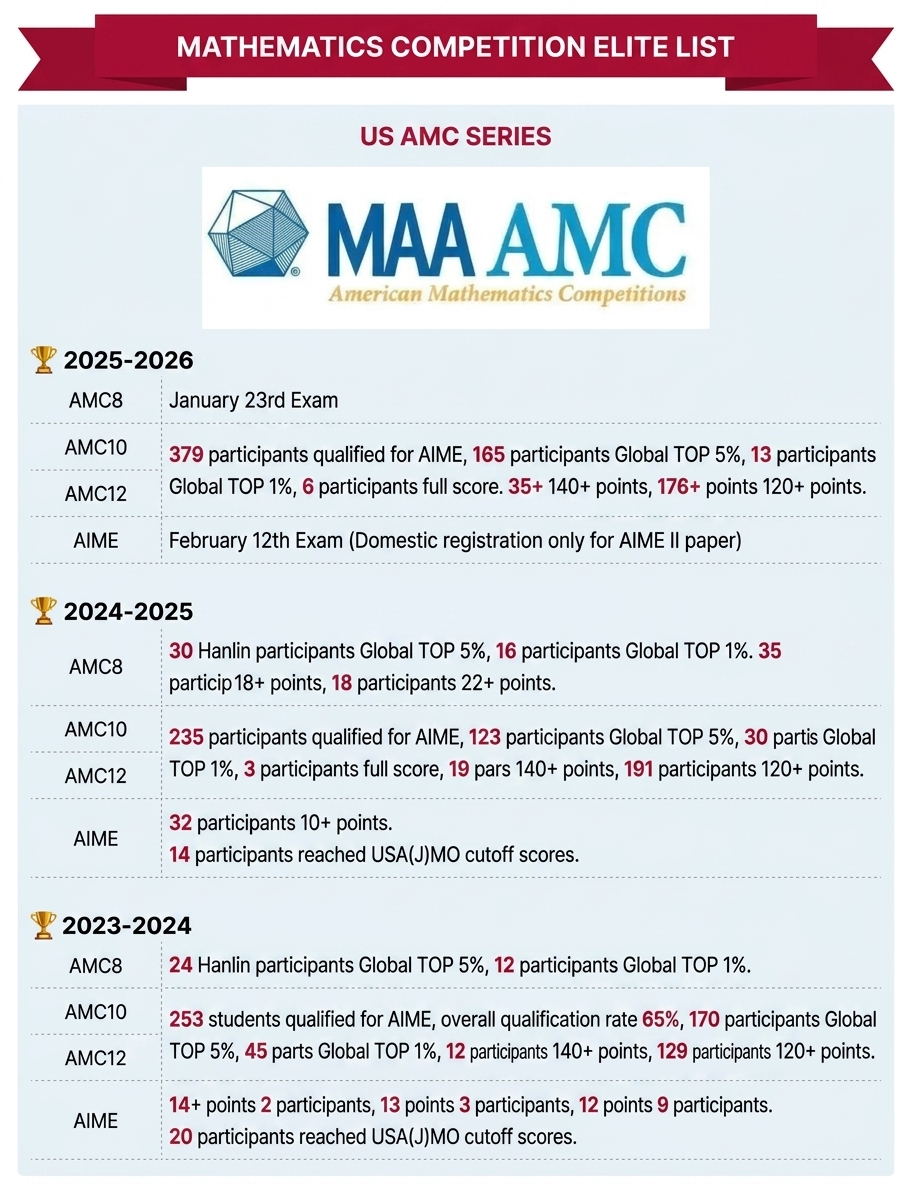
The "sharp surge" in AMC12 cutoffs has puzzled many parents and students. This article provides an in-depth analysis of the reasons behind the cutoff surge and offers tailored preparation plans for students with different backgrounds to help you achieve ideal results in the 2026 competition.
I. Two Key Reasons for the AMC12 Cutoff Surge
Reason 1: Full Scoring Due to Question Error
Event Background: During the 2025 AMC12 US Region Exam A, a question contained a design flaw—none of the five options provided was correct.
Resolution: After verifying the issue, the MAA committee decided to award all test-takers full 6 points for that question. Since the AMC12 cutoff is determined based on the performance of US students, this full-point concession caused the top 1% cutoff to soar to a perfect 150!
Although such a scenario is rare, it serves as a reminder: official scoring policies can be adjusted due to special circumstances. Therefore, preparation should focus on comprehensive readiness rather than pinning hopes on individual questions.
Reason 2: Persistent Leakage Issues
Current Situation Analysis: While question leakage has not been completely eradicated, official authorities in the China region have implemented multiple preventive measures: promoting in-person exams, using multiple exam paper sets, and planning to introduce new regulations in February 2026 to crack down on cheating.
Credibility Restoration: With the gradual implementation of these measures, the credibility of the AMC competition is steadily recovering, and its status as a highly internationally recognized math competition remains solid.

II. Three Reasons Why AMC12 Is Still Worth Taking
1. Powerful Academic Endorsement
For students applying to top-tier schools such as MIT, Stanford, Oxford, and Cambridge, a high AMC12 score plus AIME qualification serves as a compelling academic endorsement, significantly boosting competitiveness.
2. Scores Must Align Authentically with Other Achievements
High AMC12 scores need to be consistent with other academic performance (such as AIME scores, A-Level/IB math grades). If a significant discrepancy appears—for example, a perfect AMC12 score but an underwhelming AIME score—it may raise admissions officers' doubts about the authenticity of the application materials.
3. Significant Academic Reinforcement
The mathematical thinking and knowledge accumulated during competition preparation not only help you excel in the contest but also tangibly enhance your subject proficiency in regular school studies.
III. 2026 AMC12 Basic Format Overview
Exam Dates: Expected in November 2026 (specific dates to be announced officially).
Eligibility: Students in 12th grade (senior high school) or below, and under 19.5 years of age.
Exam Format: 25 multiple-choice questions. Each correct answer earns 6 points, no points deducted for wrong answers, 1.5 points for unanswered questions. Maximum score: 150 points. Exam duration: 75 minutes.
Version A/B Explanation: Version A and Version B are different exam papers, but they are similar in difficulty and coverage. Students may choose to take either Version A or Version B, or both; the highest score will be used for award ranking and AIME qualification.
Topic Summary:
Algebra: 9–10 questions, covering complex inequalities, Cauchy inequalities, advanced function problems, etc.
Geometry: 6–8 questions, involving solid geometry, plane geometry, etc.
Number Theory: 4–6 questions, including Euler's formula, Fermat's little theorem, etc.
Combinatorics & Probability: 3–5 questions, covering permutations, combinations, recurrence relations, etc.
IV. Tailored AMC12 Preparation Plans for Students with Different Backgrounds
1. Starting from Scratch for AMC12
Focus: Organize the foundational knowledge of the AMC12 competition to form a complete framework; master the basic concepts across the four modules (Algebra, Geometry, Number Theory, Combinatorics).
Recommended Timeline: 8–12 months
Recommended Course: AMC12 Direct Track Course
2. Transitioning from AMC10 to AMC12
Focus: Expand into AMC12-specific topics, particularly newly added content such as complex inequalities, Cauchy inequalities, advanced function problems, Euler's formula, Fermat's little theorem, etc.; strengthen Number Theory and Combinatorics.
Recommended Timeline: 6–8 months
Recommended Course: AMC12 Premium Prep Class
3. Non-First-Time AMC12 Takers
Focus: Reinforce weak areas strategically, summarize frequently-missed points and unfamiliar topics from previous AMC12 attempts; conduct intensive strengthening training to improve speed and accuracy.
Recommended Timeline: 4–6 months
Recommended Course: AMC12 Intensive Sprint Class
AMC12 Preparation Courses
Our instructors are all graduates of top global universities. With precise curriculum planning and full‑course learning tracking, we support you all the way to improving scores and winning awards! Scan the QR code to learn about AMC10/12 competition courses. You can also receive a free, carefully prepared lecture handout. Online customer service. WeChat consultation.