

AMC12 Four Core Modules High-Frequency Exam Points Summary! How to Win an AMC12 Award in 6 Months?

AMC12 is open to students in grade 12 and below, covering all high school mathematics knowledge (excluding calculus). It tests both breadth of knowledge and depth of thinking. Building on AMC10, AMC12 adds complex numbers, trigonometric identity transformations, higher-order inequalities, and more, significantly increasing overall difficulty and comprehensiveness.

I. AMC12 Four Core Modules High-Frequency Exam Points

1. Algebra Module: The Foundation for Scoring

Algebra is AMC12's "scoring zone." By focusing on key areas, you can achieve an accuracy rate of over 80%.

Polynomials: Factorization and Vieta's formulas are core; the rational root test is extremely useful.

Function Properties: Graph transformations, parity determination, domain.

Sequences: Memorize arithmetic and geometric sequence formulas; use the construction method to solve recursive sequences.

2. Geometry Module: Proportion on the Rise

In recent years, the number of geometry questions has been increasing. Practice both plane and solid geometry.

Triangles and Circles: Similarity and the power of a point theorem (secant/tangent/intersecting chords) are must-know.

Solid Geometry: Volume and surface area calculations, occasionally combined with probability.

Analytic Geometry: Positional relationships between lines and circles; memorize the chord length formula.

3. Number Theory Module: Logical Reasoning

Solve number theory problems using properties—don't just brute-force calculate.

Modular Arithmetic: Congruence properties, modular exponent simplification; remainder problems are very practical.

Prime Factorization: Number of divisors, GCD/LCM.

Indeterminate Equations: Integer solutions to linear equations in two variables; pay attention to constraints.

4. Combinatorics Module: Counting + Probability

Don't panic when facing combinatorics problems—master the methods and you'll solve them.

Permutations and Combinations: Use the insertion method for non-adjacent arrangements; account for ordering in fixed-order problems.

Probability: Classical probability, complementary events; don't confuse conditional probability.

Inclusion-Exclusion Principle: Two-set/three-set counting; avoid double-counting overlapping parts.

II. AMC12 Award Categories

Award Criteria
Perfect Score Award Score a perfect 150
Distinguished Honor Roll Top 1% globally
Honor Roll Top 5% globally
AIME Qualification Reach the AIME cutoff score
Global Honor Award Grade 10 or below with a score of 90 or above

III. 6-Month Preparation Timeline

It is recommended to allocate 4–6 months for preparation, dedicating 3–4 hours per week:

Months 1–2: Foundation Building – Complete knowledge points and establish a knowledge framework.

Months 3–4: Module-Specific Intensive Training – Break through Algebra, Geometry, Number Theory, and Combinatorics one by one.

Month 5: Full Past Papers Practice – Timed mock exams + detailed error analysis.

Month 6: Final Sprint and Review – Re-attempt incorrect questions + optimize exam strategies.

IV. Continuous Planning from AMC8 to AMC12

The AMC competition system follows a complete progression path: AMC8 → AMC10 → AMC12 → AIME. AMC8 is an introductory competition that develops problem-solving thinking and exam rhythm; AMC10/12 are the key stepping stones to AIME qualification. Waiting until high school to suddenly decide to take AMC12 means insufficient knowledge reserves competition thinking, and a completely unfamiliar exam pace. Starting systematic planning from elementary school allows students to comfortably aim for AIME in high school, adding core competitiveness to applications for top STEM programs.

We are an authorized AMC test center and offer free registration assistance!

Scan the code to inquire about AMC 12 registration for the 2026 season ⇓

Scan the QR code to get free AMC 12 prep resource pack

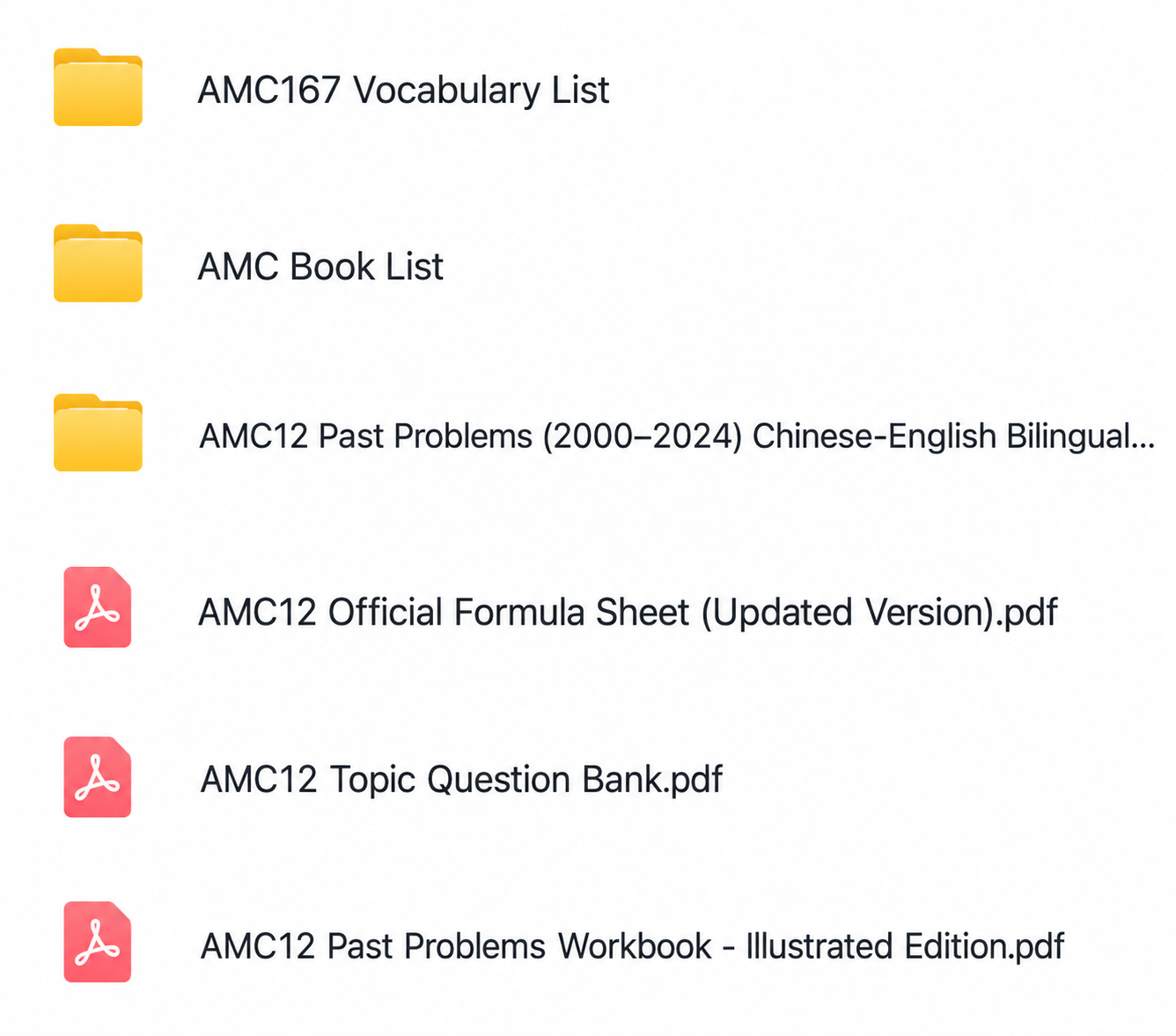
(Includes past AMC 12 exam papers with solutions, reading lists, formula sheets, and more)
AMC12 Scores and Top University Admissions – Tiered Preparation Strategies for Different Foundations

As the most influential secondary school mathematics competition globally, organized by the Mathematical Association of America (MAA), AMC12 attracts over 300,000 participants annually. It is not only a "hard currency" for assessing students' mathematical and logical abilities but also a stepping stone to the world's top universities. Data shows that approximately 90% of Ivy League admittees have a background in AMC competitions. For Chinese students, their solid mathematical foundation gives them a competitive edge in the AMC system.

I. Academic Value: AMC12 Scores and Top University Admissions Benchmarks

AMC12 covers the core areas of the high school mathematics curriculum, with a difficulty level roughly equivalent to the first round of China's High School Mathematics League. Its scores provide clear tiered value when applying to overseas top universities:

Top 5% (approximately 100+ points): Makes the applicant a strong contender for Top 50–Top 30 universities.

AIME Score of 7+ / AMC12 Top 2.5%: Provides a significant academic advantage for Top 30 university applications.

Top 1% (Distinguished Honor Roll): Serves as powerful endorsement for Top 20 elite universities (such as the Ivy League).

Furthermore, advancing to AIME (American Invitational Mathematics Examination) is the defining threshold of AMC12's value. Qualifying for AIME signifies entry into the global elite of mathematics students and is the strongest academic proof for applying to top STEM programs.

II. AMC12 Difficulty Gradient and Common Point-Loss Areas

The AMC12 paper consists of 25 questions, with a clear stepwise difficulty distribution, heavily relying on abstract thinking and cross-domain comprehensive application skills.

Questions 1–10 (Foundation): Comparable to middle school challenging problems and high school Grade 10 basics; the foundation for scoring.

Questions 11–20 (Core Mid-Range): Correspond to advanced Grade 10–11 in-school content; the key battleground for.

Questions 21–25 (Final/Tie-Breaker): Competition-level difficulty, involving extensive out-of-syllabus advanced topics.

High-Frequency Point-Loss Areas: Candidates should be particularly cautious of the following modules during preparation: integrated problems combining complex numbers and trigonometry, plane geometry with multiple circles or nested triangles, complex counting and probability (including inclusion-exclusion principle and recursion), advanced number theory (congruences, order, indeterminate equations), and long-worded application problems (demanding high modeling ability).

III. Tiered AMC12 Preparation Strategies

AMC12 is not an overnight achievement; it requires a tailored strategy based on the student's grade level and mathematical foundation:

Zero Foundation / Average Middle School Student: Directly challenging AMC12 is extremely difficult, with a high likelihood of getting stuck after Question 11. It is recommended to first use AMC10 as a transitional step to solidify the foundation before higher levels.

Grade 10 in China / Excellent In-School Math Student: A systematic 3–6 month training program is recommended to comprehensively master the expanded knowledge points and stably reach the AIME qualification cutoff. To冲击 the top 5%, extensive practice is needed to summarize problem-solving patterns for the final questions.

Grade 11 / Students with Competition Experience: If the student already has experience in other math competitions or a high AMC10 score, 3 months of systematic practice can secure a high score. The preparation focus should be directly on conquering the final questions (21–25).

IV. Scientific Preparation Path Planning

To achieve a high score in AMC12 during high school, it is necessary to complete all high school mathematics content in advance, supplemented by specialized competition training. A scientific preparation plan should follow these three stages:

Diagnostic and Foundation Building: Use full-length mock exams to identify weak areas, and systematically fill knowledge gaps according to the syllabus.

Summer Intensive: Develop "question-type sensitivity" by maintaining focused daily study, prioritizing accuracy on mid-range questions, and summarizing mistakes to distinguish between knowledge gaps and thinking errors.

Final Sprint and Mock Exams: Strictly adhere to the 75-minute time limit while completing past papers from the last 10 years. Focus on training exam strategies, learning to identify high-difficulty question types and make decisive to ensure stable performance in the actual exam.

We are an authorized AMC test center and offer free registration assistance!

Scan the code to inquire about AMC 12 registration for the 2026 season ⇓

Scan the QR code to get free AMC 12 prep resource pack

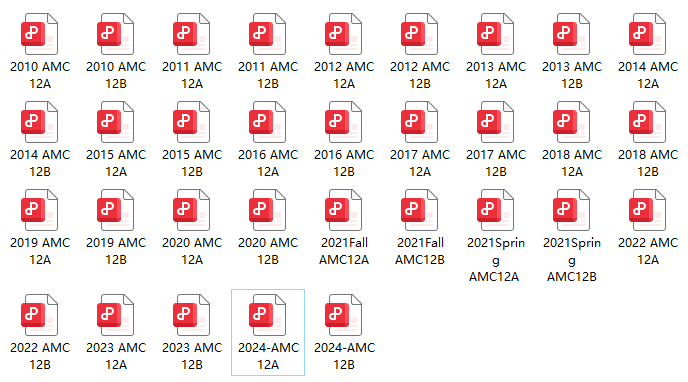
(Includes past AMC 12 exam papers with solutions, reading lists, formula sheets, and more)
Online Customer Service
Contact Customer Service